





TSLP is a protein belonging to the cytokine family, typically expressed in epithelial cells at barrier surfaces such as the lungs, skin, and intestines. It is primarily produced by non-hematopoietic cells, including fibroblasts, epithelial cells, and various stromal or stromal-like cells. Research indicates that TSLP participates in initiating the inflammatory cascade that drives the development of asthma and other allergic diseases. TSLP forms a ternary signaling complex with TSLPR and the IL-7Rα chain, activating intracellular signaling through the STATs and JAK2 pathways. The TSLP receptor is a member of the hematopoietic factor receptor family, classified as a type I cytokine receptor protein. It forms a high-affinity receptor complex only when co-expressed with the IL-7 receptor α chain. The TR-FRET TSLP/TSLPR assay kit can quantitatively measure the binding activity between TSLP and TSLPR, providing a technical tool for studying this signaling pathway.
Upon binding of TSLP to TSLPR, the dimer enhances the recruitment of IL-7Rα, forming an extracellular ternary complex that activates JAK2. JAK2 mediates the phosphorylation of STATs, enabling their translocation into the nucleus to activate downstream gene transcription. Reporter gene cell lines constructed based on this signaling pathway can be used to evaluate the in vitro efficacy of TSLP-related drugs, with luciferase readings reflecting the activation level of the pathway. Studies have shown that glucocorticoids can reduce the expression of TSLP and TSLPR in asthma models, altering the function of TSLP-induced dendritic cells (DCs) and shifting antigen-induced Th2 responses toward Th1 responses. This results in decreased levels of IL-4, IL-5, and IL-13, alongside increased IL-10 and IFN-γ, a process dependent on the downregulation of OX40L in DCs and increased IL-12 production. TR-FRET technology can be applied to study conformational changes in TSLP and TSLPR after binding, assessing dynamic changes in receptor-ligand interactions under varying conditions.
DOI:10.3389/fimmu.2018.01595
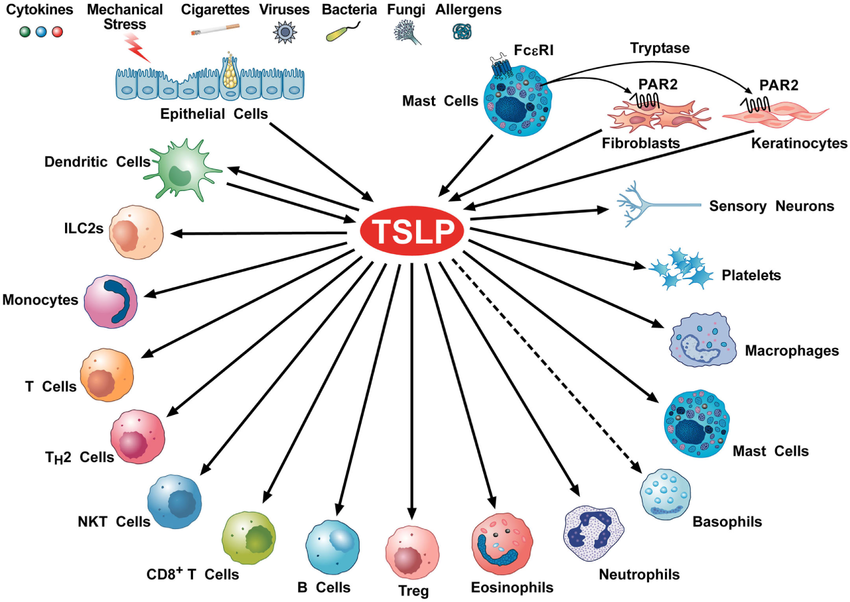
Data from asthma patients indicate a positive correlation between the severity of airway inflammation and TSLP expression levels. The TSLP-TSLPR axis and downstream signaling molecules play a critical role in the development and progression of allergic inflammatory diseases such as allergic asthma. The mechanisms of TSLP include: (1) acting on bone marrow-derived dendritic cells, mast cells, natural killer cells, and T cells to mediate innate immunity; (2) effectively activating natural killer T cells in murine asthma models, leading to IL-13 production; and (3) activating mast cells to produce IL-5, IL-8, IL-1, and TNF, recruiting eosinophils via IL-5 and eotaxin-2, and attracting neutrophils via IL-8, thereby exacerbating airway inflammation. The TR-FRET TSLP/TSLPR assay kit can be used to screen molecules capable of blocking TSLP-TSLPR binding and evaluate their immunomodulatory activity.
Globally, the leading TSLP monoclonal antibody drug was approved in the United States in December 2021, becoming the first biologic to demonstrate sustained and significant reductions in exacerbations in a broad population of severe asthma patients. This drug inhibits downstream inflammatory cascades by blocking TSLP-receptor binding. In China, TSLP monoclonal antibodies from multiple pharmaceutical companies have entered clinical trials. TR-FRET technology can be applied to assess the blocking efficacy of different monoclonal antibodies on TSLP-TSLPR binding, providing a quantitative method for drug screening and optimization.
As a novel cytokine, TSLP occupies an upstream regulatory position in the pathogenesis of allergic diseases such as asthma. Therapeutic strategies targeting TSLP offer broader anti-inflammatory effects compared to those targeting downstream cytokines like IL-4, IL-5, and IL-13. TSLP monoclonal antibodies can simultaneously suppress multiple Th2 cytokines and are applicable to a wider range of asthma patients, including those with non-eosinophilic asthma. The TR-FRET TSLP/TSLPR assay kit can evaluate TSLP-receptor binding activity in patient samples, providing molecular-level insights for disease subtyping.
The TSLP/TSLPR signaling pathway plays a central role in the pathogenesis of allergic inflammatory diseases. The TR-FRET TSLP/TSLPR assay kit provides a sensitive and efficient tool for studying this pathway, with applications in molecular mechanism research, drug screening, and clinical monitoring. Future studies will further elucidate the role of TSLP in various allergic diseases, explore the potential of TSLP monoclonal antibodies in conditions such as chronic sinusitis and atopic dermatitis, and develop more selective TSLP inhibitors. As understanding of the TSLP signaling network deepens, its therapeutic value in allergic diseases will continue to expand.
Nanjing UA-Bio Technology Co., Ltd. has independently developed the "UniOne® TR-FRET Human TSLP/TSLPR Binding Kit" (Catalog No.: UA086125), a high-performance analytical platform specifically designed to study the interaction between thymic stromal lymphopoietin (TSLP) and its receptor TSLPR. Based on time-resolved fluorescence resonance energy transfer (TR-FRET) technology, this kit enables precise and efficient evaluation of the binding activity between human TSLP and TSLPR, offering a standardized solution for research on type 2 immune responses, allergic disease mechanisms, and anti-inflammatory drug development.
| Core Advantages | Specifications / Functional Description |
|---|---|
| High Purity and Full Biological Activity | The kit's core components include rigorously validated high-purity, biologically active human TSLP protein (maintaining native four-helix bundle conformation) and TSLPR (forming a heterodimeric complex with IL-7Rα). Both retain correct spatial conformations and full binding functionality, accurately simulating the high-affinity interaction between TSLP and TSLPR under physiological conditions to ensure data accuracy, reproducibility, and relevance. |
| Exceptional Lot-to-Lot Consistency and Stability | Leveraging an internationally advanced protein expression platform and highly standardized production processes, coupled with a stringent quality control system, the product exhibits outstanding long-term stability and excellent lot-to-lot consistency, providing reliable support for continuous drug screening and mechanistic research. |
| Ready-to-Use Flexible Platform | This TR-FRET-based kit features a simple "add-mix-read" workflow without cumbersome washing steps. Its optimized formulation is compatible with automated multi-well plate (96/384-well) platforms, making it suitable for diverse applications such as screening anti-TSLP/TSLPR antibodies/antagonists (e.g., tezepelumab biosimilars), evaluating receptor blockers, competitive binding assays, affinity analysis, and asthma drug activity assessment. |
| Comprehensive Solutions and Expert Support | We provide fully validated standard protocols, representative dose-response curves, and detailed result interpretation guidelines to facilitate rapid establishment of stable and reproducible workflows. Nanjing UA-Bio's technical team offers end-to-end professional support for experimental design, optimization, and data analysis. |
Nanjing UA-Bio Technology Co., Ltd. is dedicated to providing cutting-edge, high-quality reagents and tools for immunology, cell therapy, and innovative drug development. For detailed technical parameters, validation data, or application inquiries regarding the "UniOne® TR-FRET Human TSLP/TSLPR Binding Kit" (Catalog No.: UA086125), please feel free to contact us.








