





Targeted protein degradation technologies have made significant progress in chemical biology and drug discovery in recent years. Among them, PROTAC technology achieves specific ubiquitination and proteasomal degradation of target proteins by inducing proximity between the target protein and E3 ubiquitin ligase. BCL6, as a transcriptional repressor, plays a critical role in various physiological and pathological processes. CRBN is a commonly used E3 ligase component for designing degradation chimeric molecules. The BCL6/CRBN PROTAC assay kit based on TR-FRET principles provides a quantitative detection method for evaluating the in vitro activity of such degradation systems.
TR-FRET technology combines time-resolved fluorescence with fluorescence resonance energy transfer detection modes. Using long-lived lanthanide chelates as donors, non-radiative energy transfer occurs when the donor and acceptor are in close spatial proximity. This technology effectively reduces background fluorescence interference and improves the signal-to-noise ratio.
In PROTAC research systems, the kit design typically includes recombinantly expressed BCL6 protein, labeled CRBN protein, and specific recognition antibodies. When the tested PROTAC molecule simultaneously binds to BCL6 and CRBN, their spatial proximity enhances the TR-FRET signal. The signal intensity is positively correlated with the formation efficiency of PROTAC-induced ternary complexes, indirectly reflecting degradation induction capability.
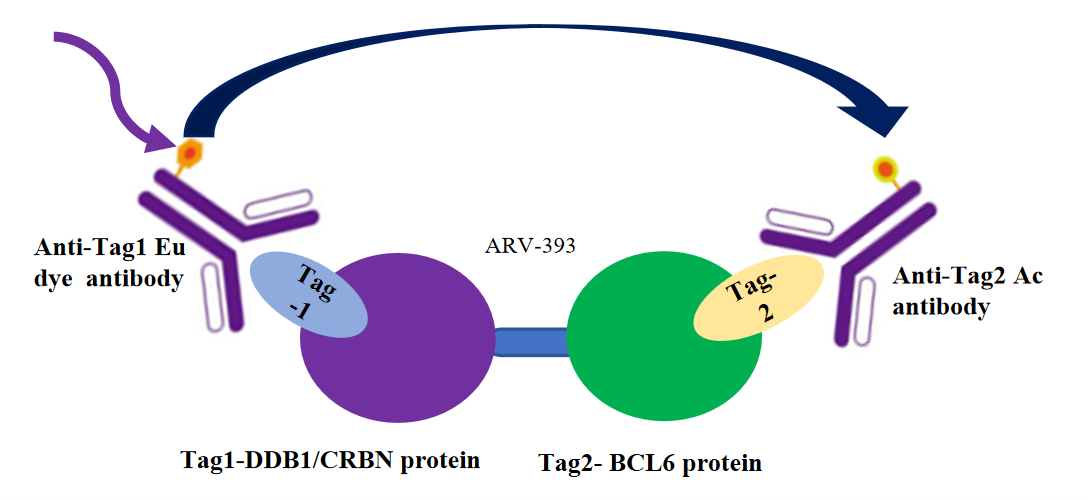
This type of kit typically includes the following core components: tagged BCL6 fusion protein, anti-tag antibody labeled with a fluorescent acceptor, biotinylated CRBN protein, streptavidin-labeled lanthanide donor, and reaction buffer. The reaction is conducted in low-volume microplates, with a total reaction volume generally ranging from 20 to 50 microliters.
The experimental procedure consists of: diluting the tested PROTAC molecule, adding BCL6 and CRBN proteins, incubating, then adding antibody and donor reagents, continuing incubation in the dark, and finally reading fluorescence signals at 665 nm and 620 nm using a multifunctional microplate reader. The signal ratio is standardized for data analysis.
In terms of sensitivity, the kit can detect PROTAC-induced complex formation in the nanomolar to micromolar concentration range. The dynamic range typically exceeds two orders of magnitude, and the Z' factor under optimized conditions can be higher than 0.6, indicating good reproducibility and statistical reliability.
Specificity validation can be performed by: adding excess unlabeled target protein or competitive small molecule inhibitors to observe signal reduction; or using negative control molecules that do not bind CRBN to confirm background signal levels. Additionally, the reaction system has some tolerance to common solvents such as dimethyl sulfoxide, with a maximum solvent concentration not exceeding 1%.
Taking the screening of unknown PROTAC molecules as an example, first set up positive controls, negative controls, and test sample wells in the reaction plate. Positive controls can use known high-activity BCL6 degradation chimeric molecules, while negative controls use an equal volume of solvent. After adding all components, incubate at room temperature or 4°C for 1 to 3 hours. Read the signals and calculate the ratio signal value, then further calculate the relative activity percentage.
If the TR-FRET signal induced by the tested molecule is significantly higher than the negative control, it suggests that the molecule can simultaneously bind BCL6 and CRBN and has the potential to form ternary complexes. However, it should be noted that in vitro complex formation capability does not fully equate to intracellular degradation activity, and subsequent cell-level experiments are needed for validation.
This kit is mainly suitable for the following research scenarios: high-throughput screening of PROTAC molecules, structure-activity relationship analysis, kinetic characterization of ternary complex formation, and comparative studies of different E3 ligase ligands. Its advantages include simple operation, no need for radioactive labeling, real-time monitoring, and compatibility with automated platforms.
In terms of limitations, first, TR-FRET signals are sensitive to pH, ionic strength, and temperature, requiring strict control of reaction conditions. Second, the kit only detects binary and ternary complex formation and cannot directly reflect ubiquitination or subsequent degradation events. Furthermore, its applicability to specific BCL6 mutants or CRBN variants needs separate validation.
In summary, the BCL6/CRBN PROTAC assay kit based on TR-FRET principles provides a reliable in vitro evaluation tool for targeted protein degradation. This method has significant advantages in detection sensitivity, throughput, and operational convenience, supporting molecular screening and mechanism research in early drug discovery. Future development directions include improving the ability to suppress non-specific signals, developing detection systems compatible with more E3 ligases, and integrating them into fully automated drug screening platforms. With the continuous advancement of chemical biology technologies, such assay kits are expected to play a broader role in research on precise regulation of protein homeostasis.
Nanjing UA-Bio Technology Co., Ltd. (UA-Bio) has independently developed the "UniOne® TR-FRET Human BCL6/CRBN PROTAC Binding Kit" (Catalog No.: UA086021), a high-performance analysis platform specifically designed for studying PROTAC molecules targeting BCL6 protein to induce interactions between BCL6 and CRBN (Cereblon) E3 ubiquitin ligase. BCL6 is a transcriptional repressor that plays a key driver role in various B-cell malignancies, including diffuse large B-cell lymphoma (DLBCL). This kit is based on time-resolved fluorescence resonance energy transfer (TR-FRET) technology, aiming to accurately and efficiently evaluate the ternary complex formation activity of human BCL6 protein with CRBN-DDB1 complex mediated by PROTAC molecules. It provides a stable and reliable standardized solution for your research in targeted protein degradation (PROTAC) technology development, anti-tumor drug screening, and overcoming the "undruggable" challenge of transcription factors.
| Core Advantages of the Product | Detailed Parameters / Functional Description |
|---|---|
| High Purity and Complete Biological Activity | The core components of the kit include high-purity, high-biological-activity human BCL6 protein (containing the BTB domain) and CRBN-DDB1 complex, verified through multi-dimensional quality control. Both maintain correct native conformations and complete protein-protein interaction functions, accurately simulating PROTAC molecule-mediated specific ternary complex formation between BCL6 and CRBN, ensuring the accuracy, reproducibility, and functional relevance of experimental data. |
| Excellent Batch-to-Batch Consistency and Stability | Relying on an internationally leading protein expression platform and highly standardized production processes, combined with a strict quality control system, the product exhibits excellent long-term stability and outstanding batch-to-batch consistency, providing solid and reliable quality assurance for your long-term and continuous PROTAC drug screening and mechanism research. |
| Ready-to-Use Flexible Experimental Platform | This kit is based on homogeneous TR-FRET technology, adopting a simple "add-incubate-read" operation mode without cumbersome washing steps. Its optimized formulation system is compatible with multi-well plate (96/384-well) automated platforms, flexibly applicable to various research needs such as high-throughput screening of BCL6-targeting PROTAC molecules, ternary complex formation evaluation, degrader affinity determination, and competitive binding experiments. |
| Complete Solution and Professional Support | We provide fully validated standard experimental protocols, typical dose-response curves, and detailed result interpretation guidelines to help you quickly establish stable and reproducible experimental workflows. Nanjing UA-Bio's professional technical team can offer comprehensive technical consultation and support for your research design, experimental optimization, and data analysis. |
Nanjing UA-Bio Technology Co., Ltd. is always committed to providing cutting-edge, high-quality core reagents and tools for immunology, cell therapy, and innovative drug research. For detailed technical parameters, validation data, or specific application inquiries regarding the "UniOne® TR-FRET Human BCL6/CRBN PROTAC Binding Kit" (Catalog No.: UA086021), please feel free to contact us.








