





BCL-xL is a crucial anti-apoptotic protein in the BCL-2 family, overexpressed in various cancer cells, making it a well-validated target for anti-tumor therapy. However, BCL-xL is also essential for platelet survival, and inhibitors targeting this protein often cause significant toxic side effects on platelets. ABT263, as a dual inhibitor of BCL-2/BCL-xL, exhibits anti-tumor activity but its clinical application is limited due to platelet toxicity. To address this issue, researchers utilized PROTAC technology to modify ABT263, retaining its target-binding moiety while linking it to an E3 ligase ligand, resulting in the novel degrader DT2216. The TR-FRET BCL-xL/VHL PROTAC Kit enables quantitative detection of PROTAC molecules' dual binding activity to BCL-xL and VHL, providing a technical tool for degrader screening.
DT2216 simultaneously binds to BCL-xL and an E3 ligase, facilitating ubiquitination of the target protein via the E3 ligase and subsequent degradation through the ubiquitin-proteasome system. To overcome platelet toxicity, researchers selected VHL as the E3 ligase. VHL is highly expressed in various tumor cells, including acute lymphoblastic leukemia, liver cancer, colon cancer, and prostate cancer cells, but shows low expression in platelets, thereby reducing the degrader's toxicity to platelets. DT2216 specifically degrades BCL-xL without affecting BCL-2 or MCL-1. Proteomic results demonstrate that DT2216 selectively reduces BCL-xL levels without significantly altering other proteins. TR-FRET technology can be applied to study DT2216's cooperative binding with BCL-xL and VHL, evaluating its selectivity in inducing target protein degradation.
DT2216 significantly degrades BCL-xL protein in MOLT-4 T-ALL cells, with a half-maximal degradation concentration (DC50) of 63 nM and a maximal degradation rate of 90.8%. In contrast, this degradation effect is minimal in platelets, with a DC50 >3 μM and a maximal degradation rate of only 26%. DT2216 effectively kills tumor cells with a half-maximal effective concentration (EC50) of 52 nM, demonstrating nearly fourfold higher tumor cell-killing activity compared to the original inhibitor ABT263, while substantially reducing platelet toxicity. Interestingly, DT2216 can bind to BCL-2 with high affinity in extracellular protein binding assays, where both BCL-2 and BCL-xL form stable ternary complexes with DT2216 and VHL. However, in live-cell protein binding experiments, BCL-2 fails to form ternary complexes.
In animal studies, following intraperitoneal injection, DT2216 concentrations in tumor tissues significantly exceeded the EC50 and were maintained for approximately 10 days, providing prolonged suppression of target protein levels. Researchers compared the effects of DT2216 and ABT263 on platelet levels in mice. ABT263 administration reduced platelets to extremely low levels within about 6 hours, followed by a slow recovery, exceeding normal levels by day 3 and returning to baseline by day 10, potentially causing spontaneous bleeding or thrombosis. In contrast, DT2216's effect on platelets was milder, without rebound increases. Simultaneously, DT2216 significantly inhibited tumor growth, exhibiting stronger anti-tumor activity than ABT263. The TR-FRET BCL-xL/VHL PROTAC Kit can assess DT2216's binding affinity to BCL-xL and VHL, providing data support for in vivo activity evaluation.
Some tumor cells co-express multiple anti-apoptotic proteins, such as small cell lung cancer H146, which expresses both BCL-2 and BCL-xL. Combining DT2216 with the BCL-2 inhibitor ABT199 significantly enhanced anti-cancer effects, with a combination index of 0.166, indicating strong synergy. While DT2216 combined with MCL-1 inhibitors showed clear synergistic effects in cell experiments, it caused mortality in mouse studies due to hepatocyte dependence on MCL-1 and BCL-xL for survival. The anti-cancer efficacy of DT2216 plus ABT199 surpassed that of the dual inhibitor ABT263 while exhibiting lower platelet toxicity. In patient-derived relapsed/refractory acute T-lymphoblastic leukemia models, DT2216 combined with ABT199 or traditional chemotherapeutic agents demonstrated superior anti-cancer effects compared to monotherapy, extending median survival in mice.
BCL-xL protein has been proven to correlate with cellular drug resistance. DT2216 enhances the sensitivity of drug-resistant breast cancer cells to chemotherapeutic agents, potentiating the anti-cancer effects of docetaxel, vincristine, and doxorubicin. This effect has also been observed in prostate cancer, liver cancer, and colon cancer models. By degrading BCL-xL, DT2216 can reverse tumor cell resistance to multiple chemotherapeutic drugs, offering a novel strategy to overcome clinical resistance. The TR-FRET BCL-xL/VHL PROTAC Kit can evaluate the degradation activity of different PROTAC molecules, guiding the development of combination therapies to overcome resistance.
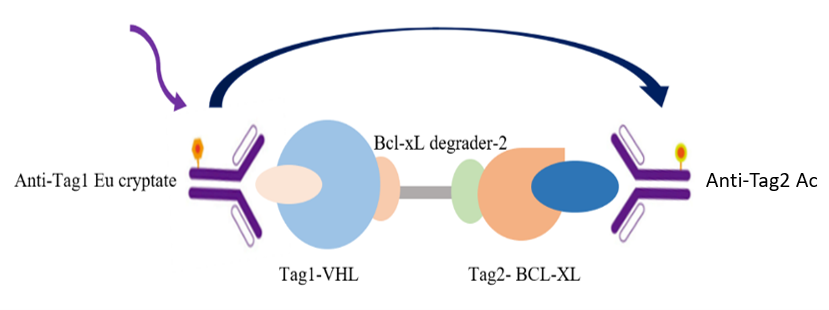
TR-FRET technology combines time-resolved fluorescence and fluorescence resonance energy transfer principles. Time-resolved fluorescence utilizes the long-lived fluorescence properties of lanthanide chelates to effectively eliminate short-lived background fluorescence interference. Fluorescence resonance energy transfer occurs when donor and acceptor fluorophores are sufficiently close, generating specific signals through non-radiative energy transfer. In the BCL-xL/VHL PROTAC Kit, donor-labeled BCL-xL protein and acceptor-labeled VHL protein are co-incubated. When a PROTAC molecule simultaneously binds both, the donor and acceptor are brought into proximity, enabling energy transfer. This homogeneous, wash-free detection method offers high sensitivity and throughput, making it suitable for large-scale compound screening.
Nanjing UA-Bio Technology Co., Ltd. (UA-Bio) has independently developed the "UniOne® TR-FRET Human BCL-XL/VHL PROTAC Binding Kit" (Catalog No.: UA086019), a high-performance analysis platform specifically designed for studying PROTAC molecules targeting BCL-XL protein-mediated interactions between BCL-XL and VHL (Von Hippel-Lindau) E3 ubiquitin ligase complex. BCL-XL is a key member of the anti-apoptotic protein family, overexpressed in various tumors and involved in drug resistance mechanisms. Based on time-resolved fluorescence resonance energy transfer (TR-FRET) technology, this kit enables precise and efficient evaluation of ternary complex formation activity between human BCL-XL protein and VCB complex (VHL-EloB-EloC) mediated by PROTAC molecules. It provides stable and reliable standardized solutions for targeted protein degradation (PROTAC) technology development, anti-tumor drug screening, and apoptosis resistance strategy research.
| Core Product Advantages | Detailed Parameters / Functional Description |
|---|---|
| High Purity and Intact Biological Activity | The kit's core components utilize high-purity, biologically active human BCL-XL protein and VCB complex validated through multi-dimensional quality control. Both maintain correct native conformations and intact protein-protein interaction functions, accurately simulating PROTAC-mediated specific ternary complex formation between BCL-XL and VHL, ensuring experimental data accuracy, reproducibility, and functional relevance. |
| Exceptional Batch-to-Batch Consistency and Stability | Leveraging internationally leading protein expression platforms and highly standardized production processes combined with stringent release quality control systems, the product exhibits outstanding long-term stability and excellent batch-to-batch consistency, providing solid quality assurance for long-term, continuous PROTAC drug screening and mechanism research. |
| Ready-to-Use Flexible Experimental Platform | This homogeneous TR-FRET-based kit employs a simple "add-incubate-read" workflow without cumbersome washing steps. Its optimized formulation is compatible with multi-well plate (96/384-well) automation platforms, flexibly applicable to high-throughput screening of BCL-XL-targeting PROTAC molecules, ternary complex formation evaluation, degrader affinity determination, and competitive binding assays. |
| Comprehensive Solutions and Professional Support | We provide fully validated standard protocols, typical dose-response curves, and detailed result interpretation guides to facilitate rapid establishment of stable, reproducible experimental workflows. Nanjing UA-Bio's professional technical team offers end-to-end consulting and support for research design, experimental optimization, and data analysis. |
Nanjing UA-Bio Technology Co., Ltd. remains committed to providing cutting-edge, high-quality core reagents and tools for immunology, cell therapy, and innovative drug development. For detailed technical parameters, validation data, or specific application inquiries regarding the "UniOne® TR-FRET Human BCL-XL/VHL PROTAC Binding Kit" (Catalog No.: UA086019), please feel free to contact us.








