





In 2001, the concept of PROTAC was first proposed, which utilizes bifunctional ligands to specifically bind target proteins while recruiting E3 ligases for ubiquitination, ultimately degrading the target proteins. Due to limitations such as cell penetration ability, the technology remained dormant for about a decade. With the advancement of small-molecule drugs, PROTAC technology has demonstrated significant application value, successfully degrading many proteins—from gene regulatory proteins and retinoic acid-binding proteins to kinases—becoming a powerful tool for addressing undruggable protein targets. The core of this technology lies in the design of PROTAC small-molecule ligands, with the key being the stabilization of interactions between the target and ubiquitin ligase.
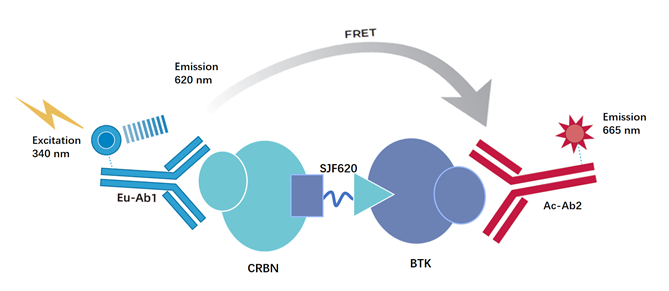
BTK is a critical kinase essential for B-cell development. Mutations in BTK are directly associated with various diseases, including chronic lymphocytic leukemia. Covalent drug molecules like ibrutinib target the cysteine residue at position 481 of BTK to inhibit its activity, but resistance mutations such as C481S have been reported in patients, necessitating new therapeutic strategies. PROTAC technology provides a novel approach to overcoming this resistance. The TR-FRET BTK/CRBN PROTAC Kit enables quantitative detection of the dual binding activity of PROTAC molecules to BTK and CRBN, offering a technical tool for degrader screening.
Researchers synthesized 11 PROTAC molecules of varying lengths, with one end linked to a classic reversible inhibitor of BTK and the other to pomalidomide targeting CRBN. In Ramos cells, these molecules achieved maximum degradation capability at around 24 hours, exhibiting a U-shaped concentration-response curve. Effective BTK-PROTAC-CRBN ternary complex formation occurs only at optimal concentrations, while binary complexes dominate at low or high concentrations, reducing degradation efficacy. Among the 11 molecules, longer-chain compounds demonstrated stronger degradation ability, confirmed by TR-FRET experiments showing that longer-chain molecules more readily form stable ternary complexes, whereas shorter chains face steric hindrance.
SPR experiments revealed that longer-chain PROTAC molecules exhibit binding affinities for BTK or CRBN similar to their corresponding monofunctional small molecules, while shorter-chain PROTACs may even weaken binding. To corroborate these findings, researchers employed mathematical modeling and hydrogen-deuterium exchange mass spectrometry, both confirming that longer-chain PROTACs do not induce thermodynamic synergy but still form stable complexes to degrade BTK. This suggests that in PROTAC design, synergistic effects are not mandatory; instead, stable ternary complex formation is key to degradation activity. The TR-FRET BTK/CRBN PROTAC Kit can assess the dual binding activity of PROTAC molecules to BTK and CRBN, validating ternary complex formation capability.
Quantitative proteomics analysis of PROTAC-treated cells confirmed that, compared to BTK inhibitors, only PROTACs specifically degraded BTK. However, PROTACs also degraded other proteins, such as the structurally similar TEC kinase. This highlights the need to consider selectivity in PROTAC design to avoid unintended off-target degradation. TR-FRET technology can be applied for high-throughput screening of highly selective PROTAC molecules by evaluating their binding affinity to different target proteins.
In rat experiments, PROTAC molecules were found at similar concentrations in the spleen and lungs, but only BTK in the spleen was effectively degraded. Although the reason remains unclear, this marks the first demonstration of PROTAC-mediated BTK degradation in vivo, significantly advancing the technology's application. This tissue-specific degradation may stem from differences in CRBN expression levels, PROTAC distribution, or intracellular microenvironments across tissues. The TR-FRET BTK/CRBN PROTAC Kit can evaluate PROTAC binding activity in different tissues, providing technical support for understanding tissue specificity.
TR-FRET combines time-resolved fluorescence and fluorescence resonance energy transfer principles. Time-resolved fluorescence leverages the long-lived fluorescence of lanthanide chelates to eliminate short-lived background interference. Fluorescence resonance energy transfer occurs when donor and acceptor fluorophores are sufficiently close, generating specific signals via non-radiative energy transfer. In the BTK/CRBN PROTAC Kit, donor-labeled BTK and acceptor-labeled CRBN are co-incubated; energy transfer occurs when PROTAC simultaneously binds both. This homogeneous, wash-free assay offers high sensitivity and throughput, making it ideal for large-scale compound screening.
This study elucidates that PROTAC-mediated BTK degradation does not require thermodynamic synergy; stable ternary complex formation alone suffices, offering new insights for other targets and expanding PROTAC applications. The TR-FRET BTK/CRBN PROTAC Kit provides a sensitive, efficient tool for studying BTK degraders, applicable to mechanistic research, drug screening, and activity evaluation.
Nanjing UA-Bio Technology Co., Ltd. (UA-Bio) independently developed the "UniOne® TR-FRET Human BTK/CRBN PROTAC Binding Kit" (Catalog No.: UA086079), a high-performance analysis platform specifically designed for studying PROTAC molecules targeting Bruton's tyrosine kinase (BTK) to induce BTK-CRBN (Cereblon) E3 ubiquitin ligase interactions. BTK is a pivotal kinase in the B-cell receptor (BCR) signaling pathway, playing a central role in B-cell malignancies and autoimmune diseases. Based on time-resolved fluorescence resonance energy transfer (TR-FRET) technology, this kit accurately and efficiently evaluates the ternary complex formation activity between human BTK protein and CRBN-DDB1 complex mediated by PROTAC molecules. It provides a standardized, reliable solution for targeted protein degradation (PROTAC) technology development, anticancer drug screening, and research on strategies to overcome BTK inhibitor resistance.
| Core Product Advantages | Detailed Parameters / Functional Description |
|---|---|
| High Purity and Intact Biological Activity | The kit's core components include high-purity, biologically active human BTK protein (containing PH-TH-SH2-SH3-kinase domains) and CRBN-DDB1 complex, rigorously validated through multi-dimensional quality control. Both maintain native conformations and full protein-protein interaction functionality, accurately simulating PROTAC-mediated BTK-CRBN ternary complex formation to ensure data accuracy, reproducibility, and functional relevance. |
| Exceptional Batch Consistency and Stability | Leveraging an internationally advanced protein expression platform, highly standardized production processes, and stringent release quality control, the product delivers outstanding long-term stability and batch-to-batch consistency, providing a solid foundation for continuous PROTAC drug screening and mechanistic research. |
| Ready-to-Use Flexible Platform | This homogeneous TR-FRET-based kit features a simple "add-incubate-read" workflow without cumbersome washing steps. Its optimized formulation supports multi-well plate (96/384-well) automation, adaptable for high-throughput PROTAC screening, ternary complex evaluation, degrader affinity measurement, and competitive binding assays. |
| Comprehensive Solutions and Expert Support | We provide validated protocols, standard dose-response curves, and detailed interpretation guides to facilitate rapid establishment of robust workflows. Nanjing UA-Bio's technical team offers end-to-end professional consultation for experimental design, optimization, and data analysis. |
Nanjing UA-Bio Technology Co., Ltd. is committed to delivering cutting-edge, high-quality reagents and tools for immunology, cell therapy, and innovative drug development. For detailed technical parameters, validation data, or application inquiries regarding the "UniOne® TR-FRET Human BTK/CRBN PROTAC Binding Kit" (Catalog No.: UA086079), please feel free to contact us.








