





IgG is the most abundant and functionally central antibody molecule in human humoral immunity, featuring a Y-shaped tetrapeptide chain glycoprotein structure composed of two heavy chains and two light chains connected by disulfide bonds, with a molecular weight of approximately 150 kDa. Its functional structure includes the Fab region, responsible for antigen-specific recognition and neutralization; the Fc region, mediating complement activation, antibody-dependent cell-mediated cytotoxicity (ADCC), antibody-dependent cellular phagocytosis (ADCP), and FcRn binding; and the hinge region, which provides conformational flexibility to enhance antigen-binding efficiency. Human IgG is divided into four subtypes (IgG1 to IgG4), which exhibit significant differences in hinge region length, number of disulfide bonds, Fc receptor affinity, and complement activation capacity, determining their roles in infections, autoimmunity, allergies, and inflammation. The TR-FRET Total IgG Assay Kit can be used to quantitatively measure total IgG and subtype levels, providing a technical tool for immunological research.
As the primary effector molecule of humoral immunity, IgG performs multiple functions. In neutralization, IgG directly blocks the binding of viruses and bacterial toxins to host receptors, serving as the main mechanism of vaccine protection. In opsonophagocytosis, the Fc region binds to phagocyte FcγRs, significantly enhancing pathogen clearance efficiency. In complement activation, IgG initiates the classical complement pathway, forming membrane attack complexes to mediate bacteriolysis and cytolysis. In placental transport, IgG is the only antibody that can cross the placenta, providing passive immunity to newborns via FcRn-mediated transfer. In immune regulation, IgG modulates pro-inflammatory and anti-inflammatory phenotypes through Fc glycosylation modifications, including sialylation and afucosylation, contributing to immune homeostasis. TR-FRET technology can be applied to study the effects of different glycosylation modifications on IgG-Fc receptor interactions.
Changes in IgG levels hold significant clinical diagnostic value. Elevated IgG is observed in chronic infections, systemic lupus erythematosus, rheumatoid arthritis, autoimmune hepatitis, and IgG-type multiple myeloma. Reduced IgG occurs in primary or secondary immunodeficiency, protein-losing enteropathy, nephropathy, and severe liver damage. IgG subclass testing is used to evaluate recurrent infections, autoimmune diseases, allergic disorders, and vaccine responses. IgG4-related disease, characterized by fibrosis, obliterative phlebitis, and elevated IgG4, has become a research focus in mechanisms and treatment. The TR-FRET Total IgG Assay Kit enables quantitative measurement of IgG levels in clinical samples, supporting disease diagnosis and monitoring.
Intravenous immunoglobulin (IVIG) is used to treat primary immunodeficiency, autoimmune encephalitis, immune thrombocytopenia, and Kawasaki disease. Monoclonal antibody drugs based on the IgG1 framework are widely employed in cancer therapy (e.g., anti-HER2 and anti-PD-1/PD-L1 antibodies), autoimmune disease treatment (e.g., anti-TNF-α and anti-IL-6R antibodies), and antiviral therapy (e.g., COVID-19 neutralizing antibodies and anti-RSV antibodies). Antibody engineering optimization strategies include afucosylation to enhance ADCC, YTE mutations to extend half-life, and Fc silencing to reduce off-target effects. The TR-FRET Total IgG Assay Kit can assess the stability and binding activity of antibody drugs.
Glycosylation at the Asn297 site of the IgG Fc region determines its effector functions. Afucosylation enhances ADCC, increasing antibody-mediated cytotoxicity. Sialylation mediates the anti-inflammatory effects of IVIG, serving as a key target for antibody optimization. Different glycoforms exhibit varying affinities for FcγRs, influencing IgG-mediated immune responses. Research on glycosylation regulation provides a theoretical foundation for developing engineered antibodies with tailored effector functions. TR-FRET technology can screen IgG variants with optimized glycosylation profiles and evaluate their Fc receptor-binding properties.
m6A modification, RNA splicing, and plasma cell endoplasmic reticulum homeostasis collectively determine IgG synthesis efficiency, offering new targets for autoimmune disease intervention. During plasma cell differentiation, the unfolded protein response and endoplasmic reticulum stress pathways influence IgG secretion. Studying post-transcriptional regulation of IgG expression helps elucidate the molecular basis of antibody production and immune homeostasis. The TR-FRET Total IgG Assay Kit can assess the impact of regulatory factors on IgG levels, providing tools for mechanistic research in autoimmune diseases.
With its modular structure, functional diversity, and broad applications, IgG remains a cornerstone of immunology and biopharmaceuticals. From basic immune mechanisms to clinical diagnostics, vaccine development, antibody drugs, and precision therapy, IgG continues to provide theoretical and technological support for disease prevention and control. The TR-FRET Total IgG Assay Kit offers a sensitive and efficient tool for studying IgG structure-function relationships and screening optimized antibody drugs.
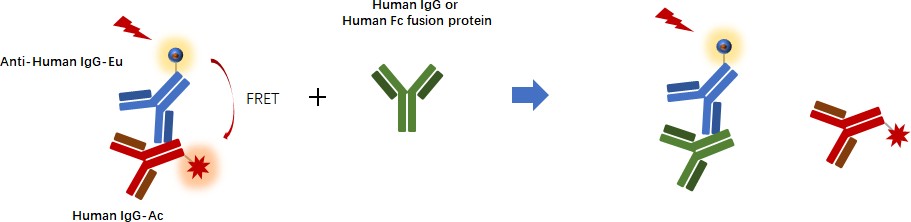
Nanjing UA-Bio Technology Co., Ltd. has independently developed the "UniOne® TR-FRET Human Total IgG Kit (Assay Pro)" (Product Code: UA085005), a high-performance analytical platform designed for quantitative detection of total human immunoglobulin G (Total IgG). This kit utilizes time-resolved fluorescence resonance energy transfer (TR-FRET) technology to accurately and efficiently measure total IgG concentrations in serum, plasma, or cell culture supernatants, providing a standardized solution for antibody drug development, immune monitoring, and biopharmaceutical quality control.
| Core Advantages | Detailed Parameters / Functional Description |
|---|---|
| High Sensitivity and Broad Dynamic Range | The kit employs an optimized TR-FRET detection system, using IgG-specific antibody pairs (fluorescent donor/acceptor-labeled) to achieve high sensitivity and specificity for total IgG quantification. With a wide dynamic range and picogram-level sensitivity, it accommodates low endogenous IgG to high recombinant antibody samples, making it ideal for antibody pharmacokinetics (PK) studies, cell culture optimization, and bioproduct residue analysis. |
| Exceptional Inter-Assay Consistency and Stability | Built on an internationally advanced TR-FRET platform and standardized production processes, combined with stringent quality control, the kit ensures long-term stability and outstanding inter-assay consistency, providing reliable data for continuous quality control and process development. |
| Ready-to-Use Flexible Platform | The kit features a simple "add-mix-read" homogeneous assay format without washing steps. Its optimized formulation is compatible with automated multi-well plates (96/384-well), enabling high-throughput antibody screening, cell line development, purification process optimization, and biosimilar activity evaluation. |
| Comprehensive Solutions and Expert Support | We provide validated protocols, standard curves, and detailed interpretation guides to help establish reproducible total IgG quantification workflows. Nanjing UA-Bio's technical team offers full support for experimental design, optimization, and data analysis. |
Nanjing UA-Bio Technology Co., Ltd. is dedicated to delivering cutting-edge, high-quality reagents and tools for immunology, cell therapy, and innovative drug development. For detailed technical specifications, validation data, or application inquiries regarding the "UniOne® TR-FRET Human Total IgG Kit (Assay Pro)" (Product Code: UA085005), please contact us.








