





Time-resolved fluorescence resonance energy transfer (TR-FRET) is a homogeneous detection technology based on non-radiative energy transfer between fluorescent donor and acceptor molecules. The core of this technology lies in the use of lanthanide chelates as fluorescent donors, with common lanthanide elements including europium and terbium. These substances possess unique fluorescent properties, with fluorescence lifetimes reaching the millisecond level, far exceeding the nanosecond-level fluorescence lifetimes of conventional organic fluorescent dyes. By employing a time-resolved mode, a delay time is set after the excitation light is turned off, allowing short-lived background fluorescence to fully decay before measuring the fluorescent signal. This effectively eliminates background interference from sample matrices, buffer components, and reaction vessels, significantly improving the signal-to-noise ratio and sensitivity of detection.
In the IgG sandwich detection system, this technology utilizes a pair of specific antibodies to recognize different epitopes of the target IgG molecule. The capture antibody is biotinylated and can specifically bind to one epitope of the target IgG molecule. The detection antibody is labeled with an acceptor fluorophore and recognizes another non-overlapping epitope on the IgG molecule. When the target IgG is present in the sample, the two antibodies bind to it, forming a sandwich immunocomplex that brings the donor and acceptor into close spatial proximity. When the distance between the donor and acceptor is within the range of 1 to 10 nanometers, the energy generated by exciting the donor can be transferred to the acceptor non-radiatively, thereby exciting the acceptor to emit fluorescence at a specific wavelength. This energy transfer efficiency is highly sensitive to the molecular distance, so detectable signals are only produced when specific immunocomplexes are formed.
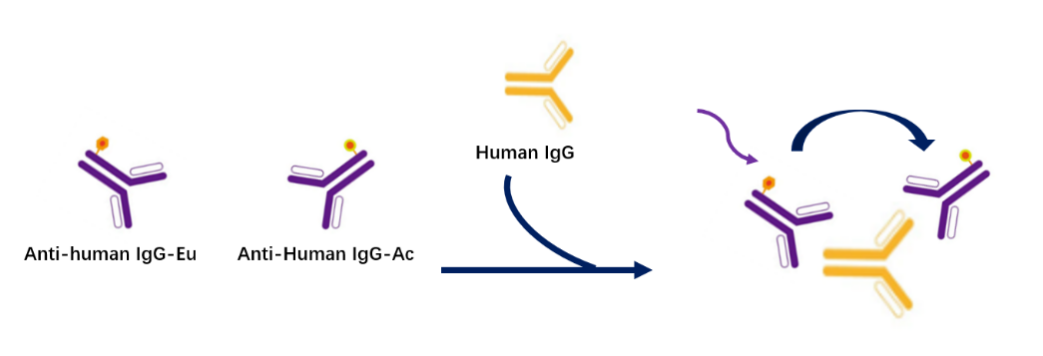
This detection kit typically includes the following core components. First, the biotinylated capture antibody. This antibody is chemically modified with biotin molecules to specifically recognize and bind to one epitope of the target IgG molecule. Second, the acceptor fluorophore-labeled detection antibody. This antibody recognizes another non-overlapping epitope on the target IgG molecule, ensuring the specificity of the sandwich structure. Third, the donor reagent, which is a streptavidin-labeled lanthanide chelate. Streptavidin has an extremely high affinity for biotin, enabling stable binding with the biotinylated capture antibody and thereby introducing the donor fluorophore into the immunocomplex. Fourth, standards and controls. The standards are target IgG molecules of known concentrations, used to establish a dose-response curve; the controls are used to monitor the accuracy and precision of the detection process. Fifth, an optimized buffer system. This buffer contains necessary stabilizers, blockers, and surfactants to reduce non-specific binding and serum matrix effects while maintaining the activity and stability of all components in the reaction system.
This detection employs a homogeneous reaction mode, eliminating the need for separation and washing steps throughout the process. This not only simplifies the operational workflow but also reduces human error. The specific operational steps are as follows. First, the sample to be tested, the biotinylated capture antibody, and the acceptor-labeled detection antibody are simultaneously added to the reaction well and incubated at an appropriate temperature. During this process, the two antibodies specifically bind to the target IgG in the sample, forming a sandwich immunocomplex. Next, the donor reagent, the streptavidin-labeled lanthanide chelate, is added. Streptavidin specifically binds to the biotin molecules on the biotinylated antibody, introducing the donor fluorophore into the immunocomplex, thereby bringing the donor and acceptor into close spatial proximity. Finally, a time-resolved fluorescence plate reader is used to excite the donor at a specific wavelength, and the acceptor's emitted fluorescence signal is measured after a delay time. The entire reaction is typically completed within a few hours, with the signal intensity positively correlated with the concentration of the target IgG in the sample.
The detection process is performed using a fluorescence plate reader equipped with a time-resolved mode. The instrument first excites the donor fluorophore, then waits for a preset delay time. This delay time is typically set between 50 and 100 microseconds, sufficient for short-lived background fluorescence to fully decay. After this delay, the instrument collects the acceptor's emitted fluorescence signal. This time-resolved measurement mode effectively reduces interference from autofluorescence caused by proteins, pigments, and other substances in biological samples, significantly improving the signal-to-noise ratio of the detection.
For data processing, a dose-response curve is established using a series of standards of known concentrations. A four-parameter logistic curve fitting model is commonly used, as it accurately describes the sigmoidal relationship between signal and concentration. By substituting the fluorescence signal of the sample into the standard curve, the concentration of the target IgG in the sample can be quantitatively calculated. This method has a broad dynamic detection range, typically spanning 3 to 4 orders of magnitude, and offers picomolar-level detection sensitivity.
Compared to traditional enzyme-linked immunosorbent assays (ELISA), the TR-FRET IgG sandwich detection kit offers several significant advantages. First, the homogeneous reaction mode eliminates the need for cumbersome washing steps, reducing operational time and increasing detection throughput. Second, time-resolved technology significantly reduces background interference, improving detection sensitivity and signal-to-noise ratio. Third, this technology is compatible with various biological sample types, including serum, plasma, cell culture supernatants, and tissue homogenates, offering excellent sample versatility. Fourth, it requires minimal reagent consumption, making it suitable for high-throughput screening applications. Fifth, the reaction system is stable, with low intra- and inter-assay coefficients of variation, ensuring excellent repeatability and reliability.
The "UniOne® TR-FRET Human IgG Sandwich Assay Kit" (Product Code: UA085006), independently developed by Nanjing UA-Bio Technology Co., Ltd. (UA-Bio), is a high-performance sandwich assay platform specifically designed for the highly sensitive and specific detection of human immunoglobulin G (IgG). This kit is based on time-resolved fluorescence resonance energy transfer (TR-FRET) technology and employs an optimized antibody pair sandwich recognition mode to accurately and efficiently quantify total IgG levels in samples such as human serum, plasma, or cell culture supernatants. It provides a stable and reliable standardized solution for applications in biopharmaceutical process development, antibody drug quality control, and immune monitoring.
| Core Advantages of the Product | Detailed Parameters / Functional Description |
|---|---|
| High Sensitivity and Broad Dynamic Range | This kit utilizes a sandwich TR-FRET detection system with a pair of high-affinity specific antibodies recognizing different epitopes of IgG (labeled with donor/acceptor fluorophores), achieving superior signal-to-background ratio and detection specificity. It offers picogram-level detection sensitivity and a broad linear range spanning over 4 orders of magnitude, enabling precise coverage from low-expression cell line screening to high-concentration purified product analysis across the entire process chain. |
| Excellent Inter-Assay Consistency and Stability | Relying on an internationally leading TR-FRET technology platform and a highly standardized production process, combined with a stringent release quality control system, all components of the kit exhibit outstanding long-term stability and excellent inter-assay consistency. This provides a solid and reliable data foundation for long-term and continuous quality control and process development. |
| Ready-to-Use Flexible Experimental Platform | This kit employs a simple "add-incubate-read" homogeneous operation mode, eliminating the need for cumbersome washing steps. Its optimized formulation system is compatible with multi-well plate (96/384-well) automation platforms, making it suitable for a variety of applications, including high-throughput antibody screening, cell line development, purification process optimization, and biosimilar activity evaluation. |
| Complete Solutions and Professional Support | We provide fully validated standard experimental protocols, typical standard curves, and detailed result interpretation guidelines to help you quickly establish a stable and reproducible IgG sandwich detection process. Nanjing UA-Bio's professional technical team offers comprehensive technical consultation and support for your research design, experimental optimization, and data analysis. |
Nanjing UA-Bio Technology Co., Ltd. is committed to providing cutting-edge, high-quality core reagents and tools for immunology, cell therapy, and innovative drug development. For detailed technical parameters, validation data, or specific application inquiries regarding the "UniOne® TR-FRET Human IgG Sandwich Assay Kit" (Product Code: UA085006), please feel free to contact us.








