





The histidine tag is one of the most widely used affinity tags in recombinant proteins, consisting of 6 to 10 consecutive histidine residues, typically fused to the N- or C-terminus of the target protein. This tag offers advantages such as small molecular weight, low immunogenicity, and minimal impact on protein structure, enabling efficient purification via nickel-ion affinity chromatography. In research areas like protein expression, purification, interaction analysis, and drug screening, rapid and accurate quantification of His-tagged proteins is crucial. Traditional detection methods like Western blot and ELISA are cumbersome and time-consuming, making them unsuitable for high-throughput screening. The TR-FRET His-Tag Detection Kit, based on time-resolved fluorescence resonance energy transfer technology, provides an efficient solution for quantitative detection of His-tagged proteins.
TR-FRET technology combines the principles of time-resolved fluorescence and fluorescence resonance energy transfer. Time-resolved fluorescence utilizes the long-lived fluorescence properties of lanthanide chelates to effectively eliminate short-lived background fluorescence interference through delayed detection, significantly improving the signal-to-noise ratio. Fluorescence resonance energy transfer occurs when donor and acceptor fluorescent molecules are sufficiently close, generating specific signals via non-radiative energy transfer. In His-tag detection, donor fluorescent molecule-labeled anti-His-tag antibodies and acceptor fluorescent molecule-labeled nickel-ion chelates participate in the reaction. When both bind to the same His-tagged protein, the donor and acceptor are brought into proximity, enabling energy transfer. This method features homogeneous, wash-free, high-sensitivity, and high-throughput characteristics, making it suitable for large-scale compound screening.
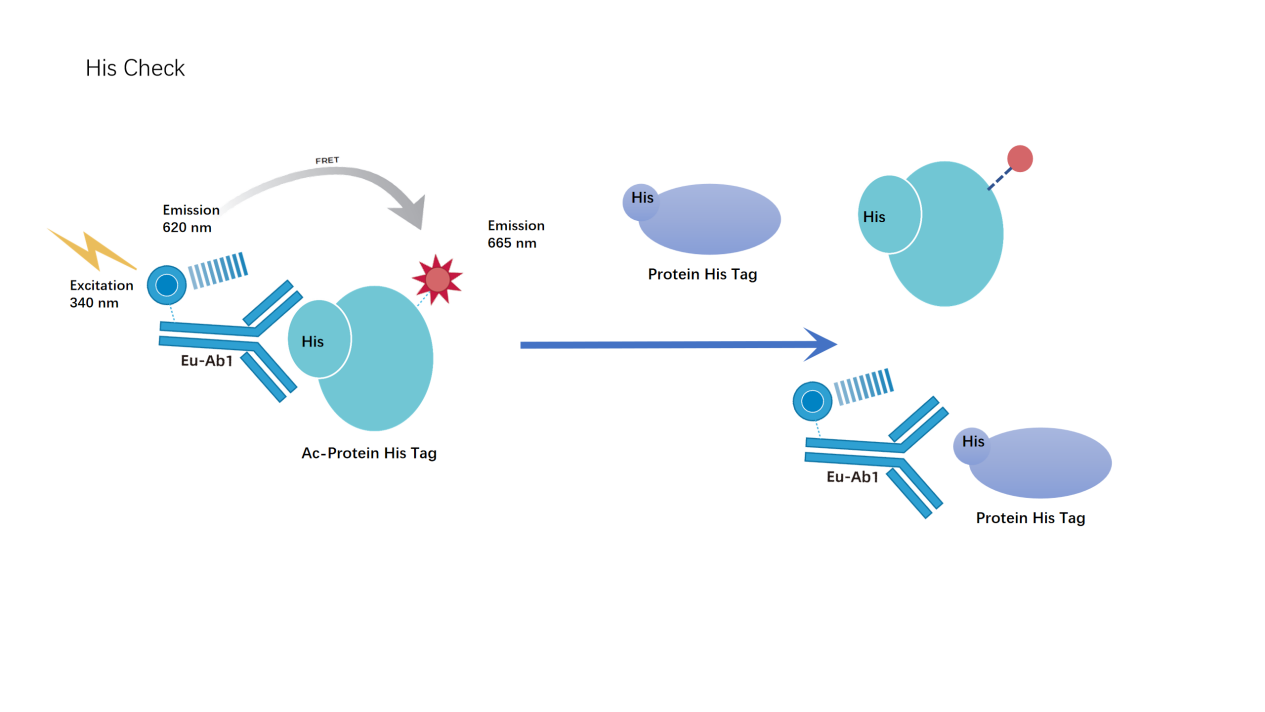
The TR-FRET His-Tag Detection Kit employs a homogeneous, wash-free detection mode, offering simple and rapid operation. During detection, the sample, labeled anti-His-tag antibodies, and labeled nickel-ion chelates are mixed and incubated in an optimized detection buffer. Incubation typically lasts 1 to 2 hours at room temperature or 37°C. After incubation, a TR-FRET-compatible microplate reader is used to measure fluorescence signals. Donor fluorescent molecules emit long-lived fluorescence upon excitation at specific wavelengths; if acceptor fluorescent molecules are brought close, they absorb donor energy and emit signals at specific wavelengths. Calculating fluorescence ratios eliminates interference from sample color and instrument fluctuations. The entire process requires no washing steps and can be completed within hours, making it ideal for high-throughput screening.
In recombinant protein expression studies, accurate and rapid quantification of His-tagged protein expression levels is key to optimizing expression conditions. The TR-FRET His-Tag Detection Kit enables direct detection of His-tagged proteins in cell lysates or culture supernatants without purification steps. Researchers can compare protein yields under different induction conditions, host cells, and expression vectors to quickly identify optimal expression protocols. Compared to traditional Western blotting, the TR-FRET method offers a wider linear dynamic range and higher throughput. It can also monitor protein recovery rates during purification steps to optimize purification processes. For difficult-to-express proteins, the method can screen truncated or fusion-tag variants for higher expression levels and better stability.
Analyzing interactions between His-tagged proteins and their binding partners is essential for studying protein function and signaling pathways. The TR-FRET His-Tag Detection Kit can detect interactions between His-tagged proteins and unlabeled or labeled proteins. In the detection system, donor fluorescent molecule-labeled anti-His-tag antibodies recognize the His-tagged protein, while acceptor fluorescent molecule-labeled antibodies recognize the binding partner. When both bind, TR-FRET signals are generated, reflecting interaction strength. This method can screen protein interaction inhibitors, validate the impact of mutations on binding, and perform competitive binding assays. Compared to traditional co-immunoprecipitation, the TR-FRET method requires no immobilization steps, enabling interaction detection in near-solution states for more accurate reflection of binding properties.
Drug screening targeting protein-protein interactions is a key direction in drug discovery. The TR-FRET His-Tag Detection Kit can establish high-throughput screening systems to evaluate small-molecule compounds' inhibitory activity against His-tagged protein interactions with binding partners. By mixing His-tagged proteins, binding partners, labeled detection reagents, and test compounds, incubation generates TR-FRET signal changes to calculate half-maximal inhibitory concentrations. This method features simplicity, low sample consumption, and miniaturization, supporting 96-, 384-, or even 1536-well plate formats. Sample volumes as low as 10–20 µL per well significantly reduce reagent costs. The method also facilitates structure-activity relationship studies to guide lead compound optimization.
Nanjing UA-Bio Technology Co., Ltd. (UA-Bio) has independently developed the "UniOne® TR-FRET His Check Kit" (Product Code: UA086117), a high-performance analytical platform designed for rapid, homogeneous detection and quantification of histidine-tagged (His-tag) fusion proteins. Based on time-resolved fluorescence resonance energy transfer (TR-FRET) technology and utilizing high-affinity anti-His antibody pairs, this kit enables precise and efficient assessment of His-tagged protein presence and relative levels in various biological samples, providing stable and reliable standardized solutions for protein expression screening, purification process monitoring, and interaction analysis.
| Core Advantages | Detailed Parameters / Functional Description |
|---|---|
| High Sensitivity & Broad Dynamic Range | The kit employs an optimized TR-FRET detection system with fluorescent donor/acceptor-labeled anti-His antibody pairs for high-sensitivity, high-specificity His-tagged protein quantification. It features high sensitivity and a wide dynamic range, enabling direct detection of His-tagged proteins in cell lysates, purification intermediates, or final products, supporting workflows from expression colony screening to final product quality release. |
| Excellent Batch Consistency & Stability | Built on an internationally leading TR-FRET platform and standardized production processes with stringent quality control, the kit ensures superior long-term stability and batch consistency, providing reliable data support for continuous protein expression and purification studies. |
| Ready-to-Use Flexible Platform | The kit features a simple "add-mix-read" homogeneous workflow without washing steps, avoiding His-tagged protein loss common in traditional ELISA methods. Its optimized formulation supports automated multi-well (96/384-well) platforms, enabling flexible applications in high-throughput expression clone screening, purification condition optimization, and protein interaction (pull-down) validation. |
| Comprehensive Solutions & Professional Support | We provide validated standard protocols, typical standard curves, and detailed interpretation guides to help establish stable, reproducible His-tag detection workflows. Nanjing UA-Bio's technical team offers full-cycle professional support for experimental design, optimization, and data analysis. |
Nanjing UA-Bio Technology Co., Ltd. is committed to providing cutting-edge, high-quality core reagents and tools for immunology, cell therapy, and innovative drug development. For detailed technical parameters, validation data, or application inquiries regarding the "UniOne® TR-FRET His Check Kit" (Product Code: UA086117), please feel free to contact us.








