





Time-Resolved Fluorescence Resonance Energy Transfer (TR-FRET) combines the dual advantages of time-resolved fluorescence detection and fluorescence resonance energy transfer, providing an efficient homogeneous assay solution for precise quantification of cyclic guanosine monophosphate (cGMP). In this detection system, biotin-labeled cGMP molecules specifically bind to streptavidin, while europium (Eu)-labeled anti-cGMP antibodies serve as fluorescent donors, and acceptor fluorophore (Ac)-labeled anti-tag antibodies target biotin-labeled molecules. When donor and acceptor antibodies are spatially proximate, energy from the excited donor can transfer to the acceptor via FRET, eliciting characteristic fluorescence emission at 665nm.
When free cGMP is present in cell lysate samples or standard curves, it competes with biotin-labeled cGMP for binding to Eu-labeled anti-cGMP antibodies, reducing the formation of donor-acceptor complexes and consequently decreasing FRET signals. The signal attenuation correlates positively with cGMP concentration in samples, enabling precise quantification through standard curves. This homogeneous reaction system eliminates washing steps, streamlining operations and minimizing human error.
The detection system comprises six core components, all requiring strict storage at -80°C. Biotin-cGMP conjugate serves as a competitive binding element provided as 100× concentrate, requiring dilution to working concentration before use. cGMP calibrators at 500μM are used for gradient dilution to establish standard curves. Eu-labeled anti-cGMP antibodies are supplied as 100× concentrate, while streptavidin-acceptor conjugates are 12.5× concentrate—both require thawing on ice before use. Lysis/detection buffer processes cell samples and prepares reaction systems, whereas stimulation buffer (without IBMX) is dedicated to cell pretreatment.
Kits of varying sizes accommodate 100, 500, 2500, or 10000 tests, with component volumes proportionally adjusted to maintain consistency. Freeze-thaw cycles should be limited to three to preserve protein activity and detection sensitivity.
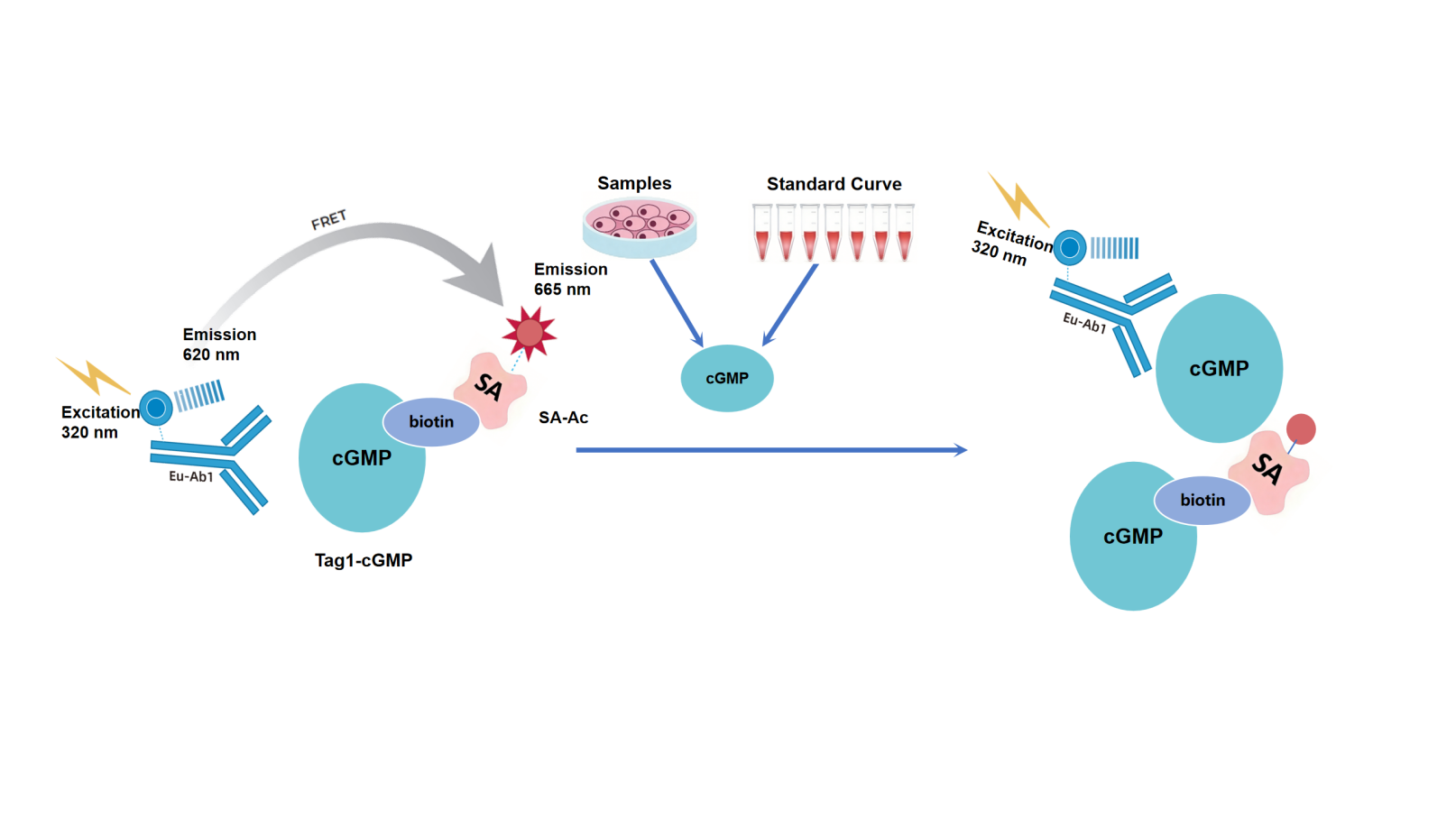
During preparation, frozen components must be thawed on ice without agitation to prevent antibody/protein conformational changes. Cell samples treated with stimulation buffer require lysis/detection buffer to release intracellular cGMP. cGMP calibrators are serially diluted into at least six concentrations spanning expected sample values to ensure standard curve reliability.
After mixing, reactions incubate for 60 minutes at room temperature (protected from light) to reach competitive binding equilibrium. Detection uses a time-respective microplate reader (excitation: 340nm; emission: 620nm donor, 665nm acceptor). Data analysis employs the 665nm/620nm signal ratio to normalize pipetting variations and instrument fluctuations.
TR-FRET’s time-resolved feature eliminates short-lived background fluorescence, achieving superior signal-to-noise ratios over traditional ELISA. The homogeneous format omits coating, washing, and separation steps, shortening processing time and reducing contamination risks. Dynamic detection ranges typically span three orders of magnitude, meeting both basic research and high-throughput screening sensitivity needs. Signal stability persists over 24 hours post-reaction, supporting batch testing and retesting.
For phosphodiesterase modulator screening, this technology monitors cGMP hydrolysis dynamics in real time, providing reliable compound efficacy data. Compared to radioisotope assays, it eliminates radiation hazards and reduces waste disposal costs/environmental risks.
Standard curves require duplicates to assess pipetting errors, with correlation coefficients ≥0.99. Cell lysates should be analyzed promptly to prevent endogenous phosphodiesterase-mediated cGMP degradation. Samples exceeding linear ranges need dilution with lysis/detection buffer.
Each batch requires positive controls and blanks to monitor system stability/reagent validity. Fluorescence crossover between channels is corrected via instrument compensation. Abnormal data warrants checks of freeze-thaw history, incubation temperature precision, and detection delay to ensure accuracy/reproducibility.
Nanjing UA-Bio’s "UniOne® TR-FRET Human cGMP Detection Kit" (Cat#: UA086127) is a high-performance platform for quantifying cyclic guanosine monophosphate (cGMP)—a key secondary messenger regulating vasodilation, visual transduction, and natriuretic peptide signaling. Based on TR-FRET competitive immunoassay principles, it precisely measures cGMP in cell lysates, tissue homogenates, or in vitro systems, offering standardized solutions for cardiovascular research, neuroscience, and drug screening.
| Core Advantages | Specifications / Features |
|---|---|
| High Sensitivity & Wide Dynamic Range | Optimized TR-FRET competitive assay employs high-specificity cGMP antibodies and labeled tracers for sub-nanomolar sensitivity, covering basal to stimulated cGMP levels. Ideal for NPR activity analysis, NO signaling, and guanylate cyclase agonist screening. |
| Exceptional Lot Consistency & Stability | Standardized production and rigorous QC ensure long-term stability of fluorescent labels, antibodies, and standards, supporting continuous high-throughput screening. |
| Ready-to-Use Flexible Platform | "Mix-incubate-read" homogeneous format eliminates washing steps, compatible with 96/384-well automation for cGMP pathway activation, PDE inhibitor screening, and cardiovascular drug evaluation. |
| Comprehensive Support | Validated protocols, dose-response curves, and analysis guides expedite assay establishment. UA-Bio’s technical team provides end-to-end consultation for experimental design and optimization. |
Nanjing UA-Bio specializes in cutting-edge reagents for immunology, cell therapy, and drug discovery. For details on "UniOne® TR-FRET Human cGMP Detection Kit" (Cat#: UA086127), including specifications or applications, contact us anytime.








