





Cyclic adenosine monophosphate (cAMP), as an important intracellular second messenger molecule, directly reflects the activation or inhibition state of G protein-coupled receptor signaling pathways through its concentration changes. The design objective of the high-range detection kit is to accurately capture the significant increase in intracellular cAMP levels following adenylate cyclase activation, while also ensuring stable measurement of baseline levels.
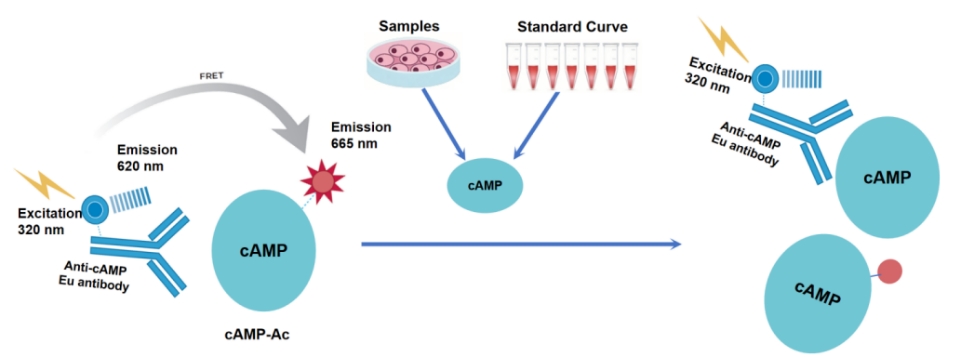
This detection system employs the principle of competitive immunoassay. The reaction system contains both lanthanide-labeled cAMP tracers and free cAMP from the sample, which compete to bind with dye-labeled anti-cAMP antibodies. When the tracer binds to the antibody, fluorescence resonance energy transfer (FRET) occurs between the lanthanide donor and the dye acceptor, generating emission signals at specific wavelengths.
The core distinction of the high-range detection mode from the standard mode lies in the differential configuration of tracer concentrations. By reducing the initial tracer concentration, the competitive binding equilibrium shifts toward detecting higher cAMP concentrations. This design extends the detection window to the micromolar range, accommodating the concentration levels observed during full adenylate cyclase activation.
The introduction of time-resolved fluorescence measurement technology effectively eliminates background fluorescence interference. Lanthanides exhibit long fluorescence lifetimes ranging from microseconds to milliseconds. During the delayed measurement window after pulsed excitation, short-lived scattered light and autofluorescence completely decay, allowing only the specific signals from long-lived donors to be collected. This characteristic significantly improves the signal-to-noise ratio, maintaining linear responses even for high-concentration samples.
The experimental workflow must strictly adhere to standardized temperature and timing controls. Cell seeding density should be optimized based on preliminary results to avoid abnormal elevation of baseline cAMP levels due to overcrowding. The stimulation duration with agonists or antagonists must be precisely controlled, as adenylate cyclase responses typically peak within minutes to tens of minutes. Prolonged incubation may lead to cAMP degradation due to phosphodiesterase activity.
The lysis buffer must include non-selective phosphodiesterase inhibitors to prevent post-lysis cAMP degradation. The lysis process should be performed rapidly on ice to minimize enzymatic interference. After adding detection reagents, samples must be incubated in the dark for at least one hour to ensure equilibrium in the competitive binding reaction.
Standard curves are constructed using a four-parameter logistic regression model. The linear range of the high-range detection mode typically spans three orders of magnitude, requiring at least eight concentration gradients of standards. Each experimental batch should include a synchronous standard curve to correct for systematic deviations caused by inter-well temperature variations and pipetting errors.
When calculating sample cAMP concentrations, fluorescence ratio signals should be input into the standard curve equation for back-calculation. For samples exceeding the upper limit of the standard curve, a dilution and re-test strategy may be employed, but dilution factors should not exceed fivefold to avoid amplifying errors. Results should be normalized to cell counts or total protein, typically expressed as picomoles of cAMP per million cells or per milligram of total protein.
Matrix effects in high-concentration samples may compromise detection accuracy. Residual protein components and small-molecule metabolites in cell lysates can non-specifically bind to lanthanides, causing donor fluorescence quenching. High-speed centrifugation to remove insoluble debris and adding matching proportions of lysis buffer to standard curve preparations can partially counteract this effect.
Microplate material selection also impacts signal stability. Low-protein-binding polystyrene plates minimize non-specific antibody adsorption to well walls, maintaining reaction homogeneity. Repeated freeze-thaw cycles of antibody and tracer stocks should be avoided, as minor conformational changes in proteins may lead to affinity shifts.
The high-range detection mode combines the convenience of homogeneous assays with broad dynamic range and high sensitivity. Its no-wash protocol makes it ideal for high-throughput screening. However, this method measures total cAMP content without distinguishing between free and bound molecular states. For studies requiring spatiotemporal resolution of dynamic changes, orthogonal validation methods remain necessary.
Nanjing UA-Bio Technology Co., Ltd.'s independently developed "UniOne® TR-FRET Human cAMP HiRange Detection Kit" (Catalog No.: UA086053) is a high-performance analytical platform specifically designed for quantifying high-concentration cAMP levels. As one of the core second messengers, cAMP plays pivotal roles in GPCR signal transduction, hormonal responses, and metabolic regulation. This kit utilizes time-resolved FRET (TR-FRET) technology with a competitive immunoassay principle optimized for high-concentration cAMP detection, providing accurate and efficient quantification in cell lysates, tissue homogenates, or in vitro reaction systems. It offers standardized solutions for GPCR agonist screening, potent compound evaluation, and in-depth signaling pathway analysis.
| Core Advantages | Detailed Parameters / Functional Description |
|---|---|
| Ultra-Wide Detection Range & High Sensitivity | The kit employs an optimized TR-FRET competitive assay system tailored for high-concentration cAMP detection, featuring an ultra-wide dynamic range (HiRange) that covers concentration variations from low baseline to highly stimulated levels (e.g., with potent agonists or high-concentration compounds). It is particularly suited for screening strong GPCR agonists, evaluating high-potency compounds, and in-depth analysis of signaling pathways with broad dynamic ranges. |
| Exceptional Batch Consistency & Stability | Leveraging internationally advanced TR-FRET technology and highly standardized production processes, coupled with rigorous quality control, the kit ensures outstanding long-term stability and batch-to-batch consistency for all components (including fluorescent donor/acceptor labels, antibodies, and standards). This provides reliable support for long-term, continuous high-throughput screening and mechanistic studies. |
| Ready-to-Use Flexible Platform | The kit features a simple "add-mix-read" homogeneous assay format without cumbersome washing or separation steps, significantly streamlining workflows and reducing operational errors. Its optimized formulation is compatible with automated multiwell (96/384) platforms, making it adaptable for various applications such as GPCR agonist/antagonist screening, adenylate cyclase activity analysis, phosphodiesterase (PDE) inhibitor evaluation, and cell signaling research. |
| Comprehensive Solutions & Expert Support | We provide thoroughly validated standard protocols, representative dose-response curves, and detailed interpretation guides to help establish robust and reproducible cAMP detection workflows. Nanjing UA-Bio's technical team offers end-to-end professional support for experimental design, optimization, and data analysis. |
Nanjing UA-Bio Technology Co., Ltd. is committed to delivering cutting-edge, high-quality reagents and tools for immunology, cell therapy, and innovative drug development. For detailed technical specifications, validation data, or application consultations regarding the "UniOne® TR-FRET Human cAMP HiRange Detection Kit" (Catalog No.: UA086053), please feel free to contact us.








