





TGF-β1 protein is a pleiotropic cytokine that plays important roles in various biological processes such as cell proliferation, development, apoptosis, fibrosis, angiogenesis, wound healing, and cancer. This protein is synthesized in a latent form and requires proteolytic cleavage and activation to exert its biological functions. Abnormal expression of TGF-β1 is associated with multiple diseases, including fibrotic disorders, autoimmune diseases, and malignant tumors. Due to its broad and complex biological functions, TGF-β1 is considered a dual-role cytokine that can both suppress tumorigenesis and promote tumor progression.
GARP is a type I transmembrane docking protein encoded by the Lrrc32 gene. It is located in a conserved chromosomal region between human and mouse genomes, and the Lrrc32 gene locus is frequently altered in human cancers. Structurally, GARP consists of three domains: an extracellular domain, a transmembrane domain, and an intracellular domain. The extracellular domain contains two sets of leucine-rich repeats (LRRs) separated by a proline-rich domain and a C-terminal LRR. Two conserved cysteine residues located on the 7th and 12th LRRs form disulfide bonds with the latency-associated peptide (LAP) of latent TGF-β1. In human tissues, GARP is expressed in peripheral blood, placenta, and pancreas, with particularly high expression in activated regulatory T cells, activated B cells, and platelets.
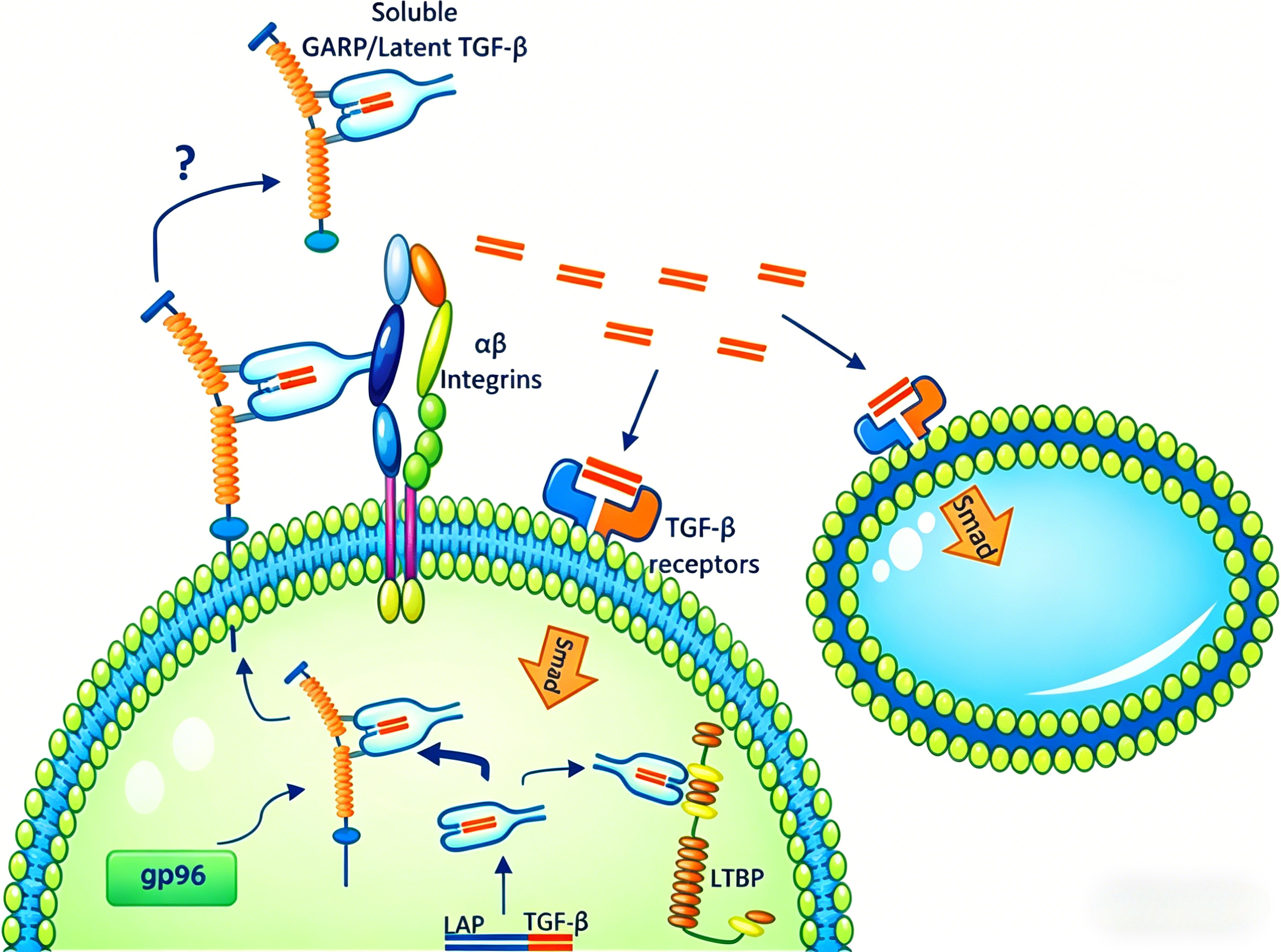
GARP is a key regulator of TGF-β1 expression and activation. By binding to latent TGF-β1, GARP serves as a docking receptor that concentrates latent TGF-β1 on the cell surface and enhances its activity. After cleavage by furin-like proteases, TGF-β1 forms latent TGF-β1, and GARP can increase the efficiency of this protease-dependent cleavage. The endoplasmic reticulum chaperone gp96 ensures proper folding of GARP and its expression on the cell surface. On the cell surface, the GARP-latent TGF-β1 complex interacts with integrins αVβ6 and αVβ8 to release mature TGF-β1 peptides. Mature TGF-β1 then interacts with TGF-β receptors in an autocrine or paracrine manner to activate downstream signaling pathways. In some cases, the GARP-latent TGF-β1 complex can also be released from the cell surface, but the activation mechanism of the soluble complex remains unclear.
The GARP-TGF-β1 complex plays critical roles in embryonic development. During palatogenesis, GARP is specifically expressed in the medial edge epithelial cells of the palatal shelves and is essential for TGF-β3 activation and signaling, which is required for normal palate development. Mice with global Lrrc32 gene deletion die within 24 hours after birth due to palatal fusion defects, a phenotype indistinguishable from that of Tgfb3 gene-deficient mice. Additionally, GARP-TGF-β1 is involved in retinal development and tumorigenesis. In the immune system, GARP-TGF-β1 participates in regulatory T cell conversion, platelet-mediated immune suppression, tumor immune evasion, oral tolerance, and the prevention of graft-versus-host disease, allergies, and lupus.
GARP supports TGF-β1-driven cancer cell growth and dissemination by modulating both innate and adaptive immune systems, facilitating tumor immune evasion. In innate immunity, TGF-β1 suppresses the maturation of natural killer cells and dendritic cells. Tumor-derived TGF-β1 polarizes macrophages into tumor-associated macrophages, which secrete pro-inflammatory cytokines such as IL-6, IL-23, and IL-17 to promote cancer progression. TGF-β1 from tumor-associated macrophages is a major driver of epithelial-to-mesenchymal transition. Tumor-derived TGF-β1 also promotes the formation of cancer-associated fibroblasts, which exert potent pro-tumorigenic effects on epithelial cells through autocrine TGF-β1 secretion. In adaptive immunity, active TGF-β1 impairs anti-tumor immunity by directly inhibiting the clonal expansion and cytotoxicity of CD8-positive cytotoxic T cells. TGF-β1 also induces Foxp3 expression, conferring regulatory and immunosuppressive phenotypes to CD4-positive T cells. In human ovarian cancer ascites, infiltrating FoxP3-positive GARP-positive regulatory T cells are present, and in advanced hepatocellular carcinoma, the frequency of GARP-positive FoxP3-positive regulatory T cells is higher, correlating positively with immunosuppression and more aggressive phenotypes.
Given the significant role of GARP-TGF-β1 in tumor immunity, therapeutic strategies targeting this complex have garnered attention. Monoclonal antibodies blocking the interaction between latent TGF-β1 and GARP have demonstrated therapeutic effects in a syngeneic mouse breast cancer model. Beyond inhibiting GARP-latent TGF-β1 interactions on tumor cells, novel antibody strategies are emerging, such as blocking GARP-latent TGF-β1 complexes on regulatory T cell surfaces to prevent active TGF-β1 secretion. LAP-blocking antibodies reduce tumor growth in melanoma, colorectal cancer, and glioblastoma animal models by decreasing the number of GARP-positive LAP-positive regulatory T cells. Selective inhibition of TGF-β1 production by regulatory T cells can overcome tumor resistance to PD-1/PD-L1 blockade. In one-third of metastatic melanoma cases, evidence of GARP-expressing regulatory T cells and their TGF-β1 production has been observed. Combined GARP-TGF-β1 blockade and PD-1 blockade enhances the effector functions of anti-tumor CD8-positive T cells without increasing immune cell infiltration or depleting intratumoral regulatory T cells.
Nanjing UA-Bio Technology Co., Ltd. (UA-Bio) has independently developed "TGF-β1 Protein, Human" (Catalog No.: UA040085), a high-quality recombinant protein reagent specifically designed for research on cell proliferation, differentiation, immune regulation, and tissue fibrosis. This human transforming growth factor-β1 (TGF-β1) protein, a core member of the TGF-β superfamily, efficiently activates SMAD signaling pathways to regulate cell proliferation, differentiation, apoptosis, and immune responses. It serves as a stable and reliable standardized tool for research in tumor biology, stem cell studies, and fibrotic disease mechanisms.
| Key Product Advantages | Detailed Parameters / Functional Description |
|---|---|
| High Purity and Full Biological Activity | The product employs an advanced recombinant expression system and highly standardized purification processes, validated by multi-dimensional quality control to ensure >95% purity, correct native conformation (including proper disulfide bonds and latent/active state conversion), and full biological functionality. The protein effectively binds TGF-β receptor complexes (TβRI/TβRII), accurately mimicking TGF-β1-mediated cell growth inhibition, epithelial-mesenchymal transition (EMT), and immune regulation under physiological conditions. |
| Excellent Batch-to-Batch Consistency and Stability | Strict management from gene construction to protein expression and purification, combined with a comprehensive release testing system, ensures consistent biological activity, purity, and long-term stability across batches. This provides a solid foundation for long-term and continuous cell biology and disease mechanism research. |
| Ideal Tool for Multiple Applications | This protein performs exceptionally well in various applications, including immune cell (Treg, Th17) differentiation induction, fibroblast activation studies, EMT model construction, stem cell differentiation regulation, organoid culture, and signaling pathway analysis. It is widely applicable to tumor microenvironment research, fibrotic disease mechanism exploration, regenerative medicine, and drug activity evaluation. |
| Low Endotoxin and High Batch Consistency | The product undergoes multi-step chromatography purification and endotoxin removal processes, resulting in extremely low endotoxin levels (<0.1 EU/μg), meeting stringent requirements for cell culture and functional assays. Rigorous quality control ensures high consistency in protein activity and purity across batches. |
| Comprehensive Solutions and Professional Support | We provide fully validated standard protocols, representative biological activity data, and detailed product analysis certificates to help establish stable and reproducible experimental workflows. Nanjing UA-Bio's technical team offers professional consultation and support for research design, experimental optimization, and data analysis. |
Nanjing UA-Bio Technology Co., Ltd. is committed to providing cutting-edge, high-quality core reagents and tools for immunology, cell therapy, and innovative drug development. For detailed technical parameters, validation data, or application inquiries regarding "TGF-β1 Protein, Human" (Catalog No.: UA040085), please feel free to contact us.








