





Transforming growth factor-beta 1 (TGF-β1) was discovered in biochemical studies in the 1970s, initially used to isolate soluble factors that could induce anchorage-independent growth or transformation of normal cells. Shortly thereafter, the high-affinity receptors for TGF-β1, TGF-RI and TGF-RII, were identified. In 1985, the complementary DNA (cDNA) of human TGF-β1 was successfully cloned, followed soon by the cloning of mouse TGF-β1 cDNA. This breakthrough provided favorable conditions for genetic research and quickly revealed the important roles of TGF-β1 in biological processes such as cancer, fibrosis, and immune tolerance. In the early 1990s, two independent research groups reported that the loss of the TGF-β1 gene in mice led to widespread multi-organ inflammation and early death, a phenotype similar to that observed in mice with major regulatory T-cell deficiencies. This sparked significant interest in the intersection of TGF-β1 and regulatory T-cell biology. Rat TGF-β1 protein, as a research model, has played a crucial role in elucidating the biological functions of this cytokine.
The biogenesis, activation, and signaling processes of TGF-β1 are complex. Nearly all cells produce latent forms of TGF-β1, which can be secreted extracellularly but require activation to function in an autocrine or paracrine manner. Latent TGF-β1 can be secreted as large latent complexes or small latent complexes. Large latent complexes can bind to fibronectin or extracellular matrix proteins, while small latent complexes can bind to cell surface GARP, expressed on regulatory T cells, platelets, and endothelial cells, or to LRRC33, expressed on macrophages and microglia. Activation of latent TGF-β1 requires cleavage or conformational changes in the small or large latent complexes to release mature TGF-β1 or expose its active binding motif. Due to the ubiquitous expression of TGF-β1 receptors and their signaling modules, most cells can respond to active TGF-β1.
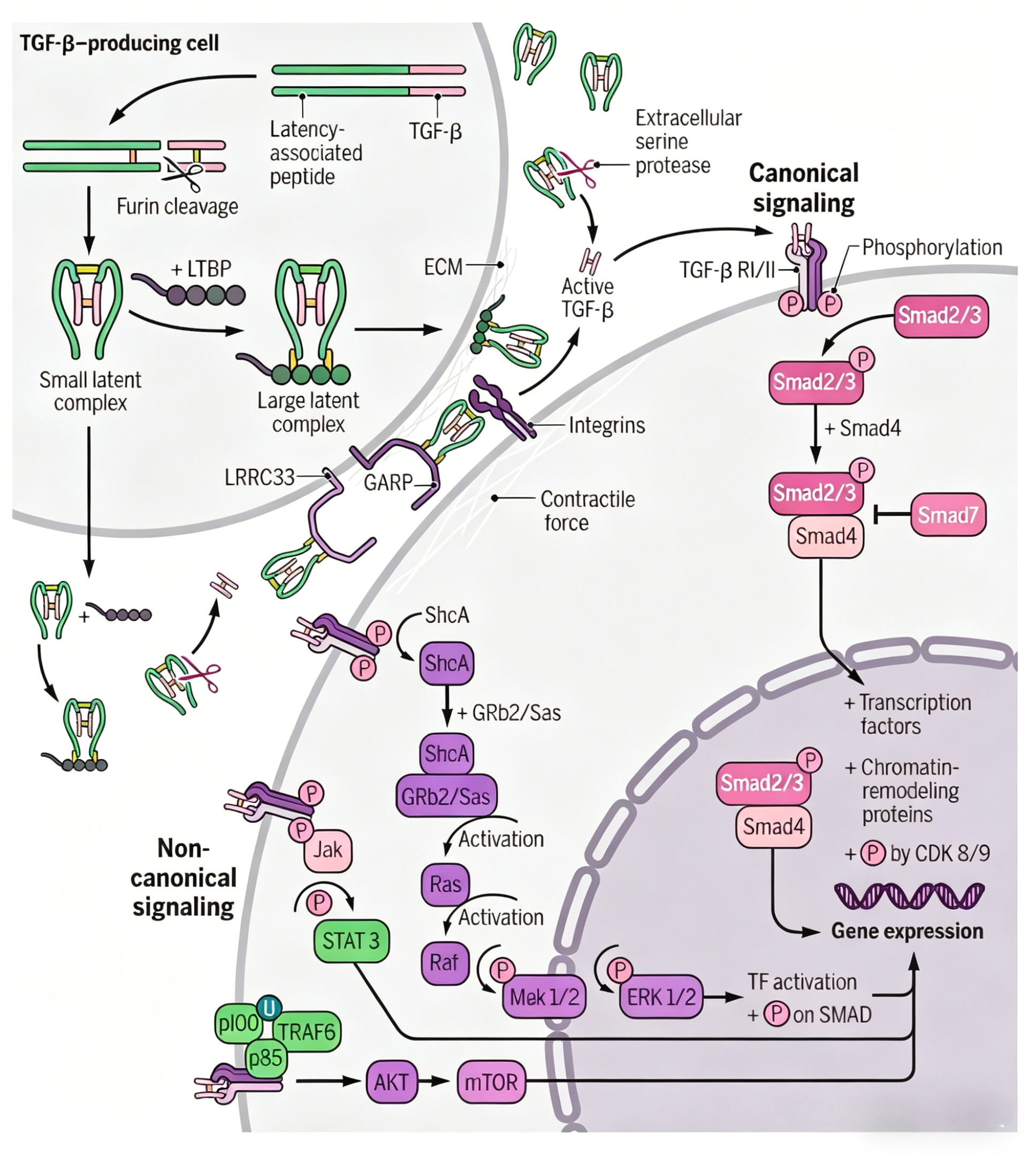
Active TGF-β1 binds to TGF-β receptor II on target cells, recruiting and activating the intracellular domain of TGF-β receptor I. Phosphorylation of the cytoplasmic tail of TGF-β receptor I leads to signal activation via the canonical Smad-dependent pathway or non-canonical pathways. Both thymus-derived regulatory T cells and peripherally induced regulatory T cells require active TGF-β1 signaling for normal development. TGF-β1 signaling is critical for the development of regulatory T cells in both the thymus and periphery. Additionally, TGF-β1 guides the differentiation of other T-cell subsets, including T helper 17 (Th17) cells. Among CD4-positive T cells, regulatory T cells are the primary producers of latent TGF-β1 and can activate latent TGF-β1 through cell surface receptors such as GARP and integrins. Although substantial evidence suggests that regulatory T cell-derived TGF-β1 does not play a major role in the immunosuppressive functions of regulatory T cells, TGF-β1 signaling remains indispensable for their development.
Among CD4-positive T cells, regulatory T cells are the primary producers of latent TGF-β1 and can activate this cytokine through the expression of cell surface receptors such as GARP and integrins. The role of regulatory T cell-derived TGF-β1 in immunosuppression remains controversial. Research indicates that TGF-β1 signaling is essential for regulatory T cell development, but the TGF-β1 produced by regulatory T cells may primarily act on other cell types. Active TGF-β1 also directs the differentiation of other T-cell subsets, including Th17 cells, highlighting its complex, context-dependent functions in immune regulation. Rat TGF-β1 protein serves as a research tool and can be used in vitro to induce regulatory T cell differentiation experiments, providing support for elucidating its mechanisms of action.
The role of TGF-β1 in cancer immune evasion is well-documented. A tumor microenvironment rich in TGF-β1 suppresses intratumoral T-cell trafficking, reducing the efficacy of immune checkpoint inhibitors. The extensive infiltration of regulatory T cells into the tumor microenvironment is a key barrier to effective cancer immunotherapy. Regulatory T cells expressing integrins activate latent TGF-β1 produced by tumor cells, promoting cancer immune evasion. Tumor cells and platelets actively modulate local TGF-β1 levels and function through GARP. Intratumoral TGF-β1 converts conventional T cells into peripherally induced regulatory T cells, increasing the pool of regulatory T cells in the tumor microenvironment and enhancing local TGF-β1 production through surface GARP secretion and activation of latent TGF-β1.
Although TGF-β1 plays some beneficial roles in immunity, TGF-β1 signaling and regulatory T cell activation largely exert negative effects on many aspects of adaptive and innate immunity, leading to immune evasion, resistance to immunotherapy, and tumor progression. The TGF-β1/regulatory T cell axis attenuates the cytotoxic activity of CD8-positive cells, blocks Th1 polarization, and promotes the tolerogenic functions of dendritic cells. TGF-β1 signaling effectively suppresses natural killer (NK) cell function by inhibiting the mammalian target of rapamycin (mTOR) pathway. This axis also drives macrophages toward a tumor-promoting M2 phenotype. Furthermore, the TGF-β1/regulatory T cell axis contributes to tumorigenesis and resistance to immune checkpoint inhibitor therapy by enhancing the activity of cancer-associated fibroblasts. The pleiotropic effects of TGF-β1 in the tumor microenvironment include suppression of antitumor immune responses, enhancement of protumorigenic responses, and interactions with various cell types to promote other components of protective immunity.
Nanjing UA-Bio Technology Co., Ltd. (UA-Bio) has independently developed "TGF-β1 Protein, Mouse/Rat" (Product Code: UA040172), a high-quality recombinant protein reagent specifically designed for cell proliferation and differentiation, immune regulation, and tissue fibrosis research in mouse/rat models. This protein is derived from mouse/rat TGF-β1, a core member of the TGF-β superfamily, and efficiently activates the SMAD signaling pathway to regulate cell proliferation, differentiation, apoptosis, and immune responses. It serves as a stable and reliable standardized tool for preclinical tumor biology, stem cell research, and fibrosis disease mechanism exploration.
| Core Advantages | Detailed Parameters / Functional Description |
|---|---|
| High Purity and Full Biological Activity | The product utilizes an internationally leading recombinant expression system and highly standardized purification processes, validated through multi-dimensional quality control to ensure >95% purity, correct native conformation (including proper disulfide bond formation and latent/active state conversion), and full biological functionality. The protein efficiently binds to mouse/rat TGF-β receptor complexes (TβRI/TβRII), accurately mimicking TGF-β1-mediated cell growth inhibition, epithelial-mesenchymal transition (EMT), and immune regulation signaling under physiological conditions. |
| Excellent Batch Consistency and Stability | From gene construction and protein expression to purification and quality control, the product undergoes rigorous management, combined with a comprehensive release testing system, to ensure stable biological activity, consistent purity, and excellent long-term stability. This provides a solid and reliable quality guarantee for long-term, continuous preclinical cell biology and disease mechanism research. |
| Ideal Tool for Multi-Scenario Applications | This protein performs exceptionally well in various application systems, including immune cell (Treg, Th17) differentiation induction, fibroblast activation studies, EMT model construction, stem cell differentiation regulation, organoid culture, and signaling pathway analysis. It is widely applicable to preclinical tumor microenvironment research, fibrosis disease mechanism exploration, regenerative medicine studies, and drug activity evaluation. |
| Low Endotoxin and High Batch Consistency | The product undergoes multi-step chromatography purification and endotoxin removal processes, resulting in extremely low endotoxin levels (<0.1 EU/μg), meeting the stringent requirements of cell culture and animal experiments. A rigorous quality control system ensures high consistency in protein activity and purity across different batches. |
| Complete Solutions and Professional Support | We provide thoroughly validated standard experimental protocols, typical biological activity data, and detailed product analysis certificates to help you quickly establish stable and reproducible experimental workflows. Nanjing UA-Bio's professional technical team offers comprehensive support for research design, experimental optimization, and data analysis. |
Nanjing UA-Bio Technology Co., Ltd. is committed to providing cutting-edge, high-quality core reagents and tools for immunology, cell therapy, and innovative drug research. For detailed technical parameters, validation data, or specific application inquiries regarding "TGF-β1 Protein, Mouse/Rat" (Product Code: UA040172), please feel free to contact us.








