





Tumor necrosis factor alpha (TNF-α) is a pleiotropic cytokine that acts on multiple cell types and has been identified as a key regulator of inflammatory responses, playing a role in the pathogenesis of various inflammatory and autoimmune diseases. Structurally, TNF-α is a homotrimeric protein composed of 157 amino acids, primarily produced by activated macrophages, T lymphocytes, and natural killer cells. The protein exists in both soluble and transmembrane forms. Transmembrane TNF-α is the initially synthesized precursor form, which requires processing by TNF-α-converting enzyme (TACE) to release soluble TNF-α. Processed soluble TNF-α exerts various biological activities through type 1 and type 2 receptors. Transmembrane TNF-α also acts on TNFR1 and TNFR2, but its biological activity is primarily mediated through TNFR2.
TNF-α exerts diverse biological activities by binding and activating two distinct receptors. TNFR1 is expressed in all human tissues and contains a conserved death domain motif, serving as the primary signaling receptor for TNF-α. TNFR1 predominantly promotes inflammation and tissue degeneration. TNFR2 expression is restricted to specific cell types, such as neurons, immune cells, and endothelial cells. TNFR2 lacks a death domain and thus cannot directly induce programmed cell death; this receptor is thought to be primarily activated by transmembrane TNF-α. TNFR2 mediates localized homeostatic effects, such as cell survival and tissue regeneration. The homotrimeric TNF-α binds to the homotrimeric TNFR to induce signal transduction. Ligand binding to TNFR1 leads to the recruitment of adapter molecules.
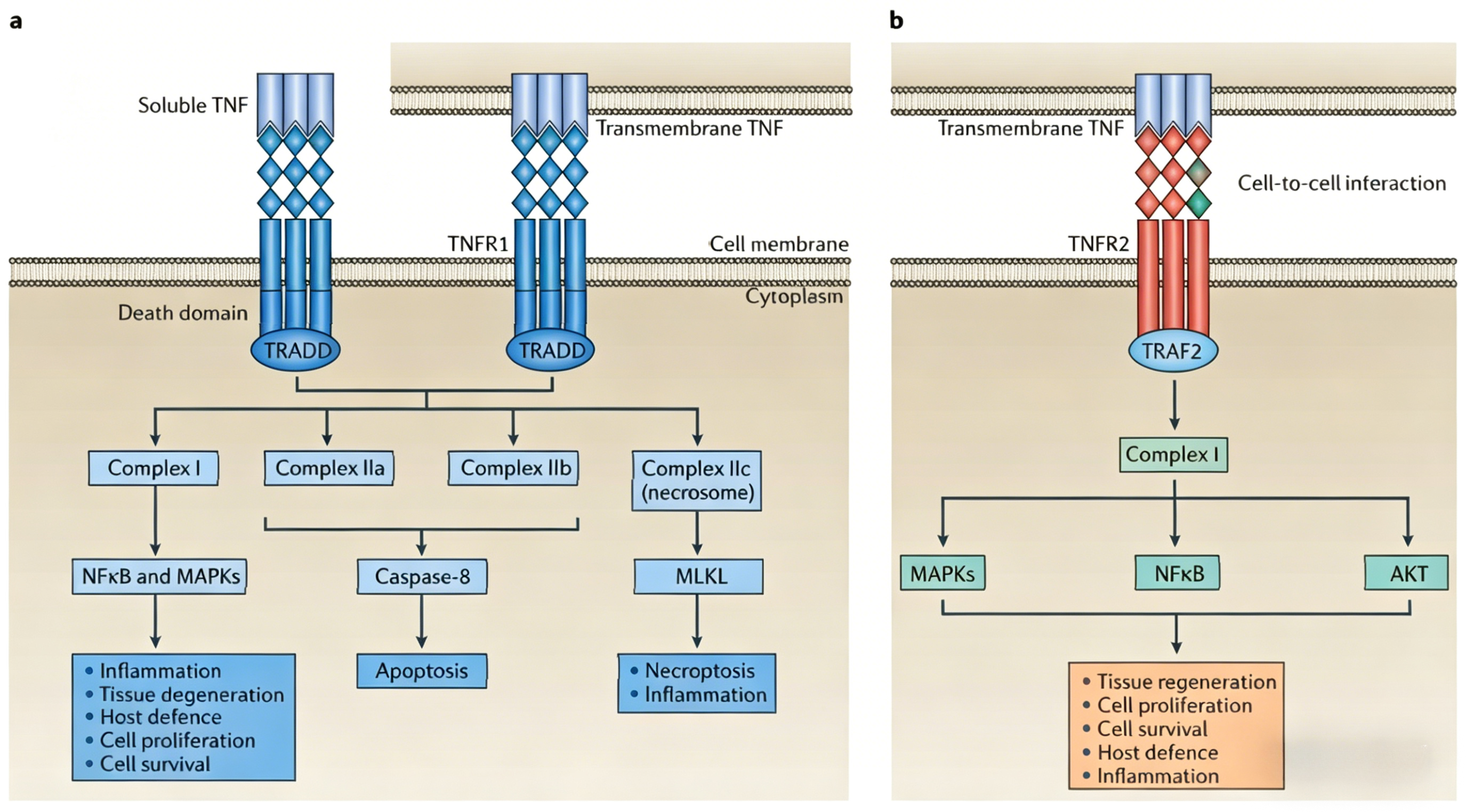
TNFR1-associated death domain protein and the assembly of distinct signaling complexes, termed Complex I, IIa, IIb, and IIc, lead to different functional outcomes. Complex I assembles at the plasma membrane, where activated TNFR1 binds to TRADD, followed by the recruitment and interaction of various components, including RIPK1, TRAF2/5, cIAP1/2, and LUBAC. This signaling pathway results in the expression of NF-κB and MAPK target genes, which play critical roles in inflammation, host defense, cell proliferation, and survival.
Complexes IIa, IIb, and IIc assemble in the cytoplasm. Complex IIa consists of TRADD, RIPK1, TRAF2, cIAP1/2, pro-Caspase-8, and FADD. Complex IIb shares the same composition as IIa but includes RIPK3. The formation of Complexes IIa and IIb activates caspase-8 and leads to apoptosis. Complex IIc is formed by the binding of RIPK1 and RIPK3 before cleavage, which activates mixed lineage kinase domain-like protein (MLKL) through RIPK3-mediated phosphorylation, inducing necroptosis and inflammation.
From a physiological perspective, TNF-α is a critical component of normal immune responses. This protein activates and modulates the immune system, triggering a cascade of inflammatory molecules, including other cytokines and chemokines. Under normal physiological conditions, TNF-α participates in host defense mechanisms against pathogen infections and maintains immune homeostasis. Timely and appropriate expression of TNF-α is essential for immune surveillance and inflammation resolution. However, inappropriate or excessive TNF-α production can be pathogenic, contributing to the development of various diseases.
Abnormal TNF-α expression is closely associated with multiple autoimmune diseases. Rheumatoid arthritis, an autoimmune disease characterized by chronic synovial inflammation and joint destruction, features TNF-α as a central pathogenic factor. Inflammatory bowel diseases, including Crohn's disease and ulcerative colitis, involve TNF-α in chronic intestinal mucosal inflammation. Psoriatic arthritis, an inflammatory arthritis associated with psoriasis, is mediated by TNF-α-induced joint and skin inflammation. Ankylosing spondylitis, a chronic inflammatory disease primarily affecting the spine and sacroiliac joints, involves TNF-α in its pathological process. Psoriasis, a chronic inflammatory skin disorder, is driven by TNF-α-induced keratinocyte hyperproliferation and inflammatory cell infiltration. Non-infectious uveitis, an intraocular inflammatory disease, also involves TNF-α in its pathogenesis.
Given the central role of TNF-α in the pathogenesis of autoimmune diseases, targeting TNF-α to block its binding to TNFRs and inhibit its biological activity has become a key therapeutic strategy. TNF-α inhibitors neutralize the biological activity of both soluble and transmembrane TNF-α, preventing receptor binding and downstream inflammatory signaling. These inhibitors reduce the production of inflammatory cytokines, suppress immune cell activation, and alleviate tissue damage. In diseases such as rheumatoid arthritis, inflammatory bowel disease, psoriatic arthritis, ankylosing spondylitis, psoriasis, and non-infectious uveitis, TNF-α inhibitors have significantly improved clinical symptoms and patient outcomes. The research and development of TNF-α inhibitors provide critical treatment options for patients with autoimmune diseases.
Nanjing UA-Bio Technology Co., Ltd. (UA-Bio) has independently developed "TNF-α Protein, Mouse" (Product Code: UA040083), a high-quality recombinant protein reagent designed for mouse inflammation models, apoptosis studies, and preclinical immune regulation research. This protein is derived from mouse tumor necrosis factor-alpha (TNF-α), a key regulator of inflammatory responses and cell death signaling pathways. It efficiently activates mouse TNFR1/TNFR2 receptor signaling, inducing inflammatory cytokine expression, apoptosis, and immune cell activation. This standardized tool provides stable and reliable support for mouse autoimmune disease model construction, anti-inflammatory drug screening, and tumor immunotherapy research.
| Core Advantages | Detailed Parameters / Functional Description |
|---|---|
| High Purity and Intact Bioactivity | The product utilizes an internationally advanced recombinant expression system and highly standardized purification processes, validated through multi-dimensional quality control to ensure >95% purity, correct native homotrimeric conformation, and full biological functionality. The protein efficiently binds mouse TNFR1/TNFR2 receptors, accurately mimicking the physiological processes of TNF-α-mediated inflammatory signaling activation, apoptosis induction, and immune modulation. |
| Excellent Batch Consistency and Stability | Strict management from gene construction to protein expression and purification, combined with a comprehensive release testing system, ensures consistent biological activity, purity, and long-term stability across batches. This provides reliable quality assurance for long-term and continuous mouse inflammation and immune research. |
| Ideal Tool for Multiple Applications | This protein performs exceptionally in mouse inflammatory cytokine induction analysis, apoptosis model construction, immune cell activation studies, collagen-induced arthritis (CIA) models, inflammatory bowel disease (IBD) models, signaling pathway analysis, and preclinical anti-inflammatory drug evaluation. It is widely applicable to autoimmune disease mechanism exploration, preclinical evaluation of anti-TNF-α biosimilars, tumor immunotherapy research, and drug screening. |
| Complete Solutions and Professional Support | We provide fully validated standard experimental protocols, typical biological activity data, and detailed product analysis certificates to help establish stable and reproducible experimental workflows. Nanjing UA-Bio's professional technical team offers comprehensive support for research design, experimental optimization, and data analysis. |
Nanjing UA-Bio Technology Co., Ltd. is committed to providing cutting-edge, high-quality core reagents and tools for immunology, cell therapy, and innovative drug development. For detailed technical parameters, validation data, or application consultations regarding "TNF-α Protein, Mouse" (Product Code: UA040083), please feel free to contact us.








