





Tumor necrosis factor-alpha (TNF-α) is a key pro-inflammatory cytokine with broad biological functions, playing a central role in immune regulation, inflammatory responses, apoptosis, and the maintenance of tissue homeostasis in both physiological and pathological processes. TNF-α is primarily produced by activated macrophages, monocytes, T cells, and natural killer (NK) cells, among other immune cells, and can also be secreted by certain non-immune cells such as fibroblasts. In normal immune responses, TNF-α coordinates the production of other cytokines, regulates cell survival and death, and participates in inflammatory defense and the maintenance of internal balance. However, excessive or sustained production of TNF-α can lead to chronic inflammation and drive the pathological progression of various autoimmune diseases.
At the molecular level, TNF-α transmits signals by binding to two distinct cell surface receptors, TNFR1 and TNFR2. Soluble and membrane-bound TNF-α, upon binding to TNFR1, primarily recruits adaptor proteins such as TRADD and TRAF2, activating three downstream pathways: the NF-κB pathway, the MAPK pathway, and the caspase-mediated apoptosis pathway. Activation of the NF-κB pathway promotes the expression of inflammation-related genes, the MAPK pathways (such as JNK and p38) participate in cellular stress responses and inflammatory regulation, while the caspase-mediated apoptosis pathway is involved in programmed cell death. Membrane-bound TNF-α binding to TNFR2 tends to activate signals such as PI3K/Akt that promote cell survival and proliferation, and can also regulate angiogenesis, while exerting a modulatory effect on TNFR1-mediated NF-κB signaling. The balance between these two receptor signaling pathways determines the biological effects of TNF-α.
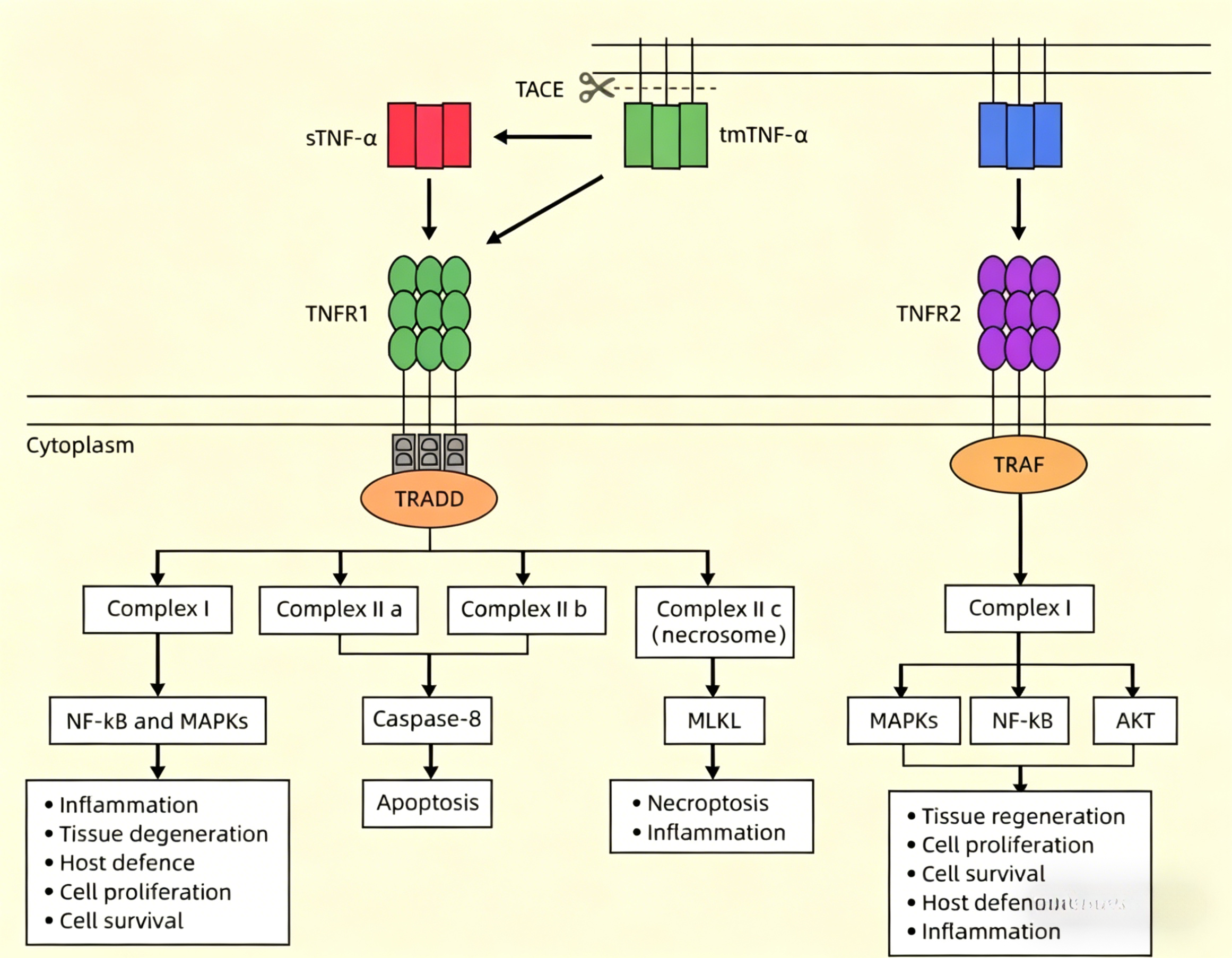
TNF-α plays a central role in a variety of immune-mediated diseases. This protein drives chronic inflammation by activating key signaling pathways such as NF-κB and MAPK, thereby promoting the onset and progression of multiple autoimmune diseases. In rheumatoid arthritis, TNF-α promotes synovial cell proliferation and the production of inflammatory factors, leading to joint destruction. In inflammatory bowel disease, TNF-α mediates chronic inflammatory responses in the intestinal mucosa, contributing to the pathological processes of Crohn's disease and ulcerative colitis. In psoriatic arthritis, TNF-α affects both joints and skin, causing synovial inflammation and epidermal hyperplasia. These diseases are all characterized by chronic inflammation, with excessive expression of TNF-α being a common pathological mechanism.
Targeted inhibition of TNF-α has become a critical strategy for treating autoimmune diseases. The mechanisms of action of TNF-α inhibitors primarily include the following aspects: neutralizing free TNF-α to prevent its binding to cell surface receptors, thereby blocking downstream inflammatory signaling; inducing apoptosis in immune cells that produce TNF-α, reducing the source of inflammatory cells; downregulating the production of other pro-inflammatory cytokines such as interleukin-1, interleukin-6, and chemokines, thereby suppressing the inflammatory cascade; and effectively inhibiting the activation of NF-κB and MAPK signaling pathways by blocking the binding of TNF-α to TNFR1, reducing the release of inflammatory mediators. Blocking TNF-α can effectively suppress downstream inflammatory responses, making it an important therapeutic strategy for controlling symptoms of autoimmune diseases.
TNF-α inhibitors have demonstrated significant efficacy in the treatment of various autoimmune diseases. In patients with rheumatoid arthritis, TNF-α inhibitors can reduce joint swelling and pain, delay the progression of joint damage, and improve quality of life. In Crohn's disease patients, TNF-α inhibitors promote intestinal mucosal healing, reduce fistula formation, and lower the risk of surgery. In psoriatic arthritis patients, TNF-α inhibitors simultaneously improve joint and skin symptoms. The use of these drugs has provided new treatment options for many patients who respond poorly to traditional therapies. The long-term efficacy and safety of TNF-α inhibitors have been widely validated in clinical practice, making them a cornerstone of autoimmune disease treatment.
As a core regulatory factor in autoimmune diseases, the market for TNF-α inhibitors continues to grow. With deepening understanding of the biological functions of TNF-α, new-generation TNF-α inhibitors are under development, including antibodies and fusion proteins with higher selectivity. Researchers are also exploring combination strategies of TNF-α inhibitors with other targeted drugs to enhance efficacy and reduce adverse effects. The introduction of biosimilars has further expanded access to TNF-α inhibitors, enabling more patients to benefit. However, the use of TNF-α inhibitors still faces challenges, including primary or secondary resistance in some patients and increased infection risks. Future research will continue to explore the fine regulatory mechanisms of TNF-α signaling pathways, develop biomarkers for predicting treatment response, and optimize personalized treatment plans.
As a core regulatory factor in autoimmune diseases, the application of TNF-α inhibitors has revolutionized the treatment landscape for many autoimmune conditions. This protein mediates complex signaling networks through two receptors, TNFR1 and TNFR2, producing diverse biological effects such as inflammation, apoptosis, and cell survival. In-depth studies of the protein structure of TNF-α, its receptor-binding mechanisms, and signaling networks will help elucidate its role in physiological and pathological processes.
The "TNF-α Protein, Mouse" (Product Code: UA040173), independently developed by Nanjing UA-Bio Technology Co., Ltd., is a high-quality recombinant protein reagent specifically designed for mouse inflammation models, apoptosis studies, and preclinical immune regulation research. This protein is mouse-derived tumor necrosis factor-alpha (TNF-α), a key regulatory factor in inflammatory responses and cell death signaling pathways. It efficiently activates mouse TNFR1/TNFR2 receptor signaling pathways, induces inflammatory factor expression, apoptosis, and immune cell activation, providing a stable and reliable standardized tool for constructing mouse autoimmune disease models, screening anti-inflammatory drugs, and researching tumor immunotherapy.
| Core Advantages of the Product | Detailed Parameters / Functional Description |
|---|---|
| High Purity and Intact Biological Activity | The product employs an internationally leading recombinant expression system and a highly standardized purification process, validated through multi-dimensional quality control to ensure >95% purity, correct native trimeric conformation, and full biological functionality. The protein efficiently binds to mouse TNFR1/TNFR2 receptors, accurately simulating the physiological processes of TNF-α-mediated inflammatory signaling activation, apoptosis induction, and immune regulation. |
| Exceptional Batch Consistency and Stability | From gene construction and protein expression to purification and quality control, the entire process is strictly managed, combined with a comprehensive release testing system, ensuring each batch of product exhibits stable biological activity, consistent purity, and excellent long-term stability. This provides solid and reliable quality assurance for your long-term and continuous mouse inflammation and immune research. |
| Ideal Tool for Multi-Scenario Applications | This protein performs excellently in various application systems, including mouse inflammatory factor induction analysis, apoptosis model construction, immune cell activation studies, collagen-induced arthritis (CIA) models, inflammatory bowel disease (IBD) models, signaling pathway analysis, and preclinical evaluation of anti-inflammatory drugs. It is widely applicable to research needs such as autoimmune disease mechanism exploration, preclinical evaluation of anti-TNF-α biosimilars, tumor immunotherapy research, and drug screening. |
| Complete Solutions and Professional Support | We provide thoroughly validated standard experimental protocols, typical biological activity data, and detailed product analysis certificates to help you quickly establish stable and reproducible experimental workflows. The professional technical team at Nanjing UA-Bio offers comprehensive technical consultation and support for your research design, experimental optimization, and data analysis. |
Nanjing UA-Bio Technology Co., Ltd. is committed to providing cutting-edge, high-quality core reagents and tools for immunology, cell therapy, and innovative drug research and development. For detailed technical parameters, validation data, or specific application consultations regarding "TNF-α Protein, Mouse" (Product Code: UA040173), please feel free to contact us.








