





In 1989, researchers collectively named substances that could promote vascular endothelial cell permeability as vascular endothelial growth factor. Initially, VEGF's primary functions included promoting vascular endothelial cell proliferation, angiogenesis, and increased vascular permeability. With further research, it was discovered that VEGF also has immune regulation, neuroprotection, tissue repair, and other functions. The VEGF family of proteins includes VEGF-A, VEGF-B, VEGF-C, VEGF-D, VEGF-E, VEGF-F, and placental growth factor, among others. VEGF-A protein is the most extensively studied. The precursor mRNA transcribed from the VEGF-A gene undergoes alternative splicing to form VEGF-A proteins with different expression regions, including VEGF121, VEGF145, VEGF165, VEGF110, VEGF183, VEGF189, and VEGF209. Among these, VEGF165 and VEGF121 are expressed in most tissues, while VEGF206 is rarely expressed in normal tissues.
VEGF165 protein is one of the most representative members of the VEGF family, consisting of 165 amino acids with a molecular weight of approximately 45 kilodaltons, existing as a homodimer. This protein contains receptor-binding domains and heparin-binding domains, enabling simultaneous binding to VEGFR and neuropilin receptors. VEGF165 is widely expressed in various tissues and is a critical regulator of normal angiogenesis and pathological neovascularization. Since VEGF is involved in the development of many diseases, its expression and mRNA are found in various malignancies, particularly in areas with abundant tumor vascularization, making it a primary target for drug development. After production, VEGF primarily acts through paracrine or autocrine pathways to mediate angiogenesis, promoting cell proliferation and metastasis. These biological functions must be achieved through binding with its receptors.
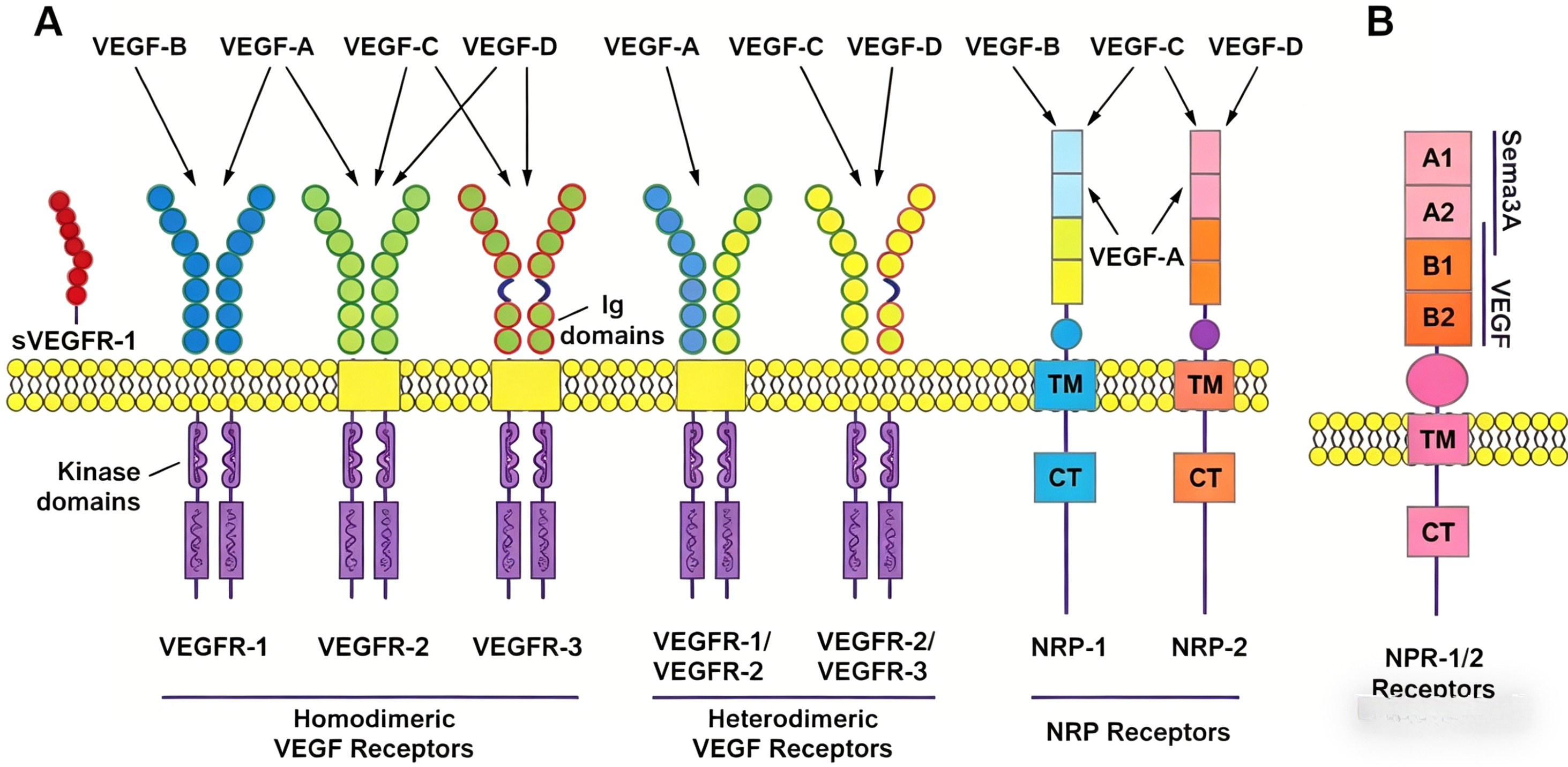
VEGFR belongs to the tyrosine kinase receptor family, with three main receptors currently associated with VEGF: VEGFR1, VEGFR2, and VEGFR3. VEGFR1 primarily regulates the migration of monocytes and macrophages, VEGFR2 is the main signal-transducing receptor for VEGF-induced angiogenesis and is highly expressed in vascular endothelial cells, and VEGFR3 is mainly involved in lymphangiogenesis. In addition to VEGFR, neuropilin receptors can also selectively bind with VEGF. VEGF165 can bind with VEGFR2 and neuropilin receptor-1 to form complexes, enhancing the signaling efficiency of VEGFR2. The binding specificity of different VEGF family members with their receptors determines the differences in their biological functions.
Tumor cells highly express VEGF165 and VEGF120, which activate the VEGFR signaling pathway upon binding with VEGFR. VEGF binding with VEGFR1 activates the transcription factor NF-κB signaling pathway, thereby inhibiting dendritic cell maturation and weakening anti-tumor immune responses. VEGFR2 activates the ERK signaling pathway, inducing endothelial cell proliferation and promoting neovascularization. VEGFR2 also activates the PI3K/AKT signaling pathway, altering vascular permeability and maintaining endothelial cell activity. Additionally, VEGFR2 activates the p38 signaling pathway, inducing endothelial cell migration. VEGF165 further binds with neuropilin receptors on epithelial cells, enhancing the intensity of VEGFR2-mediated signaling pathways. The various types of VEGF secreted by tumor cells can bind with the three VEGFRs on endothelial cell membranes, activating downstream signaling pathways and playing a crucial role in angiogenesis, which is essential for tumor nutrient uptake, oxygen supply, infiltration, and metastasis.
In addition to promoting angiogenesis, VEGF165 has significant immune regulatory functions. This protein can inhibit the maturation and differentiation of dendritic cells, reducing their antigen-presenting capacity. VEGF165 also promotes the expansion of myeloid-derived suppressor cells, enhancing their immunosuppressive activity. In the tumor microenvironment, VEGF165 inhibits T cell activation, proliferation, and infiltration, weakening anti-tumor immune responses. VEGF165 can also induce the recruitment and expansion of regulatory T cells, further enhancing the immunosuppressive microenvironment. These immune regulatory functions make VEGF165 a key molecule linking angiogenesis and immune suppression. Targeting VEGF165 can not only inhibit angiogenesis but also reverse the immunosuppressive state of the tumor microenvironment, enhancing anti-tumor immune responses.
Given the central role of VEGF165 in tumor angiogenesis and immune suppression, targeting VEGF165 has become an important strategy in anti-tumor therapy. Anti-VEGF antibodies can neutralize free VEGF165, preventing its binding with VEGFR and inhibiting the activation of downstream signaling pathways. Bispecific antibodies targeting VEGF and immune checkpoint molecules can achieve synergistic effects of anti-angiogenesis and immune activation. In ophthalmic diseases, anti-VEGF drugs can inhibit the survival and proliferation of vascular endothelial cells, thereby suppressing neovascularization, reducing vascular permeability, and minimizing vascular leakage. These therapeutic strategies have shown promising efficacy in tumors and ophthalmic diseases. As a key target for drug development, research and applications of VEGF165 inhibitors will continue to expand.
Nanjing UA-Bio Technology Co., Ltd. (UA-Bio) has independently developed "VEGF165 Protein, Human" (Product Code: UA040019), a high-quality recombinant protein reagent designed for angiogenesis mechanism research, tumor microenvironment exploration, and regenerative medicine applications. This protein is human vascular endothelial growth factor 165 (VEGF165), the most representative splice variant of the VEGF family, capable of efficiently activating the VEGFR1/VEGFR2 receptor signaling pathway to promote endothelial cell proliferation, migration, and increased vascular permeability. It provides a stable and reliable standardized tool for vascular biology research, anti-angiogenic drug development, and ischemic disease treatment.
| Core Advantages | Detailed Parameters / Functional Description |
|---|---|
| High Purity and Complete Biological Activity | The product uses an internationally advanced eukaryotic expression system and highly standardized purification processes, validated by multi-dimensional quality control to ensure >95% purity, correct native dimer conformation, and complete biological functionality. The protein efficiently binds to human VEGFR1/VEGFR2 receptors, accurately mimicking the endothelial cell proliferation, vascular permeability regulation, and angiogenic signaling mediated by VEGF165 under physiological conditions. |
| Excellent Batch Consistency and Stability | From gene construction and protein expression to purification and quality control, the entire process is strictly managed, combined with a comprehensive release testing system to ensure each batch of product has stable biological activity, consistent purity, and excellent long-term stability. This provides a solid and reliable quality guarantee for long-term and continuous angiogenesis and tumor research. |
| Ideal Tool for Multiple Applications | This protein performs excellently in various application systems, including endothelial cell proliferation and migration assays, angiogenesis experiments (tube formation), tumor angiogenesis models, ischemic disease animal models, organoid vascularization construction, and signaling pathway analysis. It is widely suitable for anti-VEGF/VEGFR drug screening (e.g., evaluation of biosimilar activities like bevacizumab), regenerative medicine research, tumor microenvironment mechanism exploration, and drug activity evaluation. |
| Complete Solutions and Professional Support | We provide thoroughly validated standard experimental protocols, typical biological activity data, and detailed product analysis certificates to help you quickly establish stable and reproducible experimental processes. Nanjing UA-Bio's professional technical team offers comprehensive support for research design, experimental optimization, and data analysis. |
Nanjing UA-Bio Technology Co., Ltd. is committed to providing cutting-edge, high-quality core reagents and tools for immunology, cell therapy, and innovative drug development. For detailed technical parameters, validation data, or specific application inquiries regarding "VEGF165 Protein, Human" (Product Code: UA040019), please feel free to contact us.








