





Mesothelin is a glycosylphosphatidylinositol (GPI)-anchored cell surface glycoprotein. The MSLN gene is located at 16p13.3 and encodes the MSLN precursor protein, which is hydrolyzed to produce two protein products: megakaryocyte-potentiating factor (MPF) and mesothelin. The precursor protein consists of an N-terminal signal peptide, mature MPF, a furin cleavage site, mature MSLN, and a GPI-anchoring sequence. Upon reaching the cell membrane surface, MSLN is anchored to the membrane via GPI. The precursor protein is cleaved by furin or other applicable enzymes to generate soluble MPF and mature MSLN. Mature MSLN can be shed from the cell membrane by the ADAM17 convertase, forming soluble mesothelin-related peptides. MSLN expression is limited in normal tissues but is overexpressed in several solid tumors, such as ovarian cancer, breast cancer, colorectal cancer, and pancreatic cancer, and is associated with lower survival rates, making it an ideal target for tumor-specific therapy. PE-labeled MSLN Fc and Avi-tagged proteins can be used to quantitatively detect MSLN protein expression levels and binding activity, providing technical tools for solid tumor research.
The protein that interacts with MSLN in vivo is CA125/MUC16, a member of the mucin family, which is expressed in ovarian cancer and malignant mesothelioma and elevated in the serum of ovarian cancer patients. CA125/MUC16 was initially used as a biomarker for ovarian cancer. The interaction between CA125/MUC16 and MSLN mediates heterotypic cell adhesion and is considered a potential mechanism for peritoneal metastasis in ovarian tumors. This interaction provides a molecular basis for the spread and colonization of tumor cells in the peritoneal cavity, and targeting this interaction may be an effective strategy to inhibit tumor metastasis. PE-labeled MSLN Fc and Avi-tagged proteins can be used to study the binding properties of MSLN and CA125/MUC16, providing screening tools for the development of therapeutic drugs that block this interaction.
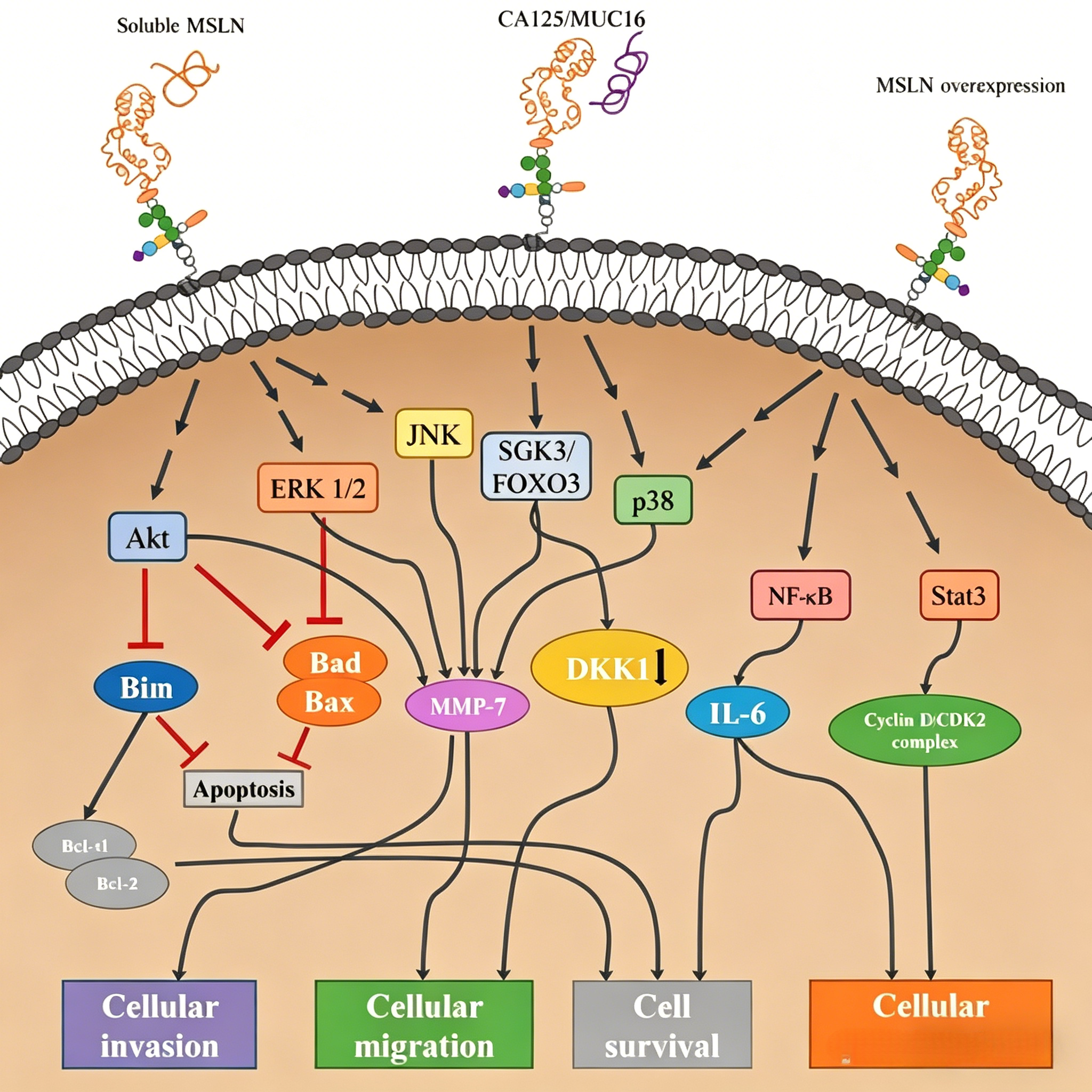
The exact role of MSLN remains unclear. In animal models, MSLN knockout mice exhibit normal development and reproductive capacity, indicating that MSLN function is not essential for life. However, compared to wild-type mice, MSLN knockout mice show inhibited growth of cancer cells in the peritoneal cavity, while supplementation with MSLN protein or MPF promotes lung cancer growth, suggesting that MSLN may promote cancer growth and metastasis in vivo. Existing evidence indicates that MSLN may play a potential role in tumor cell adhesion, progression, proliferation, survival, and chemotherapy resistance. Soluble or cell surface MSLN can trigger the Akt, ERK1/2, and JNK signaling pathways, inhibit apoptosis, and promote cell survival. The Akt, ERK1/2, and JNK pathways can increase the expression of matrix metalloproteinase 7 (MMP7), thereby enhancing cell migration and invasion rates. Overexpression of MSLN also leads to the activation of NF-κB and STAT3 signaling, promoting cell survival and proliferation.
The downstream effects of MSLN-activated Akt and ERK1/2 signaling include the stimulation of Bcl-xL and Bcl-2 expression and the inhibition of Bim, Bad, and Bax genes, thereby suppressing apoptosis and promoting cell survival. The MMP7 pathway can also be triggered via the SGK3/FOXO3 and p38 pathways. SGK3/FOXO3 signaling has been shown to downregulate Dkk1, increasing cell migration. Overexpression of MSLN also activates p38 signaling, as well as NF-κB and STAT3 signaling. The downstream effects of NF-κB include increased IL-6 expression, promoting cell survival and proliferation, while STAT3 signaling downstream promotes the formation of cyclin E and CDK2 complexes, driving cell proliferation by acting on the cell cycle. The synergistic effects of these signaling pathways make MSLN a critical driver of tumor progression. PE-labeled MSLN Fc and Avi-tagged proteins can be used to study the interaction between MSLN and downstream signaling molecules, providing quantitative analysis tools for mechanistic research.
Anetumab ravtansine is an antibody-drug conjugate (ADC) consisting of a single-chain antibody linked to the microtubule inhibitor DM4 via a linker. Upon binding to MSLN, DM4 is internalized and binds to tubulin, disrupting microtubule assembly, inhibiting the cell cycle, and leading to cell death. This therapeutic strategy leverages the specificity of antibodies to recognize MSLN, delivering cytotoxic drugs precisely to MSLN-positive tumor cells, improving efficacy and reducing systemic toxicity. Clinical studies have shown that anetumab ravtansine exhibits certain antitumor activity in patients with MSLN-positive solid tumors. PE-labeled MSLN Fc and Avi-tagged proteins can be used to evaluate the binding capacity of antibody-drug conjugates to MSLN antigens and validate their functional activity.
Chimeric antigen receptor (CAR) therapy utilizes various host immune cells to induce tumor-targeted responses by designing structures that recognize target antigens. In acute myeloid leukemia (AML), CAR-NK cells and CAR-T cells have been studied. Upon recognizing target antigens, NK and T cells are activated and induce cytotoxic mechanisms by secreting perforin and granzymes, leading to tumor cell lysis. Although MSLN has long been considered a target for solid tumors, recent studies have found that MSLN is overexpressed in AML, suggesting its potential as a marker for other hematologic malignancies. Bispecific T-cell engagers recruit T cells to tumor cells by binding to tumor-associated antigens, while the other end of the molecule binds to CD3 on T cells. Upon binding, T cells are activated and kill tumor cells through the same mechanism as CAR-T cell lysis.
Nanjing UA-Bio Technology Co., Ltd. (UA-Bio) has independently developed the "PE-Labeled MSLN Fc&Avi Tag Protein, Human" (Product Code: UA011284), a high-performance fluorescent-labeled probe specifically designed for mesothelin (MSLN)-targeted research and solid tumor immunotherapy evaluation. This protein consists of the human MSLN extracellular domain fused with an Fc tag and an Avi tag, labeled with PE fluorescence, enabling efficient binding to anti-MSLN antibodies or affinity ligands. It serves as a stable and reliable standardized tool for CAR-T cell therapy evaluation, antibody drug screening, and solid tumor biomarker research.
| Core Advantages | Detailed Parameters / Functional Description |
|---|---|
| High Purity and Intact Bioactivity | The product is produced using an internationally leading eukaryotic expression system and highly standardized purification processes, validated by multi-dimensional quality control to ensure >95% purity and correct native conformation (retaining intact glycosylation modifications). The Fc tag helps maintain protein stability and proper folding, while the Avi tag supports biotinylation applications. The PE labeling process is optimized to ensure high labeling efficiency while maintaining high-affinity binding to antibodies, accurately simulating the antigenic properties of MSLN on the surface of mesothelioma, pancreatic cancer, and other solid tumor cells. |
| High-Brightness PE Labeling | The optimized PE fluorescence labeling ratio ensures stable fluorescent dye labeling per MSLN protein molecule, emitting bright orange-red fluorescence signals (emission peak ~575 nm) under 488 nm excitation, suitable for flow cytometry (FACS) detection, providing high sensitivity for the evaluation and precise quantification of MSLN-targeted molecules. |
| Excellent Batch Consistency and Stability | Strict quality control is implemented throughout the processes of protein expression, labeling, and purification, combined with a comprehensive release testing system, ensuring stable binding activity, consistent fluorescence intensity, and excellent long-term stability for each batch of products. This provides reliable quality assurance for long-term and continuous MSLN-targeted research. |
| Ideal Tool for Multiple Applications | This protein performs excellently in various application systems, including CAR-T cell positivity rate detection by flow cytometry, anti-MSLN antibody/antagonist screening, competitive binding assays, biomarker detection and analysis for mesothelioma/pancreatic cancer and other solid tumors, and flow cytometry. It is widely applicable to MSLN-targeted CAR-T cell therapy development, solid tumor diagnostic tool research, and drug activity evaluation. |
| Complete Solutions and Professional Support | We provide fully validated standard experimental protocols, typical flow cytometry data, and detailed result interpretation guidelines to help you establish stable and reproducible MSLN-targeted molecule detection processes. The professional technical team at Nanjing UA-Bio offers comprehensive support for research design, experimental optimization, and data analysis. |
Nanjing UA-Bio Technology Co., Ltd. is committed to providing cutting-edge, high-quality core reagents and tools for immunology, cell therapy, and innovative drug development. For detailed technical parameters, validation data, or specific application inquiries regarding the "PE-Labeled MSLN Fc&Avi Tag Protein, Human" (Product Code: UA011284), please feel free to contact us.








