





Siglecs are a family of receptors that bind to sialylated glycans, belonging to single-pass transmembrane type I membrane proteins. Their extracellular regions consist of 2 to 17 Ig domains, with the N-terminal containing a V-set Ig domain that binds sialic acid and a variable number of C2-set Ig domains. Currently, 15 human and 9 murine Siglec molecules have been identified. Siglec receptors can be further divided into evolutionarily conserved receptors and rapidly evolving CD33-related receptors. Based on differences in intracellular signaling domains, Siglec receptors can be categorized into inhibitory, activating, and non-signaling types. Inhibitory Siglec receptors contain immunoreceptor tyrosine-based inhibitory motifs (ITIMs) and immunoreceptor tyrosine-based switch motifs (ITSMs), which regulate intracellular signaling through the involvement of SHP1 and SHP2 phosphatases, suppressing immune cell activation in a manner similar to PD-1/PD-L1. FITC-labeled Siglec-2 His-tag protein can be used for quantitative detection of Siglec-2 protein expression levels and binding activity, providing a technical tool for immune checkpoint research.
Many studies have reported changes in the expression of sialylated glycans in cancer and the tumor microenvironment. Tumor cells are often hypersialylated, producing ligands for inhibitory Siglec receptors on immune cells. Due to the overexpression of sialyltransferases, pancreatic ductal adenocarcinoma cells exhibit increased sialylation, which is recognized by Siglec-7 and Siglec-9 on myeloid cells and polarizes monocytes toward a pro-tumor macrophage phenotype. Similarly, upregulation of Siglec-9 ligands has been confirmed in colorectal cancer, prostate cancer, breast cancer, and non-small cell lung cancer. Genome-wide screening has identified sialylated CD43 as a highly specific ligand for Siglec-7, inhibiting NK cell-mediated killing of leukemia cells. CD24 is overexpressed in many cancers and, through its interaction with Siglec-10 on tumor-associated macrophages, becomes a key mechanism of immune evasion in certain ovarian and breast cancers. FITC-labeled Siglec-2 His-tag protein can be used to study the interaction between Siglec-2 and its ligands, providing quantitative data for target validation.
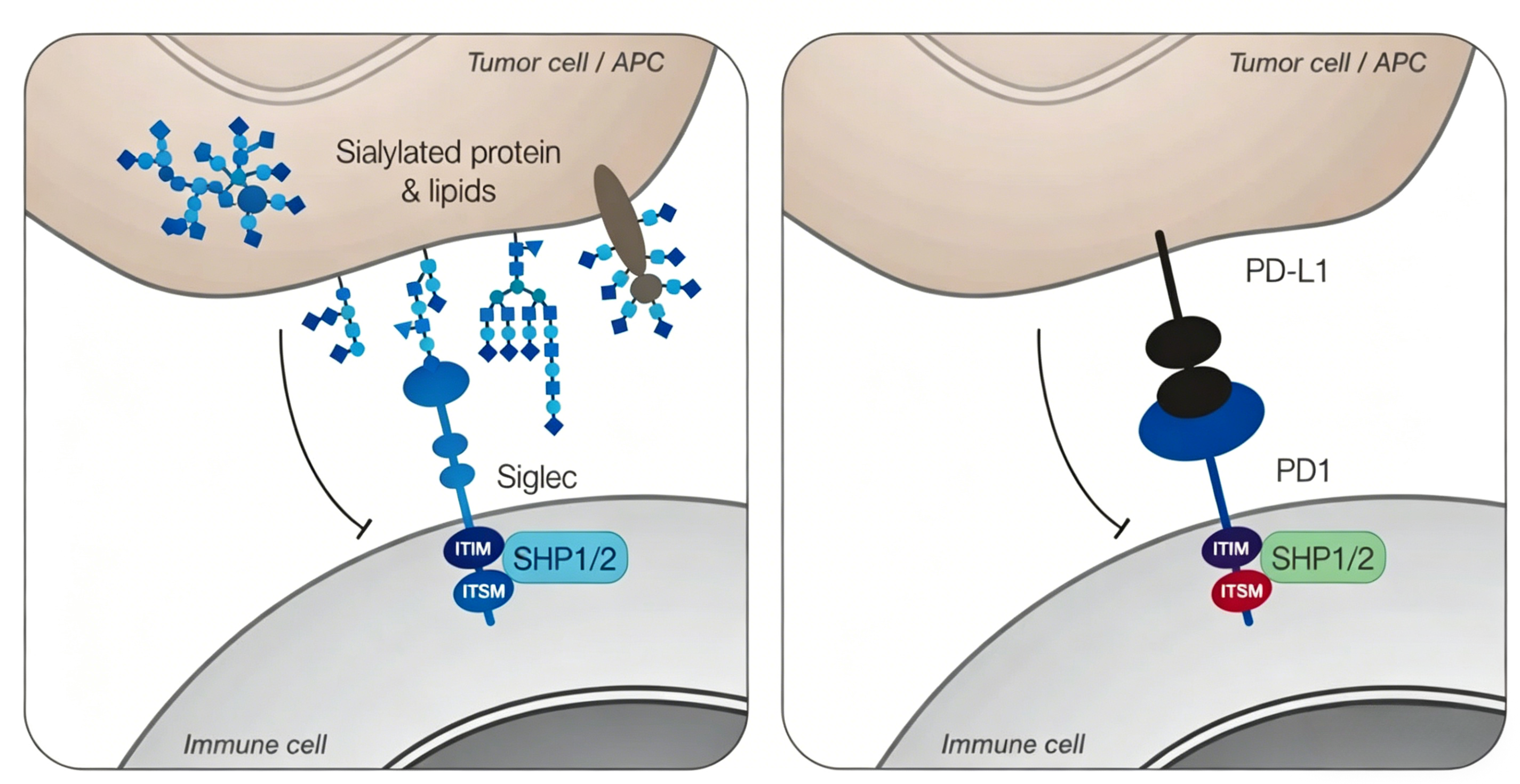
Siglec receptors are widely expressed on various cells of the immune system. Innate immune cells, particularly macrophages, highly express multiple Siglec receptors, including Siglec-3, Siglec-5, Siglec-7, Siglec-9, and Siglec-10. The binding of sialylated glycans on pancreatic cancer cells to Siglec-7 and Siglec-9 can induce a pro-tumor macrophage phenotype. The interaction between sialylated CD24 on cancer cells and Siglec-10 on tumor-associated macrophages inhibits phagocytosis. Siglec-15 on macrophages has also been shown to suppress T cell-mediated anti-tumor immunity. Dendritic cells are critical mediators of anti-tumor immune responses. Studies have demonstrated that murine Siglec-G on dendritic cells regulates antigen processing, while murine Siglec-E is involved in antigen uptake and presentation to CD4-positive T cells. Sialylated glycans on human monocyte-derived dendritic cells inhibit immune cell activation through Siglec-7 and Siglec-9.
NK cells are important innate lymphocytes. Research shows that Siglec-7 and Siglec-9 on NK cells can interact with cancer-associated sialylated glycans, contributing to the suppression of anti-tumor immune activation. The insertion of synthetic sialylated glycans into tumor cell membranes dose-dependently inhibits NK cell-mediated killing and degranulation. Siglec-7 interacts with sialylated PSGL-1 on multiple myeloma cells, suppressing NK cell-mediated killing of myeloma cells. In renal cancer cells, the overexpression of ganglioside Siglec-7 ligands inhibits NK cell activation. Sialylated MUC16 binds to human Siglec-9 and inhibits NK cells in ovarian cancer. Studies have found that Siglec-9 is upregulated on blood and tumor-infiltrating T cells in cancer patients, particularly on PD-1-positive T cells with tumor-specific exhaustion. Reduced Siglec-9 ligands on tumor cells significantly enhance T cell-mediated effector functions and tumor cell killing.
Recent studies suggest that the interaction between sialylated glycans in the tumor microenvironment and Siglec receptors on tumor-infiltrating immune cells may represent a novel immune checkpoint and a potential new target for cancer immunotherapy. Sialylated glycan-Siglec interactions have been shown to contribute to an immunosuppressive tumor microenvironment by inducing a pro-tumor phenotype in tumor-associated macrophages, suppressing NK cell and neutrophil activation, reducing dendritic cell maturation and antigen presentation, and inhibiting T cell responses. Siglec-5 and Siglec-10 are also upregulated upon acute T cell activation and may influence anti-tumor immunity. These findings highlight the central role of Siglec receptors in tumor immune suppression and provide a theoretical basis for developing new immunotherapeutic strategies. FITC-labeled Siglec-2 His-tag protein can be used to assess Siglec receptor expression levels on different immune cell subsets, offering a tool for immune monitoring.
Nanjing UA-Bio Technology Co., Ltd. has independently developed the "FITC-Labeled Siglec-2 His Tag Protein, Human" (Catalog No.: UA011265), a high-performance fluorescently labeled probe specifically designed for B cell biology research and targeted drug development. Siglec-2 (also known as CD22) is a B cell-specific immunoglobulin-like lectin that plays a key regulatory role in B cell activation, proliferation, and signaling. It is an important therapeutic target for autoimmune diseases and B cell malignancies (e.g., acute lymphoblastic leukemia, non-Hodgkin lymphoma). This protein consists of the human Siglec-2 extracellular domain with a His tag and is labeled with FITC. It efficiently binds to anti-CD22 antibodies or affinity ligands, providing a stable and reliable standardized tool for applications such as CAR-T cell therapy evaluation, antibody drug screening, and B cell immune monitoring.
| Core Advantages | Detailed Parameters / Functional Description |
|---|---|
| High Purity and Intact Biological Activity | The product is produced using an internationally advanced eukaryotic expression system and a highly standardized purification process. It undergoes multi-dimensional quality control validation to ensure >95% purity and correct native conformation (retaining intact glycosylation and sialic acid-binding functionality). The FITC labeling process is optimized to maintain high labeling efficiency while preserving Siglec-2's high-affinity binding to antibodies, accurately mimicking its antigenic properties on B cell surfaces under physiological conditions.-- |
| High-Brightness FITC Labeling | The optimized FITC labeling ratio ensures stable fluorescent dye conjugation per Siglec-2 protein molecule, producing bright green fluorescence signals under 488 nm excitation. It is suitable for flow cytometry (FACS) and fluorescence microscopy, providing reliable support for the evaluation and precise quantification of Siglec-2-targeting molecules.-- |
| Excellent Batch-to-Batch Consistency and Stability | Strict management is implemented throughout the protein expression, labeling, and purification processes, combined with a comprehensive release testing system. This ensures consistent binding activity, uniform fluorescence intensity, and excellent long-term stability across batches, providing solid quality assurance for long-term and continuous Siglec-2-targeting research. |
| Ideal Tool for Multi-Scenario Applications | This protein performs exceptionally well in various applications, including CAR-T cell positivity rate detection by flow cytometry, anti-CD22 antibody/antagonist screening, competitive binding assays, B cell subset analysis, and flow cytometry. It is widely applicable to CD22-targeted CAR-T cell therapy development (e.g., for acute lymphoblastic leukemia), autoimmune disease research, and drug activity evaluation. |
| Comprehensive Solutions and Professional Support | We provide thoroughly validated standard protocols, representative flow cytometry data, and detailed result interpretation guidelines to help you quickly establish stable and reproducible Siglec-2-targeting molecule detection workflows. Nanjing UA-Bio's professional technical team offers full-cycle support for research design, experimental optimization, and data analysis. |








