





CD22, also known as Siglec-2, is a key member of the sialic acid-binding immunoglobulin-like lectin family and belongs to the type I transmembrane protein family with a molecular weight of 140 kDa. The human CD22 gene is located on the long arm of chromosome 19, encoding a protein with an extracellular domain containing seven Ig domains. The outermost V-set Ig domain plays a primary role in binding α2,6-linked sialic acid ligands. The intracellular domain of CD22 includes immunoreceptor tyrosine-based inhibitory motifs (ITIMs) and immunoreceptor tyrosine-based activation motifs (ITAMs). CD22 is ubiquitously expressed in normal B cells and B-cell malignancies, primarily found on mature B cells. As a cell surface adhesion molecule that regulates B-cell activation, it helps control the sensitivity of B cells to antigen responses. CD22 expression is specific to B cells and is developmentally regulated in both mice and humans. FITC-labeled Siglec-2/CD22 Fc chimera protein can be used to quantitatively assess CD22 protein expression levels and binding activity, providing a technical tool for B-cell immunotherapy research.
CD22 can interact with sialic acid-containing cells, including T cells, B cells, neutrophils, monocytes, and red blood cells. The sialic acid ligands on B-cell surfaces that bind to the extracellular ligand-binding domain of CD22 are referred to as cis-ligands, while ligands on other cell surfaces are trans-ligands. CD22 binds to cis-ligands on B-cell surfaces and engages in trans-interactions with ligands on other cells, soluble glycoproteins, or cell-associated antigens. Cis-ligands are the primary binding partners of CD22 and serve as critical regulators of its activity. Trans-interactions may mediate cell-cell crosslinking, control B-cell adhesion and migration, and play a significant role in T-cell signaling. Most CD22 molecules on B-cell surfaces are in a masked state, limiting their interaction with trans-ligands unless cells undergo specific pretreatment to expose exogenous sialic acid binding sites. FITC-labeled Siglec-2/CD22 Fc chimera protein can be used to study CD22-ligand interactions, providing quantitative data support for target validation.
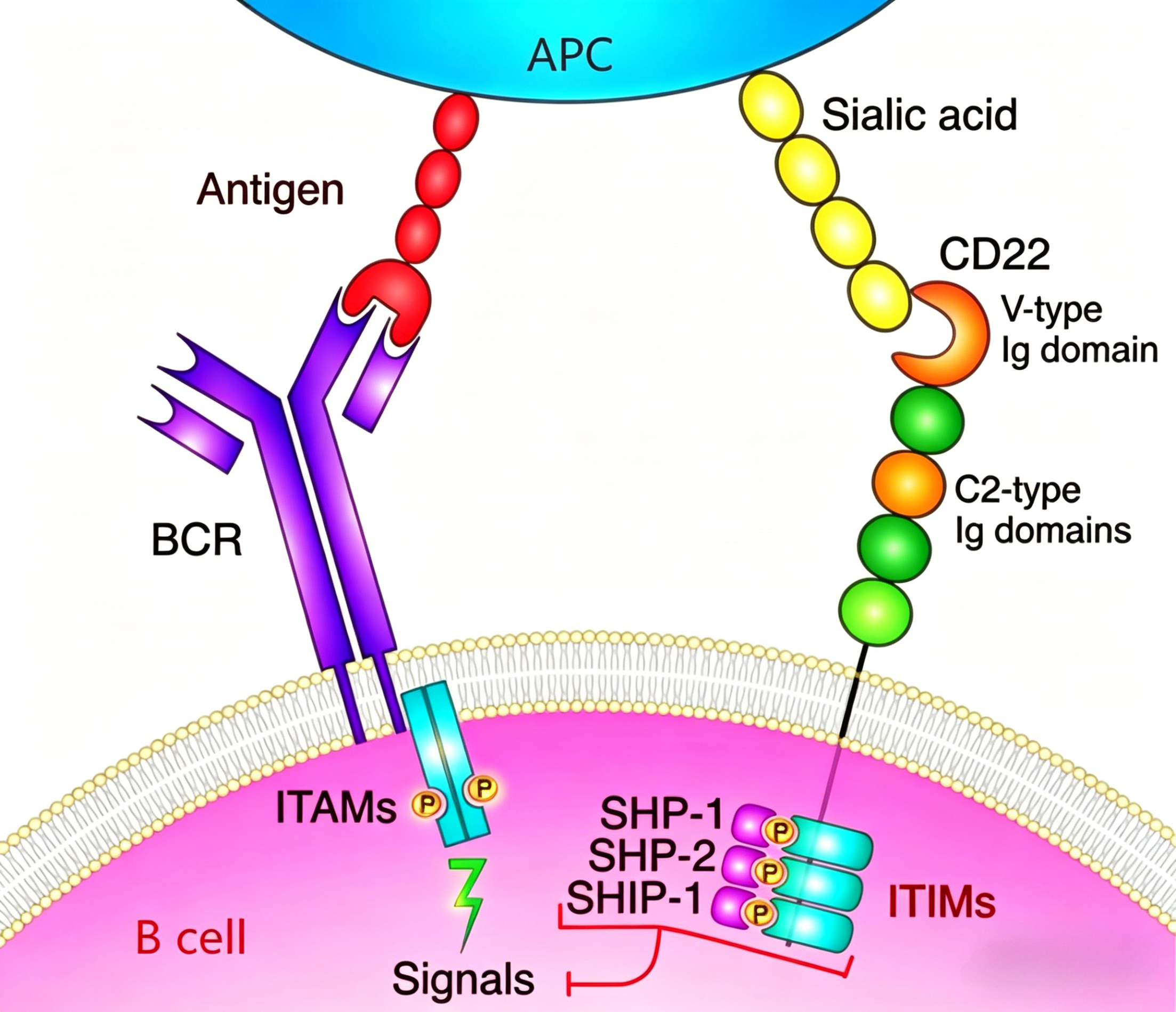
As a co-receptor of the B-cell receptor (BCR), CD22 inhibits BCR signaling through antigen-induced crosslinking with the BCR, triggering CD22 phosphorylation and subsequent dephosphorylation and inactivation of downstream signaling proteins. The regulatory capacity of CD22 on B-cell signaling depends on its proximity to the BCR and is also controlled by extracellular interactions. Upon crosslinking with the BCR, CD22 clusters into lipid rafts, where the tyrosine kinase Lyn phosphorylates tyrosine residues on CD22. These phosphorylated residues then become binding sites for SH2 domain-containing downstream signaling molecules, which further activate other signaling pathways. For example, the Src homology phosphatase 1 (SHP-1) primarily dephosphorylates the BCR, downregulating BCR signaling and modulating calcium ion flux. SHP-1 targets include CD19 and SLP65/B-cell linker protein. This negative regulatory mechanism is essential for maintaining B-cell homeostasis and preventing autoimmune responses.
CD22 suppresses autoimmune responses by crosslinking with the BCR and inhibiting B-cell activation in response to self-antigens, thereby preventing the activation of autoreactive B cells. Impaired CD22 expression or function plays a significant role in the pathogenesis of autoimmune diseases such as systemic lupus erythematosus (SLE) and rheumatoid arthritis (RA). SLE is a chronic systemic autoimmune disease characterized by polyclonal B-cell hyperactivation, autoantibody production, and immune complex deposition, leading to multi-organ damage. CD22-deficient mice exhibit B-cell hyperresponsiveness to receptor signaling, increased calcium influx upon BCR engagement, and elevated serum IgG anti-double-stranded DNA antibody titers. As a key molecule limiting B-cell activation, CD22 provides a promising therapeutic target for addressing B-cell dysregulation in autoimmune diseases. FITC-labeled Siglec-2/CD22 Fc chimera protein can be used to evaluate CD22 expression levels on B cells from autoimmune patients, serving as a tool for disease monitoring.
CD22 is exclusively expressed on mature B cells and is retained in most cases during the transformation of normal B cells into malignant cells. Data indicate that approximately 60% to 80% of B-cell lymphomas and leukemias express CD22. In recent years, CD22-targeted CAR-T cell therapy has emerged as a key strategy for treating B-cell malignancies. Autologous enriched T cells genetically modified with retroviral vectors to express chimeric antigen receptors (CARs) targeting both CD19 and CD22 have been used to treat acute lymphoblastic leukemia (ALL), advancing the field of CAR-T cell therapy. Radio-labeled CD22 monoclonal antibodies exhibit high sensitivity in the diagnosis and staging of B-cell lymphomas. FITC-labeled Siglec-2/CD22 Fc chimera protein can assess the binding capacity of CAR-T cells and antibody drugs to CD22 antigens, validating their functional activity.
Nanjing UA-Bio Technology Co., Ltd. (UA-Bio) has independently developed "Alexa Fluor 647-Labeled Siglec-2/CD22 Fc Chimera Protein, Human" (Catalog No.: UA011267), a high-performance far-red fluorescent probe designed for B-cell biology research and multicolor flow cytometry analysis. Siglec-2 (CD22) is a B-cell-specific immunoglobulin-like lectin that plays a critical regulatory role in B-cell activation, proliferation, and signaling, serving as an important therapeutic target for autoimmune diseases and B-cell malignancies (e.g., acute lymphoblastic leukemia, non-Hodgkin lymphoma). This protein is a human Siglec-2 extracellular domain fused to a human IgG Fc fragment and labeled with Alexa Fluor 647, enabling efficient binding to anti-CD22 antibodies or affinity ligands. It provides a stable and reliable standardized tool for CAR-T cell therapy evaluation, antibody drug screening, and multiparameter B-cell immune monitoring.
| Core Product Advantages | Detailed Parameters / Functional Description |
|---|---|
| High Purity and Intact Bioactivity | The product employs an advanced eukaryotic expression system and highly standardized purification processes, validated by multidimensional quality control to ensure >95% purity and correct native conformation (retaining intact glycosylation and sialic acid-binding functionality). The Fc chimera format enhances protein stability and proper folding, while the Alexa Fluor 647 labeling process is optimized to maintain high labeling efficiency without compromising Siglec-2's high-affinity antibody binding, accurately mimicking its antigenic properties on B-cell surfaces under physiological conditions. |
| Far-Red Fluorescence and Multicolor Compatibility | Labeled with Alexa Fluor 647, a fluorophore offering high brightness, excellent photostability, and low background noise. With excitation/emission peaks at ~650 nm/~665 nm in the far-red region, it avoids spectral overlap with common fluorophores like FITC and PE, supporting multicolor flow cytometry and multi-channel fluorescence microscopy imaging. |
| Exceptional Batch Consistency and Stability | Rigorous quality control from protein expression to labeling and purification ensures consistent binding activity, uniform fluorescence intensity, and outstanding long-term stability. This guarantees reliable performance for continuous Siglec-2-targeted research. |
| Versatile Application Scenarios | The protein excels in CAR-T cell positivity rate detection (supporting multicolor panel design), anti-CD22 antibody/antagonist screening, competitive binding assays, B-cell subset multiparameter analysis, and flow cytometry. It is widely applicable to CD22-targeted CAR-T cell therapy development (e.g., for ALL), autoimmune disease research, and drug activity evaluation. |
| Comprehensive Solutions and Expert Support | We provide validated standard protocols, representative flow cytometry data, and detailed interpretation guides to facilitate rapid establishment of reproducible Siglec-2-targeted molecular detection workflows. Nanjing UA-Bio's technical team offers end-to-end professional consultation and support for experimental design, optimization, and data analysis. |
Nanjing UA-Bio Technology Co., Ltd. is committed to delivering cutting-edge, high-quality core reagents and tools for immunology, cell therapy, and innovative drug development. For detailed technical specifications, validation data, or application inquiries regarding "Alexa Fluor 647-Labeled Siglec-2/CD22 Fc Chimera Protein, Human" (Catalog No.: UA011267), please feel free to contact us.








