




Regulation of Induced Proximity Targeting Chimeras (RIPTAC): A Novel Anti-Cancer Strategy Beyond Protein Degradation


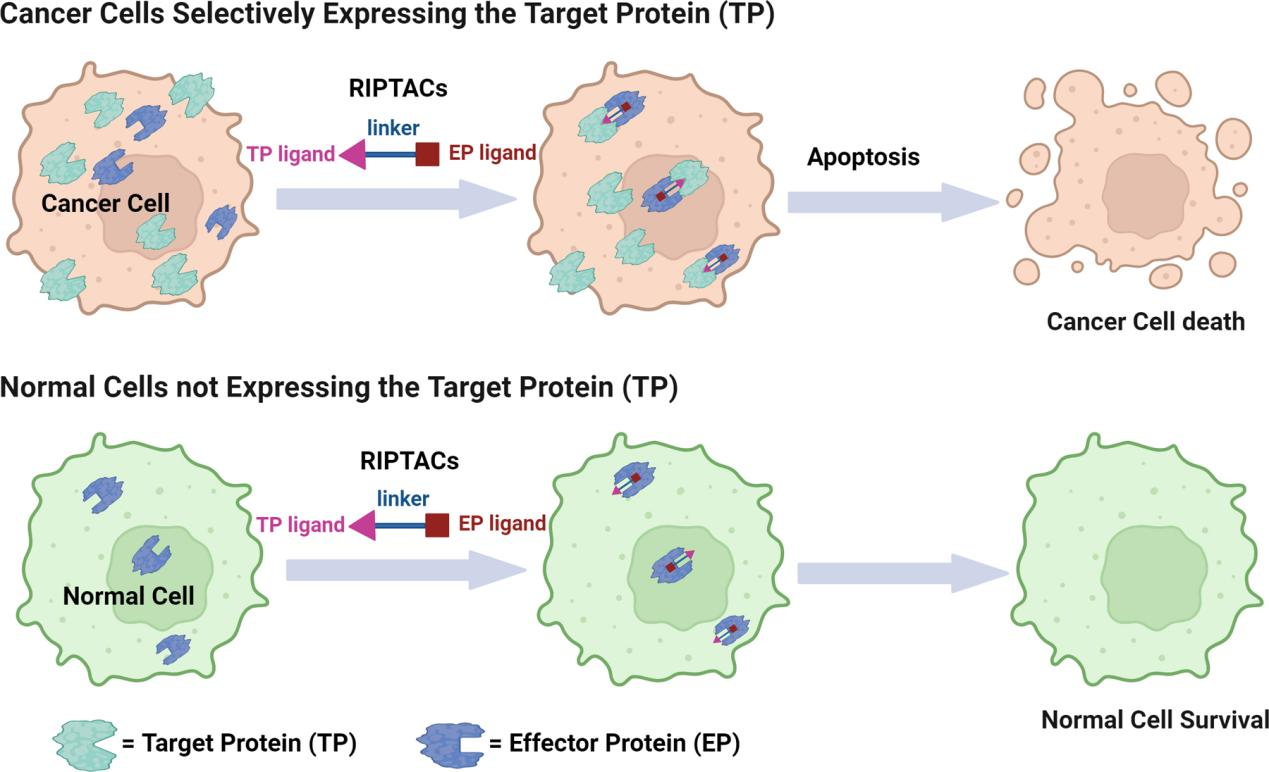
Regulated Induced Proximity Targeting Chimeras (RIPTAC) is a novel heterobifunctional small-molecule therapeutic strategy that selectively induces death in tumor cells expressing the Target Protein (TP) by simultaneously binding to the tumor-specific TP and an essential cell survival Effector Protein (EP), forming a stable ternary complex. This mechanism is independent of the ubiquitin-proteasome pathway, overcoming the reliance on E3 ligases in Targeted Protein Degradation (TPD), and does not require the target protein itself to possess pathogenic functionality, thereby providing a new technological approach to expand the druggable target space.
- Recent Advances
- Product Information
Abstract
Regulated Induced Proximity Targeting Chimeras (RIPTAC) represent a novel heterobifunctional small-molecule therapeutic strategy that selectively induces death in tumor cells expressing a target protein (TP) by simultaneously binding to both the tumor-specific TP and an essential effector protein (EP) for cell survival, forming a stable ternary complex. This mechanism operates independently of the ubiquitin-proteasome pathway, overcoming the reliance on E3 ligases in targeted protein degradation (TPD) and eliminating the need for the target protein itself to possess pathogenic functionality, thereby expanding the druggable target space. The first RIPTAC candidate drug, HLD-0915, has entered Phase I/II clinical trials, and the RIPTAC platform was acquired by Johnson & Johnson for approximately $3.05 billion, marking the transition of this emerging technology into clinical validation and industrialization.

doi: 10.1016/j.drudis.2023.103774
1 Introduction
The core challenge of precision oncology lies in achieving tumor-specific cytotoxicity while sparing normal tissues. Traditional small-molecule inhibitors require action against key proteins driving tumorigenesis, but many "undruggable" targets lack functional active pockets, and the emergence of resistance mutations further limits the long-term efficacy of such strategies. Targeted protein degradation (TPD) technologies, particularly proteolysis-targeting chimeras (PROTACs), overcome some limitations of traditional inhibitors by recruiting E3 ubiquitin ligases to induce target protein degradation. However, they still face challenges such as uneven tissue distribution of E3 ligases and resistance mechanisms involving ubiquitination system abnormalities.
RIPTAC technology was proposed by Professor Craig M. Crews' team at Yale University as an extension of PROTAC research. Its core concept is not to degrade the target protein but to induce the formation of a stable ternary complex through physical proximity, selectively blocking essential cellular functions. The first proof-of-concept study was published in 2023, systematically outlining the design principles and pharmacological characteristics of RIPTAC.
2 Structure and Mechanism of Action
RIPTAC shares a highly similar "dumbbell-shaped" heterobifunctional small-molecule structure with PROTAC, consisting of three modules: a ligand targeting the tumor-specific protein (TP), a linker, and a ligand binding to the cell survival-essential effector protein (EP). Despite their structural similarities, their mechanisms of action are fundamentally different.
In tumor cells expressing TP, RIPTAC simultaneously captures TP and EP, forming a stable TP-RIPTAC-EP ternary complex. The formation of this complex "locks" EP's function through physical occupancy, disrupting critical cellular processes and ultimately inducing tumor cell death. In normal cells with low TP expression, the ternary complex cannot form effectively, leaving EP function unaffected and ensuring a therapeutic window.
RIPTAC's mechanism exhibits three key features: (1) independence from the ubiquitin-proteasome pathway, avoiding resistance caused by uneven E3 ligase distribution or ubiquitination system abnormalities; (2) TP serves only as a localization anchor, requiring no functional activity or inhibitable sites, enabling the targeting of previously "undruggable" transcription factors, scaffold proteins, etc.; (3) unlike PROTAC's catalytic (event-driven) mechanism, RIPTAC operates via an occupancy-driven mode, demanding higher drug exposure and target-binding stability but offering greater cellular specificity.
Proof-of-concept studies have successfully integrated EP ligands such as the BRD4 inhibitor JQ1, PLK1 inhibitor BI2536, and multi-CDK inhibitors, validating the feasibility of various EPs as RIPTAC targets.
3 Core Advantages and Limitations
RIPTAC technology offers several key advantages:
Expanded target space: Traditional targeted therapies and PROTACs require targets to possess pharmacologically bindable pockets, whereas RIPTAC only requires TP to be overexpressed in tumor cells relative to normal cells, with no need for the target to have a clear biological function or inhibitable activity. This significantly broadens the range of druggable targets, particularly for tumor-associated antigens, overexpressed transcription factors, and other proteins difficult to target with conventional methods.
Overcoming resistance: Since RIPTAC's cytotoxic effect is achieved by blocking EP function, mutations in TP or activation of bypass pathways do not confer resistance. Additionally, RIPTAC's mechanism is independent of specific signaling pathways or enzymatic activity, inherently avoiding many classical resistance mechanisms.
Tissue selectivity: RIPTAC's selectivity is driven by differential TP expression in tumors, similar to antibody-drug conjugates (ADCs) but with the unique advantage of targeting intracellular proteins. This allows any overexpressed protein in tumor cells to serve as an anchor, without requiring cell surface antigens.
Oral bioavailability: As small molecules, RIPTACs exhibit superior pharmacokinetic properties and patient compliance compared to macromolecular drugs like ADCs. RIPTAC molecules targeting the p53-Y220C mutation have demonstrated good oral bioavailability.
However, RIPTAC also faces limitations. The occupancy-driven mechanism demands high target affinity and optimal in vivo exposure, posing greater challenges for medicinal chemistry optimization. EP selection must balance its essentiality in normal cells and tumor cell dependency to ensure safety. Ternary complex formation requires precise spatial conformation matching, imposing high technical demands on linker length and flexibility.
4 Clinical Research and Industry Progress
The first RIPTAC drug to enter clinical trials is HLD-0915, developed by Halda Therapeutics, targeting the androgen receptor (AR) with BRD4 as the EP for metastatic castration-resistant prostate cancer (mCRPC). The Phase I/II trial (NCT06800313) began in 2024, with the first patient dosed. HLD-0915 is administered orally once daily. Preclinical data showed significant antitumor activity in enzalutamide-resistant patient-derived xenograft (PDX) models, with an IC50 of 8.7 nM, outperforming traditional AR inhibitors and exhibiting no significant off-target toxicity such as myelosuppression. The drug has received FDA Fast Track designation.
Beyond prostate cancer, Halda Therapeutics is advancing RIPTAC candidates for ER+/HER2− metastatic breast cancer. Preclinical studies demonstrate broad-spectrum activity in both wild-type and mutant ER models, including CDK4/6 inhibitor-resistant settings, with plans to initiate Phase I trials in early 2026. Additionally, RIPTAC molecules targeting the p53-Y220C mutation showed promising tumor selectivity in preclinical data presented at AACR 2025, offering a new strategy for refractory tumors harboring this mutation (∼1% of human cancers, ∼20,000 annual US cases).
In the industry, Johnson & Johnson announced the acquisition of Halda Therapeutics for approximately $3.05 billion in cash in November 2025, integrating the RIPTAC platform into its oncology pipeline, including candidates for prostate, breast, lung, and other solid tumors. This marks the largest acquisition in the induced proximity drug field to date, reflecting strong industry confidence in RIPTAC technology.
5 Outlook and Conclusion
As the next-generation heterobifunctional molecule technology proposed by the same scientific team after PROTAC, RIPTAC represents a paradigm shift from "protein degradation" to "functional hijacking." By bypassing reliance on E3 ligase tissue distribution, it expands the scope of druggable targets and offers new avenues to overcome classical resistance mechanisms.
Future development of RIPTAC will focus on several directions: (1) broadening the repertoire of EPs to enrich application scenarios; (2) deepening mechanistic studies of ternary complex formation and structure-activity relationships to guide drug design; (3) exploring potential in non-oncology areas such as autoimmune and infectious diseases. With its unique "Hold and Kill" mechanism and strong industry interest, RIPTAC is poised to become a pivotal platform in precision medicine, opening new therapeutic pathways for cancer and beyond.
This article is reviewed and published by the technical expert team of UA
Disclaimer: This article partially utilizes artificial intelligence assistance in its creation. If any content involves copyright or intellectual property issues, please let us know and we promise to verify and remove it as soon as possible.
Purchase recombinant protein, choose Nanjing UA-Bio
UA protein focuses on providing various protein reagents, raw materials, and services required for drug research and development, cell therapy, gene therapy, and basic scientific research, including drug target proteins, immune checkpoint proteins, cytokines, tool enzymes, customized protein expression, and full-length transmembrane protein development. Youai is committed to providing customers with high-quality products and professional services, and building a High-tech Biological Enterprise with International Competitiveness.







 Business license (three certificates in one)