Targeting key GTPases such as Ras and Rho? UA-Glo® GTPase provides a reliable solution for drug screening.


GTPases (guanosine triphosphatases) are a superfamily of proteins that play a central regulatory role in cellular signal transduction, widely involved in key biological processes such as cell proliferation, differentiation, migration, vesicle trafficking, and cytoskeletal reorganization. GTPases
- Recent Advances
- Product Information
1. Background and Overview
GTPases (Guanosine Triphosphatases) are a superfamily of proteins that play a central regulatory role in cellular signal transduction, widely involved in key biological processes such as cell proliferation, differentiation, migration, vesicle trafficking, and cytoskeleton remodeling. GTPases function as molecular switches, cycling between the active GTP-bound state and the inactive GDP-bound state. This process is precisely regulated by two types of regulatory proteins: Guanine nucleotide exchange factors (GEFs) catalyze the dissociation of GDP from inactive GTPases and load GTP, activating signaling pathways; while GTPase-activating proteins (GAPs) stimulate GTP hydrolysis, terminating signal transduction.
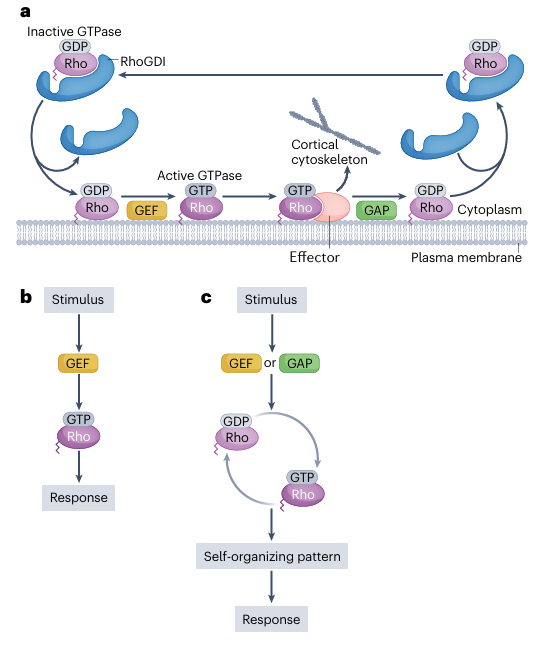
Source: Nature Reviews Molecular Cell Biology
Accurate and sensitive detection of GTPase activity and the function of its regulatory proteins (GAPs and GEFs) is fundamental for understanding signal transduction mechanisms, drug screening, and disease research. The UA-Glo® GTPase Activity Detection Kit provides a simple, sensitive, and high-throughput-compatible solution for this field.
2. Technical Principle and Detection Mechanism
The UA-Glo® GTPase Activity Detection Kit is a homogeneous bioluminescence detection system. Its core design principle is to indirectly reflect enzyme activity by quantitatively measuring the remaining GTP in the system after the GTPase reaction. The specific detection process is as follows:
1. GTPase reaction phase: Incubate the target GTPase (or GAP/GEF) with substrate GTP in an optimized reaction buffer. The GTPase hydrolyzes GTP into GDP and inorganic phosphate.
2. Conversion of remaining GTP: After the reaction, add a conversion reagent to convert all remaining GTP in the system into ATP.
3. Bioluminescence detection: Add the Detection Reagent, which contains a proprietary thermostable luciferase and its substrate luciferin. ATP drives the luciferase-catalyzed luminescence reaction, producing a stable bioluminescence signal.
4. Signal reading: Record the luminescence intensity.
The luminescence signal is inversely proportional to enzyme activity: Higher GTPase activity consumes more GTP, leaving less remaining GTP, resulting in less ATP conversion and lower luminescence signal; conversely, lower GTPase activity leaves more GTP, leading to a stronger luminescence signal.
This detection system is compatible with 96-well, 384-well, and 1536-well plates, adopting a simple "add-and-read" operation mode, greatly simplifying the experimental workflow.
3. Technical Advantages
1. High Sensitivity and Wide Dynamic Range
The UA-Glo® GTPase Activity Detection Kit can detect GTPase regulatory enzymes at the low nanogram level. Thanks to the high signal-to-noise ratio of bioluminescence detection, this method features low background noise and a wide dynamic range, enabling accurate differentiation of samples with varying activity levels.
2. Homogeneous "Add-and-Read" Operation
Unlike traditional radioactive detection methods that require multiple washing or separation steps, this kit employs a homogeneous detection mode—all reactions are completed in the same well without separation steps. The simple "add-and-read" workflow significantly reduces operation time and human error.
3. High-Throughput Compatibility
The kit is compatible with 96-well, 384-well, and 1536-well plates, easily adaptable to automated high-throughput screening platforms, making it particularly suitable for large-scale compound library screening or enzymatic kinetic studies.
4. Safe and Non-Radioactive Detection Solution
Traditional GTPase activity detection often relies on radioactively labeled GTP (e.g., [γ-³²P]GTP), posing radiation hazards and waste disposal issues. The UA-Glo® GTPase Activity Detection Kit uses bioluminescence detection, completely avoiding the use of radioactive isotopes, making it safer and more environmentally friendly.
4. Application Fields
5. Summary
The UA-Glo® GTPase Activity Detection Kit, with its high sensitivity, homogeneous and simple operation, high-throughput compatibility, and safe non-radioactive advantages, has become a core tool for GTPase signaling pathway research. Whether for basic enzymatic mechanism analysis or high-throughput drug compound screening, it provides stable and reliable detection data, meeting research needs in fields such as oncology, neuroscience, and immunology.
Keywords: GTPases, Guanosine Triphosphatases, Rho proteins, GEF Guanine nucleotide exchange factors, GAP GTPase-activating proteins, GDP, GTP, Molecular switches, Cellular signal transduction, Cytoskeleton remodeling, Cell proliferation and migration, UA-Glo, GTPase activity detection kit, High-throughput drug screening
---------------------This article is reviewed and published by the technical expert team of UA
Disclaimer: This article partially utilizes artificial intelligence assistance in its creation. If any content involves copyright or intellectual property issues, please let us know and we promise to verify and remove it as soon as possible.
Purchase recombinant protein, choose 
UA protein focuses on providing various protein reagents, raw materials, and services required for drug research and development, cell therapy, gene therapy, and basic scientific research, including drug target proteins, immune checkpoint proteins, cytokines, tool enzymes, customized protein expression, and full-length transmembrane protein development. Nanjing Univ is committed to providing customers with high-quality products and professional services, and building a High-tech Biological Enterprise with International Competitiveness.







 Business license (three certificates in one)