




The UA-Glo® Kinase ADP Detection Kit provides a precise and efficient biochemical analysis solution for PI3K target drug development.
Author: Senior Product Manager of UA Views:88 


Abnormal activation of the phosphatidylinositol-3-kinase (PI3K) signaling pathway is a key driver in the development and progression of various malignancies. The development of inhibitors targeting this pathway has become one of the core directions in tumor-targeted therapy. In the screening and characterization of kinase inhibitors, establishing a sensitive, reliable, and high-throughput-compatible activity assay method is crucial.
- Recent Advances
- Product Information
Recent Advances
UA-Glo® Kinase ADP Assay Kit Provides Accurate and Efficient Biochemical Analysis Solutions for PI3K Target Drug Development
Summary: Abnormal activation of the phosphatidylinositol-3-kinase (PI3K) signaling pathway is a key driver in the development and progression of various malignancies. Targeting this pathway has become a central focus in cancer therapy. Establishing a sensitive, reliable, and high-throughput-compatible activity assay is critical for kinase inhibitor screening and characterization.
1. Research Value of PI3K Signaling Pathway as an Anti-Tumor Target
Phosphatidylinositol-3-kinase (PI3K) and its mediated PI3K/Akt/mTOR signaling axis play a central regulatory role in cell growth, proliferation, metabolism, survival, and immune regulation. Overactivation of this pathway has been extensively linked to the development and progression of various human cancers, including prostate, breast, and colorectal cancers. Specifically, Class I PI3K phosphorylates phosphatidylinositol-4,5-bisphosphate (PIP₂) to generate phosphatidylinositol-3,4,5-trisphosphate (PIP₃), initiating downstream Akt/mTOR cascade signaling, which drives malignant transformation, therapy resistance, and immune evasion. Therefore, developing next-generation inhibitors that precisely target PI3K family members with higher selectivity and lower toxicity has become a global hotspot in cancer drug development. This process heavily relies on reliable and efficient kinase activity detection tools.
2. Technical Principle and Methodological Advantages of ADP Quantification
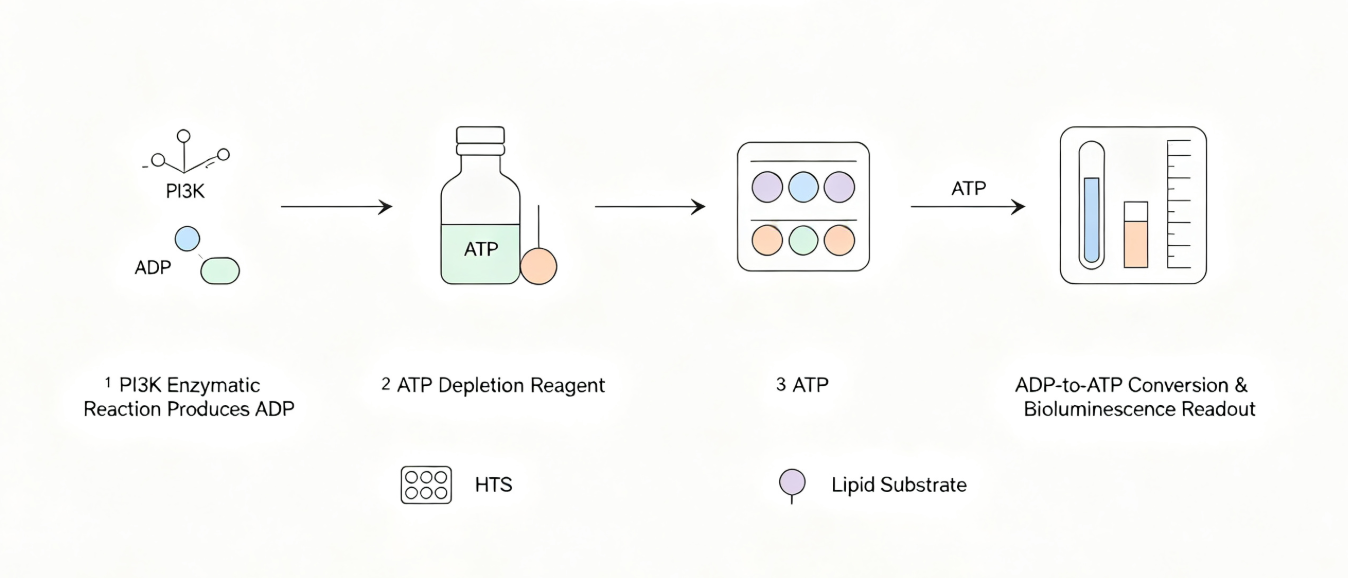
The UA-Glo® Kinase ADP Assay Kit offers a homogeneous, sensitive, and reliable solution for quantitative kinase activity analysis. Its core principle involves the specific and quantitative detection of adenosine diphosphate (ADP) production, directly reflecting kinase catalytic activity. Compared to traditional methods based on ATP depletion or radioactive labeling, this product-based approach offers higher sensitivity and a wider dynamic range, delivering excellent signal-to-noise ratios even at low ATP conversion rates. The assay employs a unique two-step design: first, an ATP removal reagent terminates the kinase reaction and depletes residual ATP to eliminate interference; then, an ADP detection reagent converts ADP back to ATP, generating bioluminescent signals proportional to ADP concentration via a luciferase/luciferin system. This design establishes a precise quantitative relationship between luminescence intensity and kinase activity, providing a robust methodological foundation for inhibitor screening and kinetic characterization.
3. Systematic Evaluation of Core Performance Parameters and Applicability
The assay system demonstrates outstanding performance characteristics. In terms of sensitivity, the UA-Glo® Kit can stably detect ADP levels as low as 0.25 pmol, with excellent signal-to-background ratios, delivering reliable results even with low enzyme amounts and high-density microplate formats (96/384-well). For ATP concentration adaptability, the system accommodates a broad range (1 µM to 1 mM), meeting the optimal reaction conditions for various kinases. Importantly, researchers can systematically vary ATP concentrations to observe inhibitor potency changes, effectively distinguishing ATP-competitive from non-competitive inhibitors. Additionally, the kit is not limited to specific kinases or substrate types—whether peptides, full-length proteins, lipids, or carbohydrates, it can effectively detect activity. Its applications extend to any ADP-generating enzymatic reaction, such as ATPase activity assays.
4. Optimized Substrate Solutions for Lipid Kinase Detection
To address the detection needs of lipid kinases like Class I PI3K, the UA-Glo® Kit includes a specialized component of significant practical value—the PI3K substrate PIP₂:3PS. This substrate consists of phosphatidylinositol-4,5-bisphosphate (PIP₂) mixed with carrier phospholipid phosphatidylserine (PS) at an optimized 1:3 ratio, closely matching the substrate preference of Class I PI3Ks. This pre-optimized design effectively resolves a critical technical challenge in lipid kinase assays: lipid substrates exist in unique membrane environments in vivo and are insoluble in aqueous solutions, making in-house substrate preparation and optimization highly challenging. The UA-Glo® Kinase ADP Assay with PI3K Substrate PIP2:3PS serves as an integrated solution, eliminating uncertainties in substrate preparation and significantly improving experimental standardization and data reproducibility.
5. Experimental Workflow and High-Throughput Screening Applicability
From an operational perspective, the kit is designed for efficiency and convenience. It employs a "add-and-read" homogeneous detection mode—requiring no antibodies, radioactive labeling, or solid-phase separation/washing steps. After the kinase reaction, simply adding ATP removal reagent and ADP detection reagent, followed by brief incubation, yields luminescent signals. The glow-type signal exhibits exceptional stability, maintaining a linear relationship between luminescence intensity and ADP concentration for 0.5 to 12 hours. This eliminates intra-batch variability due to plate reader speed limitations, enabling high-throughput microplate detection in a single run. The highly standardized workflow makes it ideal for high-throughput compound screening (HTS) on automated platforms and subsequent structure-activity relationship (SAR) studies. UA-Glo® Kinase ADP Assay with PI3K Substrate PIP2:3PS integrates these technical advantages with specialized lipid kinase substrates, offering a complete solution for PI3K inhibitor screening and mechanistic research.
6. Conclusion
In summary, the UA-Glo® Kinase ADP Assay Kit establishes an advanced technological platform for kinase activity measurement and inhibitor screening, leveraging its sensitive ADP quantification principle, broad ATP concentration compatibility, excellent signal stability, and simple homogeneous workflow. The inclusion of the specialized PI3K substrate PIP₂:3PS further addresses key technical bottlenecks in lipid kinase assays, providing a precise and efficient biochemical detection solution for PI3K/Akt/mTOR signaling pathway research and targeted drug development.
```
This article is reviewed and published by the technical expert team of UA
Disclaimer: This article partially utilizes artificial intelligence assistance in its creation. If any content involves copyright or intellectual property issues, please let us know and we promise to verify and remove it as soon as possible.
Purchase recombinant protein, choose Nanjing UA-Bio
UA protein focuses on providing various protein reagents, raw materials, and services required for drug research and development, cell therapy, gene therapy, and basic scientific research, including drug target proteins, immune checkpoint proteins, cytokines, tool enzymes, customized protein expression, and full-length transmembrane protein development. Youai is committed to providing customers with high-quality products and professional services, and building a High-tech Biological Enterprise with International Competitiveness.
Target proteins | membrane proteins | cytokines | enzymes | viral antigens | protein customization
Nanjing UA Biotechnology Co., Ltd. Email:order@ua-bio.com Phone:+86-25-56221161

Product Information

Link:





©2021-2026 all rights reserved UA Biotechnology Co.,Ltd.
Privacy Policy 
网站备案号 浙ICP备2022019033号-2 浙公网安备33010202004867号
 Business license (three certificates in one)
 Tel:+86-25-56221161
E-mail:order@ua-bio.com
All products sold on this website shall not be used for clinical diagnosis or treatment of humans or animals, and shall only be used for non-medical purposes such as industrial or scientific research.
