




Structural Characteristics and Application Value of Murine CD3E and CD3G Heterodimeric Protein
Author: Senior Product Manager of UA Views:89 


The central role of CD3 heterodimers in the T cell receptor complex.
- Recent Advances
- Product Information
Recent Advances
Structural Characteristics and Application Value of Mouse CD3E and CD3G Heterodimer Protein
The Central Role of CD3 Heterodimers in the T Cell Receptor Complex.
The T cell receptor (TCR) complex is a key molecular machinery for initiating adaptive immune responses, composed of TCRαβ or TCRγδ heterodimers on the surface and a cluster of CD3 molecules. The CD3 molecular cluster includes four subunits: CD3γ, CD3δ, CD3ε, and CD3ζ, among which the heterodimer formed by CD3ε and CD3γ (CD3E&CD3G) is an indispensable component of the complex. This heterodimer not only participates in the correct folding and membrane localization of the TCR complex but also mediates signal transduction after antigen recognition through its intracellular immunoreceptor tyrosine-based activation motifs (ITAMs). Therefore, obtaining high-purity, structurally homogeneous, and biologically active recombinant mouse CD3E&CD3G heterodimer protein holds significant tool value for in-depth research into T cell activation mechanisms and the development of related immunotherapies.
Protein Design and Molecular Construction Strategy.
This recombinant protein is designed based on the extracellular regions of mouse CD3E and CD3G. Specifically, the CD3E subunit comprises the region from Asp 23 to Asp 108, and the CD3G subunit comprises the region from Gln 23 to Ser 116, corresponding to the extracellular domain sequences annotated in GenBank entries P22646-1 and P11942-1, respectively. To achieve efficient co-expression of the heterodimer, human embryonic kidney 293 cells (HEK293) were used as the expression host, with plasmids encoding the two subunits co-transfected into the host cells. As a mammalian expression system, HEK293 cells support proper protein folding, disulfide bond formation, and complex post-translational glycosylation modifications, thereby maximizing the retention of the protein's native conformation and biological function.
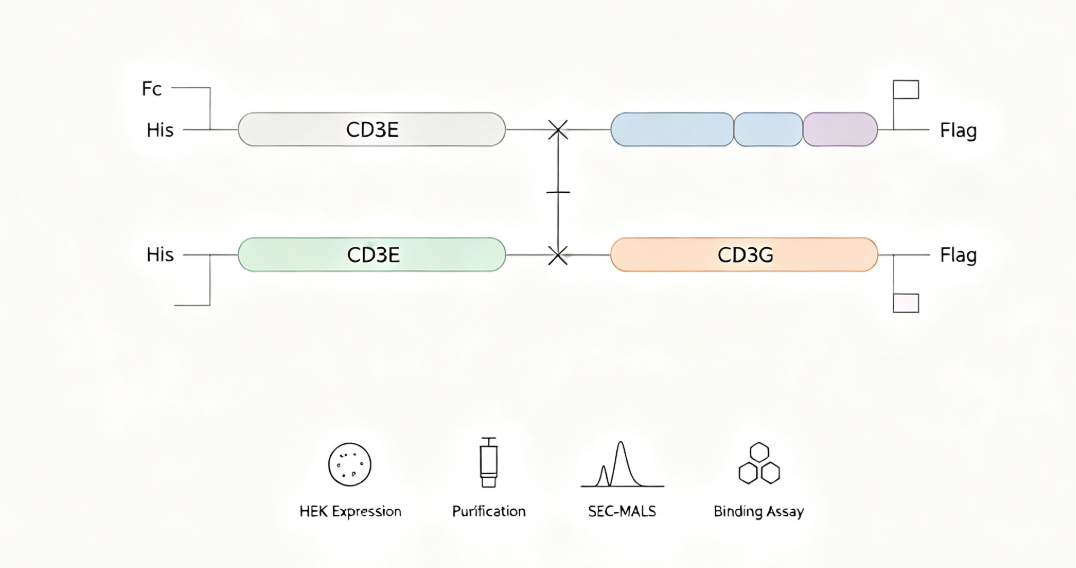
Functional Division of the Multi-Layered Tag System.
The protein employs a differentiated tag design strategy to enable independent detection and purification of the two subunits. The C-terminus of the CD3E subunit is fused with the Fc fragment of human IgG1, followed by a polyhistidine tag (His-tag), while the C-terminus of the CD3G subunit is similarly fused with the Fc fragment of human IgG1, followed by a Flag tag. This design offers multiple advantages: the Fc tag not only enables efficient purification via Protein A or Protein G affinity chromatography but also enhances protein stability in solution; the His-tag and Flag tag provide independent immunological detection markers for the two subunits, facilitating the tracking of CD3E and CD3G expression and assembly status in Western blot or ELISA experiments. The theoretical molecular weight of the CD3E fusion subunit is approximately 41.5 kDa, and that of the CD3G fusion subunit is approximately 41.6 kDa.
Validation of Physicochemical Properties and Structural Homogeneity.
Due to glycosylation modifications, the protein exhibits migration behavior in SDS-PAGE that differs from its theoretical molecular weight. Under reducing conditions, the CD3E and CD3G subunits migrate to the 48-55 kDa region; under non-reducing conditions, the heterodimer migrates as a whole to approximately 100 kDa. This result indicates that the two subunits form a stable covalent heterodimer via interchain disulfide bonds. Size-exclusion chromatography combined with multi-angle light scattering (SEC-MALS) was used to validate the protein's homogeneity, showing a purity exceeding 95% and a molecular weight distribution in the 80-95 kDa range, consistent with the expected size of the heterodimer. SEC-MALS technology directly measures the absolute molecular weight of proteins in solution, and its validation results strongly confirm that the product is in the form of a high-purity heterodimer, rather than a monomer mixture or aggregates.
Functional Validation of Biological Activity.
ELISA-based binding experiments further confirmed the biological activity of this recombinant protein. The experiments demonstrated that immobilized mouse CD3E&CD3G heterodimer protein could bind biotinylated anti-CD3ε monoclonal antibodies, with a linear detection range of 0.2-6 ng/mL. Conversely, immobilized anti-CD3ε antibodies could also capture the heterodimer protein in solution, with a linear range of 0.01-0.25 μg/mL. These data not only confirm that the recombinant protein retains the correct conformational epitopes but also provide experimental evidence for its reliability in applications such as antibody screening and receptor-ligand binding analysis.
Research Application Value.
In summary, the mouse CD3E&CD3G heterodimer protein is prepared via the HEK293 cell co-expression system, purified by Fc affinity chromatography, and validated for purity and heterodimer structure through SEC-MALS and SDS-PAGE, with its binding activity to anti-CD3ε antibodies confirmed by ELISA. This product provides a reliable experimental material for structural biology studies of the TCR-CD3 complex, screening and functional evaluation of anti-CD3 antibodies, and preclinical assessment of T cell-related immunotherapy strategies. Currently, UniScience has launched the corresponding product—CD3E&CD3G Heterodimer, Fc, His Tag&Fc, Flag Tag Protein, Mouse—to meet these research needs.
This article is reviewed and published by the technical expert team of UA
Disclaimer: This article partially utilizes artificial intelligence assistance in its creation. If any content involves copyright or intellectual property issues, please let us know and we promise to verify and remove it as soon as possible.
Purchase recombinant protein, choose Nanjing UA-Bio
UA protein focuses on providing various protein reagents, raw materials, and services required for drug research and development, cell therapy, gene therapy, and basic scientific research, including drug target proteins, immune checkpoint proteins, cytokines, tool enzymes, customized protein expression, and full-length transmembrane protein development. Youai is committed to providing customers with high-quality products and professional services, and building a High-tech Biological Enterprise with International Competitiveness.
Target proteins | membrane proteins | cytokines | enzymes | viral antigens | protein customization
Nanjing UA Biotechnology Co., Ltd. Email:order@ua-bio.com Phone:+86-25-56221161

Product Information

Link:





©2021-2026 all rights reserved UA Biotechnology Co.,Ltd.
Privacy Policy 
网站备案号 浙ICP备2022019033号-2 浙公网安备33010202004867号
 Business license (three certificates in one)
 Tel:+86-25-56221161
E-mail:order@ua-bio.com
All products sold on this website shall not be used for clinical diagnosis or treatment of humans or animals, and shall only be used for non-medical purposes such as industrial or scientific research.
