




Structure, Function, and Preparation Strategies of Recombinant Human Coagulation Factor XI Protein
Author: Senior Product Manager of UA Views:98 


The unique role of coagulation factor XI in the coagulation cascade.
- Recent Advances
- Product Information
Recent Advances
Structure, Function, and Preparation Strategies of Human Coagulation Factor XI Recombinant Protein
The Unique Role of Coagulation Factor XI in the Coagulation Cascade.
Coagulation Factor XI (FXI), as a key component of the contact pathway in coagulation, plays a distinctive and complex role in thrombin generation and thrombus formation. Unlike traditional vitamin K-dependent coagulation factors, FXI is an unusual homodimeric serine protease zymogen, with its molecular structure, activation mechanism, and physiological functions exhibiting remarkable specificity. Synthesized in the liver and secreted into the blood as a disulfide-linked homodimer, each subunit of FXI comprises four apple domains and a serine protease domain. In the classical intrinsic coagulation pathway, FXI is cleaved by activated Factor XII (FXIIa) into its active form, FXIa, which then activates Factor IX, initiating the downstream coagulation cascade. However, recent research has profoundly altered our understanding of FXI—patients with FXI deficiency (hemophilia C) exhibit only mild bleeding tendencies, and their symptoms show no clear correlation with FXI antigen levels or activity, suggesting that FXI's role in hemostasis may not rely on the traditional contact activation pathway but rather involve more complex regulatory mechanisms. Concurrently, epidemiological and clinical trial data indicate that FXI is an independent risk factor for deep vein thrombosis, ischemic stroke, and myocardial infarction, making it a highly promising target for antithrombotic drugs. Therefore, obtaining high-purity, structurally intact, and biologically active human recombinant FXI protein holds significant value as a tool for elucidating FXI's multifaceted physiological and pathological functions and developing novel FXI-targeted anticoagulants.
Protein Design and Expression Host Selection.
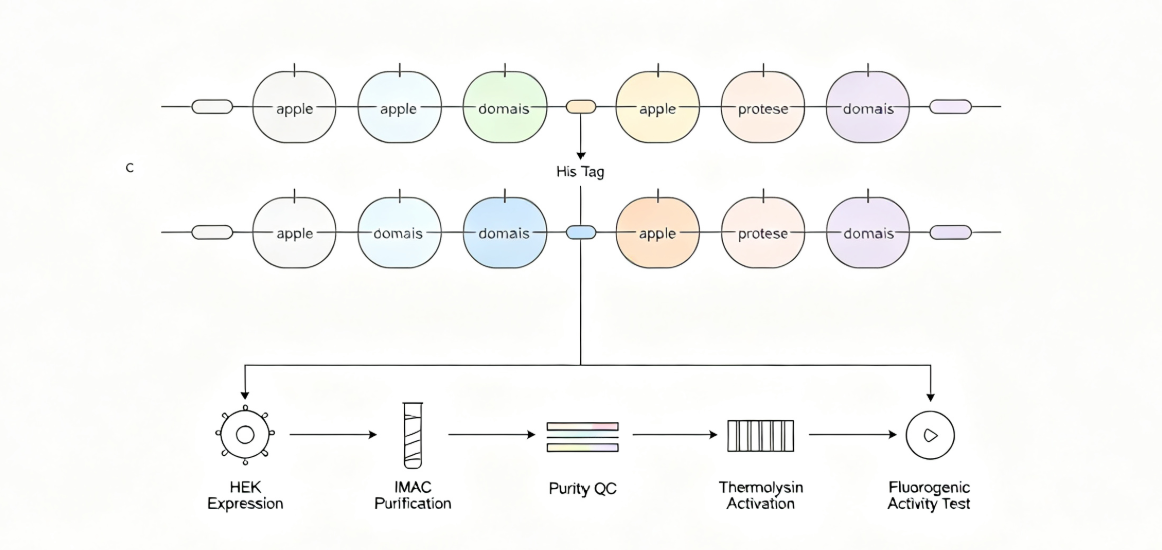
The recombinant protein is based on the full-length human FXI sequence, corresponding to UniProt database entry P03951-1, covering the region from Glu 19 to Val 625. It includes all structural domains of FXI—four apple domains (A1 to A4) and a C-terminal serine protease catalytic domain. To achieve efficient recombinant expression, human embryonic kidney 293 cells (HEK293) were selected as the expression host. As a mammalian expression system, HEK293 cells support proper protein folding, formation of interchain disulfide bonds, and complex glycosylation modifications—post-translational modifications critical for maintaining FXI's native conformation and biological function. Previous studies have shown that mammalian expression systems can produce recombinant FXI with specific activity comparable to that of the natural protein, and its electrophoretic mobility matches that of plasma-derived FXI.
Polyhistidine Tag Design and Physicochemical Properties.
The protein carries a polyhistidine tag (His Tag) at its C-terminus, facilitating purification and detection. The His tag enables one-step purification via immobilized metal affinity chromatography and allows detection using anti-His tag antibodies in Western blot or immunoprecipitation experiments, aiding in tracking the target protein during expression and purification. The theoretical molecular weight of the recombinant protein is approximately 69.5 kDa. However, due to complex N-linked glycosylation, its actual migration position in reducing SDS-PAGE ranges between 75 and 80 kDa. The protein is provided as a lyophilized powder, with the lyophilization matrix consisting of sterile PBS buffer (pH 7.4) and protective agents such as trehalose, mannitol, and Tween 80 added to maintain structural stability and activity during lyophilization and long-term storage.
Purity and Quality Control Standards.
The product undergoes rigorous purity and activity validation. Reducing SDS-PAGE confirms a purity exceeding 85%, with some batches achieving over 90% purity as verified by size-exclusion high-performance liquid chromatography (SEC-HPLC). Endotoxin levels, measured using the Limulus amebocyte lysate assay, are below 1.0 EU/µg, meeting stringent requirements for immunological and cellular experiments.
Functional Validation of Biological Activity.
The biological activity of the recombinant protein is validated through fluorogenic substrate cleavage assays. Specifically, FXI zymogen is first activated by thermolysin into active FXIa, which is then tested for its ability to cleave the fluorogenic peptide substrate Boc-IEGR-AMC (tert-butoxycarbonyl-Ile-Glu-Gly-Arg-7-amino-4-methylcoumarin). Results demonstrate a specific activity greater than 100 pmol/min/µg. This assay confirms that the recombinant FXI can be correctly activated into enzymatically active FXIa and verifies the conformational integrity of its protease domain.
Conclusion: Research Applications of the Product.
In summary, the human coagulation Factor XI His-tagged recombinant protein is produced using the HEK293 expression system, purified via metal affinity chromatography, and validated for purity by both SDS-PAGE and SEC-HPLC. Its enzymatic activity is confirmed by fluorogenic substrate cleavage assays. This product serves as a reliable experimental material for studying the molecular mechanisms of FXI in hemostasis and thrombosis, analyzing the pathology of FXI deficiency (hemophilia C), and screening and evaluating novel FXI-targeted anticoagulants. UniScience has launched the corresponding product—Coagulation Factor XI/FXI His Tag Protein, Human—to meet these research needs.
```
This article is reviewed and published by the technical expert team of UA
Disclaimer: This article partially utilizes artificial intelligence assistance in its creation. If any content involves copyright or intellectual property issues, please let us know and we promise to verify and remove it as soon as possible.
Purchase recombinant protein, choose Nanjing UA-Bio
UA protein focuses on providing various protein reagents, raw materials, and services required for drug research and development, cell therapy, gene therapy, and basic scientific research, including drug target proteins, immune checkpoint proteins, cytokines, tool enzymes, customized protein expression, and full-length transmembrane protein development. Youai is committed to providing customers with high-quality products and professional services, and building a High-tech Biological Enterprise with International Competitiveness.
Target proteins | membrane proteins | cytokines | enzymes | viral antigens | protein customization
Nanjing UA Biotechnology Co., Ltd. Email:order@ua-bio.com Phone:+86-25-56221161

Product Information

Link:





©2021-2026 all rights reserved UA Biotechnology Co.,Ltd.
Privacy Policy 
网站备案号 浙ICP备2022019033号-2 浙公网安备33010202004867号
 Business license (three certificates in one)
 Tel:+86-25-56221161
E-mail:order@ua-bio.com
All products sold on this website shall not be used for clinical diagnosis or treatment of humans or animals, and shall only be used for non-medical purposes such as industrial or scientific research.
