




Characteristics and Application Potential of Human Keratinocyte Growth Factor/Fibroblast Growth Factor 7 (KGF/FGF-7) Protein
Author: Senior Product Manager of UA Views:39 


Keratinocyte growth factor (KGF), also known as fibroblast growth factor 7 (FGF-7), is a key member of the fibroblast growth factor family. It is secreted by mesenchymal-derived cells and exerts paracrine regulatory effects by specifically binding to its epithelial cell receptor. This factor plays a critical role in promoting epithelial cell proliferation, tissue damage repair, and organ development, particularly demonstrating potential value in the regenerative treatment of endometrial damage. However, its inherent structural instability and rapid clearance in vivo hinder clinical translation. Advances in recombinant protein technology provide a feasible pathway to overcome this bottleneck.
- Recent Advances
- Product Information
Recent Advances
Characteristics and Application Potential of Human Keratinocyte Growth Factor/Fibroblast Growth Factor 7 (KGF/FGF-7) Protein
Brief Introduction: Keratinocyte Growth Factor (KGF), also known as Fibroblast Growth Factor 7 (FGF-7), is a key member of the fibroblast growth factor family. Secreted by mesenchymal-derived cells, it exerts paracrine regulatory effects by specifically binding to its epithelial cell receptor. This factor plays a critical role in promoting epithelial cell proliferation, tissue damage repair, and organ development, particularly showing potential value in the regenerative treatment of endometrial injury. However, its inherent structural instability and rapid clearance in vivo hinder clinical translation. Advances in recombinant protein technology provide a feasible pathway to overcome this bottleneck.
Molecular Identity and Structural Features
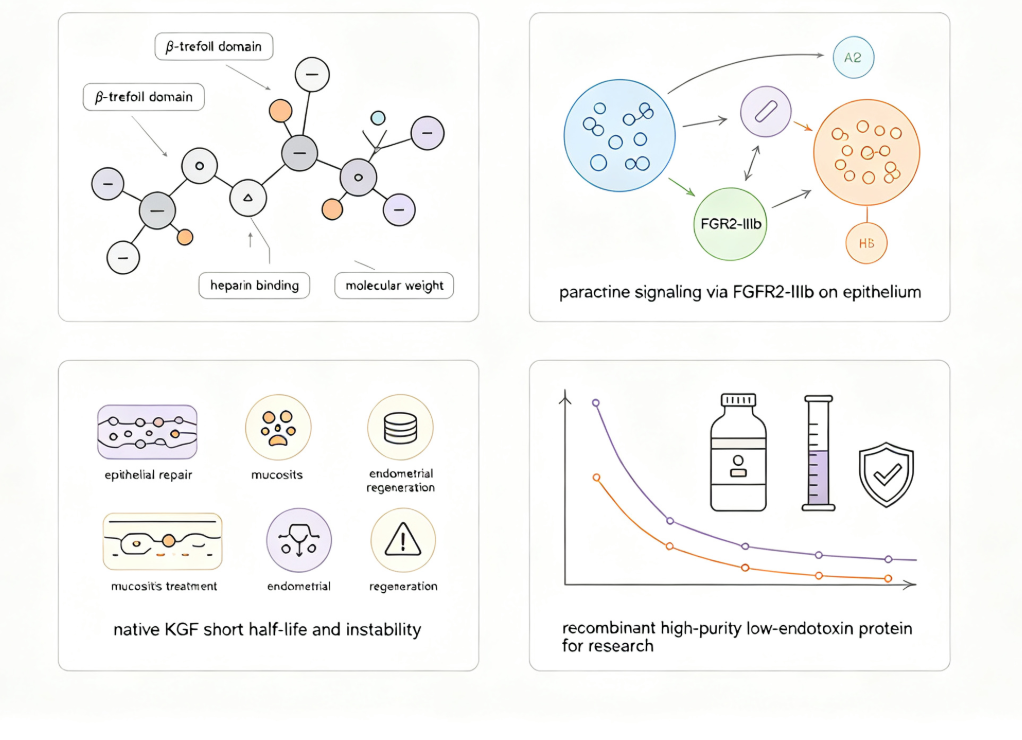
Keratinocyte Growth Factor (KGF) belongs to the Fibroblast Growth Factors (FGFs) superfamily and is named for its significant mitogenic activity in keratinocytes. Also known as FGF-7, its gene is located on human chromosome 15q21.2, encoding a single-chain polypeptide of 194 amino acid residues with a theoretical molecular weight of approximately 18.9 kDa. In its natural state, due to glycosylation modifications, it exhibits an apparent molecular weight of 26-28 kDa. As a member of the heparin-binding growth factor family, KGF/FGF-7 has a high affinity for heparin molecules, a characteristic closely related to its receptor binding and signal transduction processes. Structural biology studies reveal that KGF/FGF-7 protein contains a typical FGF domain, adopting a β-trefoil topology, with amino acid residues 57-192 forming the core functional domain responsible for mediating specific recognition and binding to receptors.
Expression Sources and Target Specificity
KGF/FGF-7 is primarily synthesized and secreted by mesenchymal-derived fibroblasts, microvascular endothelial cells, and smooth muscle cells, functioning as a typical paracrine factor. Unlike its source cells, KGF/FGF-7 targets are highly specific, mainly limited to epithelial cell lineages, with no significant mitogenic effects on fibroblasts or endothelial cells. This targeting specificity is determined by the distribution characteristics of its receptor. The functional receptor for KGF/FGF-7 is the IIIb splice variant of Fibroblast Growth Factor Receptor 2 (FGFR2-IIIb), also known as KGFR, a member of the receptor tyrosine kinase family, whose expression is highly restricted to the surfaces of various epithelial tissue cells. The specific binding of KGF/FGF-7 to FGFR2-IIIb triggers receptor dimerization and phosphorylation of the intracellular tyrosine kinase domain, subsequently activating downstream signaling cascades such as Ras-MAPK, PI3K-Akt, and PLCγ, ultimately regulating the proliferation, migration, and differentiation of target cells.
Biological Functions and Tissue Protection
KGF/FGF-7 plays multiple important roles in embryonic development, tissue homeostasis maintenance, and post-injury repair. In organ development, KGF/FGF-7 participates in regulating the branching morphogenesis and epithelial structure formation of tissues such as the lungs, kidneys, skin, and hair follicles. As a potent mitogen for epithelial cells, KGF/FGF-7 significantly promotes the proliferation of keratinocytes, intestinal epithelial cells, and hepatocytes, accelerating the re-epithelialization process at injury sites. In tissue damage repair, KGF/FGF-7 can promote synchronous regeneration of the dermis and epidermis, induce neovascularization, and drive the migration of keratinocytes from wound edges to defect areas. Additionally, KGF/FGF-7 has a clear protective effect against radiation- and chemotherapy-induced oral mucositis and intestinal mucosal damage. Recombinant KGF/FGF-7 (Palifermin) has been approved by the U.S. Food and Drug Administration for the prevention and treatment of radiation- and chemotherapy-induced oral mucositis. Based on these functional characteristics, KGF/FGF-7 is also considered to have potential applications in the repair treatment of endometrial injury, improving post-injury endometrial receptivity by promoting epithelial regeneration and angiogenesis.
Physicochemical Instability and Clinical Application Constraints
Despite its clear tissue repair and epithelial protective activities, the physicochemical properties of natural KGF/FGF-7 pose significant limitations for in vivo applications. Studies show that the biological half-life of KGF/FGF-7 in vivo is only about 8 hours, and its molecular structure is susceptible to protease degradation and thermodynamic instability, rapidly losing biological activity. This rapid clearance means that if natural KGF/FGF-7 is directly used for local treatments such as endometrial injury, its effective action window is extremely limited, making it difficult to maintain sufficient concentration and sustained signal stimulation at the injury site, thereby weakening tissue repair effects. Additionally, natural KGF/FGF-7 has low yield and complex purification processes, making it difficult to meet large-scale application demands. These stability and formulation challenges are key bottlenecks hindering the translation of KGF/FGF-7 from basic research to clinical therapy.
Solutions Provided by Recombinant Protein Technology
To overcome the application limitations of natural KGF/FGF-7, such as poor stability and short half-life, the use of genetic engineering recombinant technology to prepare high-purity, high-activity human KGF/FGF-7 protein has become an important technical pathway. Recombinant KGF/FGF-7 protein prepared using prokaryotic expression systems (e.g., E. coli) has defined production processes and controllable quality standards. Compared to natural protein, recombinant KGF/FGF-7 achieves high batch-to-batch consistency, low endotoxin levels, and high specific activity through optimized expression vectors and purification processes. For example, cell proliferation activity assays show that the half-maximal effective concentration (ED₅₀) of recombinant human KGF/FGF-7 protein can be below 10 ng/mL, with specific activity exceeding 1.0×10⁵ IU/mg.
Application Prospects of Recombinant KGF/FGF-7 Protein
Currently, the preparation technology for recombinant human KGF/FGF-7 protein has matured, and related products are available for tissue repair and regenerative medicine research. The KGF/FGF-7 Protein, Human provided by U-Health is a recombinant protein prepared using a prokaryotic expression system, processed through separation and purification, filtration, sterilization, and lyophilization, featuring high purity, high activity, and low endotoxin levels. It is suitable for research scenarios such as epithelial injury repair, organoid culture, and regenerative medicine.
This article is reviewed and published by the technical expert team of UA
Disclaimer: This article partially utilizes artificial intelligence assistance in its creation. If any content involves copyright or intellectual property issues, please let us know and we promise to verify and remove it as soon as possible.
Purchase recombinant protein, choose Nanjing UA-Bio
UA protein focuses on providing various protein reagents, raw materials, and services required for drug research and development, cell therapy, gene therapy, and basic scientific research, including drug target proteins, immune checkpoint proteins, cytokines, tool enzymes, customized protein expression, and full-length transmembrane protein development. Youai is committed to providing customers with high-quality products and professional services, and building a High-tech Biological Enterprise with International Competitiveness.
Target proteins | membrane proteins | cytokines | enzymes | viral antigens | protein customization
Nanjing UA Biotechnology Co., Ltd. Email:order@ua-bio.com Phone:+86-25-56221161

Product Information

Link:





©2021-2026 all rights reserved UA Biotechnology Co.,Ltd.
Privacy Policy 
网站备案号 浙ICP备2022019033号-2 浙公网安备33010202004867号
 Business license (three certificates in one)
 Tel:+86-25-56221161
E-mail:order@ua-bio.com
All products sold on this website shall not be used for clinical diagnosis or treatment of humans or animals, and shall only be used for non-medical purposes such as industrial or scientific research.
