




Regulation of Stem Cell Differentiation and the Application Value of Rat-Derived β-Nerve Growth Factor Protein
Author: Senior Product Manager of UA Views:43 


Stem cell biology is a core research focus in the fields of regenerative medicine and tissue engineering.
- Recent Advances
- Product Information
Recent Advances
Regulation of Stem Cell Differentiation and the Application Value of Rat-Derived β-Nerve Growth Factor Protein
Brief Introduction: Stem cell biology is a core research focus in the fields of regenerative medicine and tissue engineering. Stem cells can be classified into embryonic stem cells and adult stem cells based on their origin, and into totipotent stem cells, pluripotent stem cells, and unipotent stem cells based on their differentiation potential. Embryonic stem cells, derived from the inner cell mass of embryos, theoretically possess the potential to differentiate into all 200+ cell types of the body and construct all tissues and organs, thus being regarded as totipotent stem cells. Adult stem cells, found in mature tissues and organs—such as hematopoietic stem cells, neural stem cells, and epidermal stem cells—lack the ability to develop into complete organisms but retain the potential to differentiate into specific functional cells or even undergo trans-differentiation across germ layers. The directed differentiation of stem cells is critically regulated by various growth factors and inducers, among which rat-derived β-nerve growth factor (β-NGF) has garnered significant attention for its remarkable efficacy in neural differentiation.
Classification System and Biological Characteristics of Stem Cells
Stem cells can be categorized into two major groups based on their origin: embryonic stem cells and adult stem cells. Embryonic stem cells, derived from the inner cell mass during early embryonic development, exhibit totipotent differentiation potential, theoretically capable of differentiating into all cell types of the human body and constructing complete tissues and organs, thus representing the elite members of the stem cell family. Adult stem cells, residing in various mature tissues and organs, consist of undifferentiated cell populations, such as hematopoietic stem cells, neural stem cells, and epidermal stem cells. These cells possess the potential to develop into specific functional cells and tissues, but their differentiation capacity is more limited compared to embryonic stem cells due to their inability to form complete organisms. Furthermore, based on their differentiation potential, stem cells can be subdivided into three hierarchical levels: totipotent, pluripotent, and unipotent stem cells. Notably, certain adult stem cells can undergo trans-differentiation under specific conditions, crossing germ layer boundaries to differentiate into other tissue cell types. For example, muscle stem cells can transform into proliferative bone marrow cells, and blood precursor cells can differentiate into muscle cells, liver cells, or even brain cells. Such cells are classified as pluripotent stem cells.
Directed Differentiation of Stem Cells into Neural Lineages
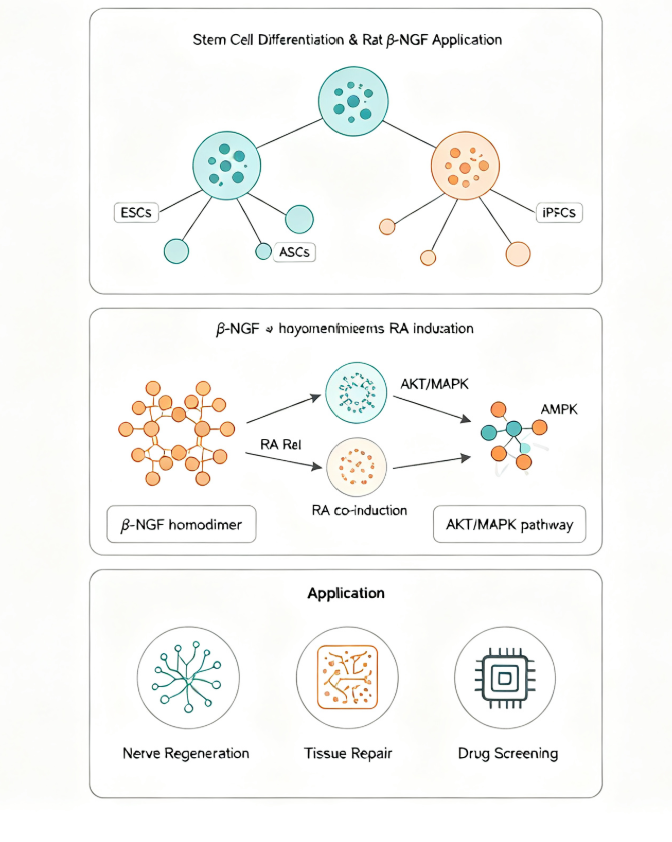
Under in vitro culture conditions, the directed differentiation of stem cells is precisely regulated by microenvironmental signals and chemical inducers. Studies have confirmed that when the culture medium contains retinoic acid (RA) and β-nerve growth factor (β-NGF), embryonic stem cells can be directed to differentiate into neural cells. This discovery highlights the central role of exogenous signaling molecules in determining stem cell fate. Further research has shown that the combined use of retinoic acid and nerve growth factor significantly enhances the differentiation of human umbilical cord blood mesenchymal stem cells into neural-like cells, with the expression levels of neural cell-specific markers being markedly higher than those observed with retinoic acid alone. Additionally, transfection of bone marrow mesenchymal stem cells with a recombinant adenovirus vector carrying the β-NGF gene effectively promotes their differentiation into neurons while avoiding the apoptosis induced by chemical inducers. This mechanism is closely related to the regulation of the AKT and MAPK signaling pathways. The construction and transfection experiments of a rat-derived β-NGF eukaryotic expression vector have also demonstrated that β-NGF significantly promotes the proliferation of embryonic rat midbrain neural stem cells and the growth of neural processes post-differentiation.
Clinical Applications of Stem Cells in Regenerative Medicine
Stem cell research holds significant theoretical and practical importance in tissue engineering, drug screening, and clinical cell transplantation therapy. In cell therapy, the directed differentiation of stem cells into desired tissue cells can provide ample raw materials for transplantation. In principle, any disease involving the loss of normal cell structure and function can be treated with stem cell therapy. Examples include using peripheral blood stem cells to treat leukemia, insulin-producing cells derived from embryonic stem cells to treat diabetes, and dopaminergic neurons to treat Parkinson's disease. Moreover, stem cells serve as ideal targets for gene therapy due to their ease of stable transfection and proliferation in vitro. Stem cells carrying therapeutic genes can function more stably and persistently after implantation in vivo, offering new avenues to overcome the major obstacles in current gene therapy. Members of the nerve growth factor family also play crucial roles in regulating the migration and differentiation of neural stem cells. Studies have shown that NGF, GDNF, BDNF, and NT-3 can enhance the in vitro migration capacity of multipotent astrocyte stem cells and their tendency to differentiate into neuronal phenotypes.
Experimental Application Value of Rat-Derived β-Nerve Growth Factor Protein
As the first member of the neurotrophin family, β-nerve growth factor plays a pivotal role in neural protection and repair. Mouse β-NGF is a homodimer composed of two polypeptide chains, each containing 120 amino acids, with a 95.8% amino acid sequence homology to rat β-NGF and approximately 90% homology to human β-NGF. β-NGF exerts its biological functions through its receptor, β-NGFR, and is critical for the development and maintenance of the sensory and sympathetic nervous systems. It also acts as a growth and differentiation factor for B lymphocytes, enhancing their survival. Research has demonstrated that NGF can functionally regulate various stem cell types, including embryonic stem cells, neural stem cells, mesenchymal stem cells, bone marrow stem cells, and dental pulp stem cells. In vitro induction experiments have shown that a composite induction medium containing all-trans retinoic acid and nerve growth factor can efficiently and stably induce bone marrow stromal stem cells to differentiate into neural-like cells in a serum-free culture system, with low apoptosis rates. The β-NGF Protein, Mouse provided by [Company Name] offers high-quality experimental materials for research on the directed differentiation of stem cells into neural lineages. This product, while possessing the same biological activity as natural proteins, also features high purity and low endotoxin levels, effectively supporting experiments such as neural cell induction, stem cell proliferation regulation, and signaling pathway mechanism studies, thereby advancing basic research and translational applications in regenerative medicine and neuroscience.
This article is reviewed and published by the technical expert team of UA
Disclaimer: This article partially utilizes artificial intelligence assistance in its creation. If any content involves copyright or intellectual property issues, please let us know and we promise to verify and remove it as soon as possible.
Purchase recombinant protein, choose Nanjing UA-Bio
UA protein focuses on providing various protein reagents, raw materials, and services required for drug research and development, cell therapy, gene therapy, and basic scientific research, including drug target proteins, immune checkpoint proteins, cytokines, tool enzymes, customized protein expression, and full-length transmembrane protein development. Youai is committed to providing customers with high-quality products and professional services, and building a High-tech Biological Enterprise with International Competitiveness.
Target proteins | membrane proteins | cytokines | enzymes | viral antigens | protein customization
Nanjing UA Biotechnology Co., Ltd. Email:order@ua-bio.com Phone:+86-25-56221161

Product Information

Link:





©2021-2026 all rights reserved UA Biotechnology Co.,Ltd.
Privacy Policy 
网站备案号 浙ICP备2022019033号-2 浙公网安备33010202004867号
 Business license (three certificates in one)
 Tel:+86-25-56221161
E-mail:order@ua-bio.com
All products sold on this website shall not be used for clinical diagnosis or treatment of humans or animals, and shall only be used for non-medical purposes such as industrial or scientific research.
