




Human FGF-10 protein: An indispensable key regulatory factor in organoid culture
Author: Senior Product Manager of UA Views:56 


Human fibroblast growth factor 10 (FGF-10) plays an irreplaceable core role in organoid culture systems, where it specifically regulates epithelial-mesenchymal interactions and is widely involved in the construction and homeostasis maintenance of various organoids, including those of the stomach, liver, lung, breast, and prostate.
- Recent Advances
- Product Information
Recent Advances
Human FGF-10 Protein: An Indispensable Key Regulatory Factor in Organoid Culture
Brief: Human fibroblast growth factor 10 (FGF-10) plays an irreplaceable core role in organoid culture systems. By specifically regulating epithelial-mesenchymal interactions, it is widely involved in the construction and homeostasis maintenance of various organoids, including gastric, liver, lung, mammary, and prostate organoids.
I. Molecular Characteristics and Functional Localization of FGF-10
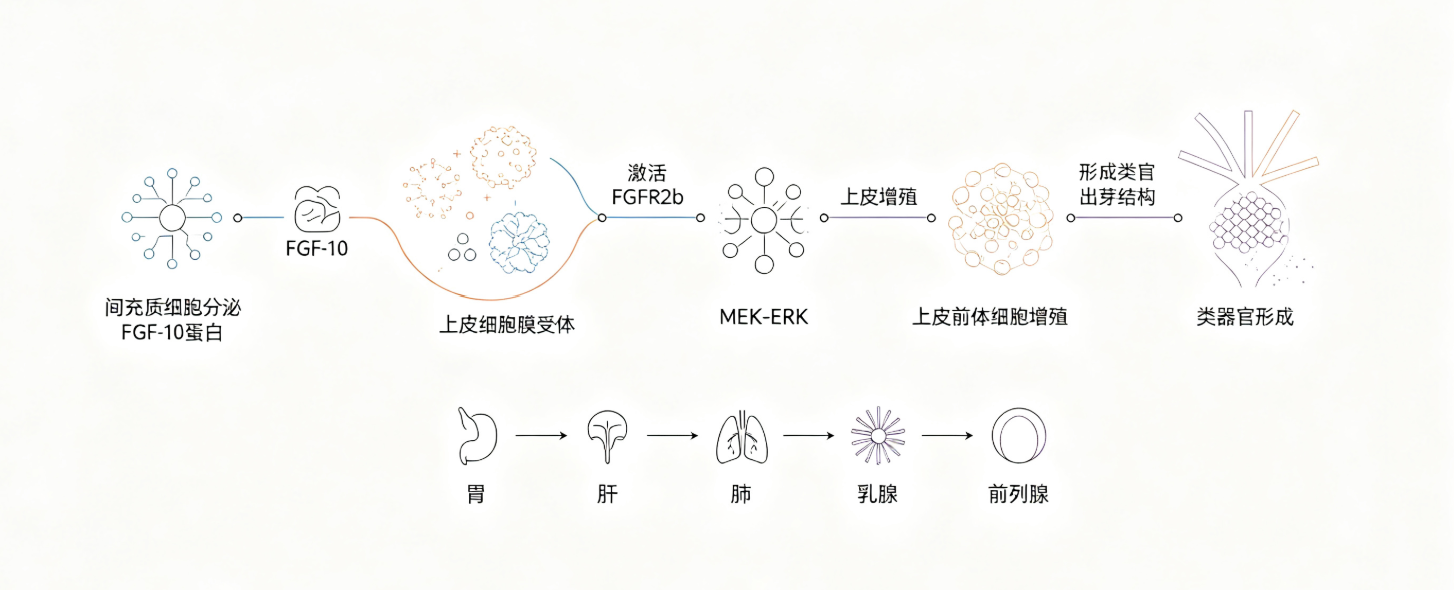
Fibroblast growth factor 10 (FGF-10), also known as keratinocyte growth factor 2 (KGF2), is a member of the FGF family with paracrine functions. This protein is a heparin-binding growth factor that shares high structural homology with FGF-7, both characterized by their ability to specifically promote epithelial cell mitosis. FGF-10 is primarily synthesized and secreted by mesenchymal cells, binding to and activating its receptor FGFR2b to mediate bidirectional signaling between mesenchymal and epithelial cells.
From a functional perspective, FGF-10 plays a dual role in embryonic development and adult tissue homeostasis. During embryonic development, FGF-10 is a key regulatory factor in gastrulation, organ primordium formation, and epithelial branching morphogenesis, participating in the morphological establishment of various organs such as the lungs, limbs, mammary glands, and salivary glands. Studies have confirmed that the spatiotemporal precision of FGF-10 expression is critical to its function—this protein is inherently thermolabile under physiological conditions, with a half-life of less than 30 minutes at 37°C. This instability is an important regulatory mechanism, preventing ectopic signaling that could lead to developmental malformations.
II. Core Mechanisms of FGF-10 in Organoid Culture
The essence of organoid culture is to simulate the microenvironment of organ development in vitro, and FGF-10 plays multiple roles in this simulation system. First, FGF-10 is a critical maintenance factor for the proliferation and survival of epithelial stem cells. Research shows that FGF-10 can promote the proliferation, migration, and anti-apoptosis of epithelial precursor cells through the FGFR1/2-MEK1/2-ERK1/2 signaling pathway, thereby sustaining the long-term expansion capacity of organoids.
Second, FGF-10 participates in regulating cell fate decisions in organoids. For example, in skin appendage organoids, transcriptome analysis reveals that FGF10 and its family members FGF7 and FGF22 are significantly enriched in differentially expressed genes of mouse sweat gland placodes and hair follicle placodes. Further functional experiments confirm that FGF-10 can drive human epidermal cell-derived organoids toward a sweat gland phenotype. In kidney organoids, FGF-10 tends to promote proximal nephron differentiation, forming a fine regulatory network with FGF8b for segmental patterning of nephrons.
Additionally, FGF-10 promotes the formation of three-dimensional structures in organoids. In lung and mammary organoids, FGF-10 induces epithelial budding and branching tubular structures, which are crucial for replicating the physiological architecture of the source tissue.
III. Applications of FGF-10 in Different Types of Organoids
Gastric Organoids. FGF-10 is an essential component in human gastric organoid culture media. Research by the Hans Clevers team demonstrates that adding FGF-10 to a base medium containing EGF, R-spondin 1, Noggin, and Wnt successfully constructs human gastric organoids, which can be used to simulate Helicobacter pylori infection. In gastric organoid culture, the synergistic effects of FGF-10 with other growth factors are indispensable for maintaining the stemness and differentiation potential of gastric epithelial stem cells.
Liver Organoids. A recent study by the Toshiro Sato team published in Nature shows that FGF-10 is one of the key factors for maintaining long-term expansion and metabolic functions in human adult hepatocyte-derived organoids. In this study, an expansion medium containing FGF-10, EGF, HGF, Wnt/R-spondin, and TGFβ inhibitors promoted hepatocytes to form small cystic organoids expressing albumin and HNF4α, enabling stable long-term passaging.
Lung and Prostate Organoids. The role of FGF-10 in branching morphogenesis during lung development has been widely applied to lung organoid construction, where it promotes the growth and branching of bronchial and alveolar organoids. In prostate organoids, FGF-10 is also listed as a key additive.
Mammary and Tumor Organoids. FGF-10 also plays a significant role in mammary organoid and breast cancer organoid cultures, where it collaborates with other factors to promote the formation of three-dimensional structures.
IV. Research Prospects and Product Support
As organoid technology continues to expand in applications such as disease modeling, drug screening, and regenerative medicine, the demand for standardized, high-quality cytokines like FGF-10 is growing. Notably, the inherent thermolability of FGF-10 protein imposes higher requirements on production processes and activity preservation. UniCell's FGF-10 Protein, Human strictly controls product purity, activity, and endotoxin levels, providing stable and reliable support for various organoid culture systems, including gastric, liver, lung, and mammary organoids, facilitating efficient research and translational outcomes.
This article is reviewed and published by the technical expert team of UA
Disclaimer: This article partially utilizes artificial intelligence assistance in its creation. If any content involves copyright or intellectual property issues, please let us know and we promise to verify and remove it as soon as possible.
Purchase recombinant protein, choose Nanjing UA-Bio
UA protein focuses on providing various protein reagents, raw materials, and services required for drug research and development, cell therapy, gene therapy, and basic scientific research, including drug target proteins, immune checkpoint proteins, cytokines, tool enzymes, customized protein expression, and full-length transmembrane protein development. Youai is committed to providing customers with high-quality products and professional services, and building a High-tech Biological Enterprise with International Competitiveness.
Target proteins | membrane proteins | cytokines | enzymes | viral antigens | protein customization
Nanjing UA Biotechnology Co., Ltd. Email:order@ua-bio.com Phone:+86-25-56221161

Product Information

Link:





©2021-2026 all rights reserved UA Biotechnology Co.,Ltd.
Privacy Policy 
网站备案号 浙ICP备2022019033号-2 浙公网安备33010202004867号
 Business license (three certificates in one)
 Tel:+86-25-56221161
E-mail:order@ua-bio.com
All products sold on this website shall not be used for clinical diagnosis or treatment of humans or animals, and shall only be used for non-medical purposes such as industrial or scientific research.
