




Human KRAS G12V mutant protein: structural features, pathogenic mechanisms, and research applications
Author: Senior Product Manager of UA Views:100 


KRAS is one of the most important proto-oncogenes in the human body, with mutations found in approximately 30% of human malignancies. Among these, the G12V mutation (substitution of glycine with valine at position 12) is one of the most common oncogenic variants.
- Recent Advances
- Product Information
Recent Advances
Human KRAS G12V Mutant Protein: Structural Features, Pathogenic Mechanisms, and Research Applications
Summary: KRAS is one of the most important proto-oncogenes in the human body, with mutations found in approximately 30% of human malignancies. Among these, the G12V mutation (glycine at position 12 replaced by valine) is one of the most common oncogenic variants. This mutation weakens the intrinsic GTPase activity of the KRAS protein and confers resistance to GTPase-activating proteins, keeping KRAS persistently in the GTP-bound activated state, thereby driving abnormal activation of multiple downstream pro-oncogenic signaling pathways.
Molecular Structural Basis and Conformational Features of KRAS G12V Mutant
The KRAS gene encodes a small GTPase protein with a molecular weight of approximately 21 kDa, which functions as a critical molecular switch in cellular signal transduction. This protein regulates various biological processes such as cell proliferation, differentiation, and survival by cycling between different guanosine nucleotide-bound states (GTP-bound active state and GDP-bound inactive state). Structurally, KRAS consists of a G domain (responsible for nucleotide binding and hydrolysis) and a hypervariable region (involved in membrane localization). The G domain contains Switch I and Switch II regions, which are crucial for conformational transitions. In the G12V mutation, the highly conserved glycine at position 12 in the phosphate-binding loop (P-loop) is replaced by the bulkier valine. This amino acid substitution spatially hinders the proper positioning of key residues during GTP hydrolysis and weakens the GTPase-activating protein-mediated acceleration of GTP hydrolysis. X-ray crystallography studies have provided high-resolution structural information on the G12V mutant. The PDB database entry 4tq9 reveals that the GDP-bound KRAS G12V mutant shares a similar overall fold with the wild-type protein but exhibits subtle differences in the conformations of the Switch I and Switch II regions, which may affect its binding affinity to downstream effector proteins. Another crystallographic study (PDB 5uqw) resolved the structure of KRAS G12V in complex with GDP at 1.5 Å resolution, offering an atomic-level detailed view of how the mutation alters the intrinsic conformational dynamics of the protein.
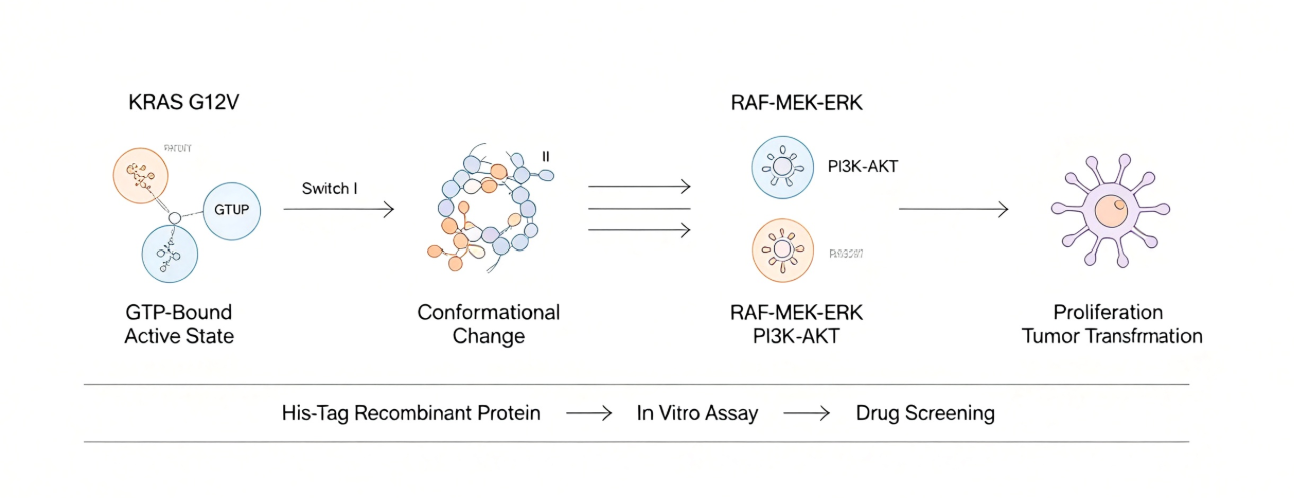
Molecular Pathogenic Mechanisms of G12V Mutation Driving KRAS Persistent Activation
The gain-of-function effect of the KRAS G12V mutation has been widely validated. Under normal physiological conditions, the GTPase activity of KRAS hydrolyzes bound GTP to GDP, thereby turning off the signal. However, the G12V mutation confers resistance to GTPase-activating protein-mediated hydrolysis, causing KRAS to preferentially accumulate in the GTP-bound active form and persistently activate downstream signaling cascades even in the absence of upstream growth signals. The COSMIC database clearly classifies G12V as one of the most common pathogenic missense mutations in KRAS, noting that the mutation impairs intrinsic GTPase activity and confers resistance to GTPase-activating proteins, leading to the accumulation of Ras protein in the active GTP-bound state. Functionally, persistently activated KRAS G12V abnormally activates key pro-oncogenic pathways such as RAF-MEK-ERK and PI3K-AKT, driving malignant cell transformation, uncontrolled proliferation, and anti-apoptotic phenotypes. A systematic study comparing various KRAS mutations found that the G12V mutation can mediate epidermal growth factor-independent proliferation in MCF10A mammary epithelial cells, with its effect strength differing from other hotspot mutations (e.g., G12D, G13D), suggesting that different positions and types of amino acid substitutions may confer unique biochemical properties and transforming capabilities to the mutant protein. Additionally, studies have shown that KRAS can form dimers, and dimerization is crucial for the oncogenic activity of mutant KRAS, providing a theoretical basis for therapeutic strategies targeting the KRAS dimerization interface.
Interaction Network of KRAS G12V with Downstream Effector Proteins
The G12V mutation not only alters the nucleotide-binding preference of KRAS but also profoundly affects its interaction patterns with various effector proteins. Recent studies using proximity labeling techniques (TurboID) combined with quantitative proteomics have systematically mapped the protein interaction networks of wild-type KRAS and high-frequency mutants such as G12V. The results show that the G12V mutant exhibits mutation-specific changes in binding partners and features of metabolic pathway reprogramming, including significant enrichment in insulin signaling, reactive oxygen regulation, and glucose and lipid metabolism pathways. At the structural level, the G12V mutation also affects KRAS's ability to form complexes with specific effector proteins. Researchers have reported the crystal structure of KRAS G12V forming a 2:2 heterotetramer with the Ras-binding domain (RA domain) of Rgl2, revealing that the G12V mutation is located precisely at the dimerization interface between KRAS and its binding partner, potentially altering the interaction dynamics at the interface to affect the activation efficiency of the RalA/B pathway. These findings indicate that KRAS G12V is not simply "locked" in an active state but reprograms cellular signal output by reconstructing protein interaction networks, a realization with important implications for the development of mutation-selective inhibitors.
His-Tagged Recombinant Protein-Based Research Tools and Applications for KRAS G12V
High-quality KRAS G12V recombinant protein is a core reagent for the aforementioned studies. To facilitate protein purification, detection, and interaction analysis in vitro, researchers typically fuse a polyhistidine tag (His-tag) to its N- or C-terminus. Currently, various commercially available His-tagged KRAS G12V recombinant proteins are available. Typical product designs usually cover amino acids 2-185 of KRAS (isoform b), which includes the complete G domain, with a 6×His tag introduced at the N-terminus to enable efficient metal chelate affinity chromatography purification. Depending on the application scenario, these protein products can be provided in different nucleotide-loaded states: GDP-loaded forms are suitable for studying nucleotide exchange activity or screening regulators that promote GDP/GTP exchange; non-hydrolyzable GTP analog (e.g., GppNHp)-loaded forms can be used to stably capture the active conformation of the protein, facilitating binding experiments with downstream effector proteins; and fluorescently labeled BODIPY-GDP-loaded forms are particularly suitable for high-throughput screening experiments based on fluorescence polarization or fluorescence resonance energy transfer principles. In terms of purity, these recombinant proteins typically achieve over 90% purity after affinity purification and are provided in aqueous buffer systems (e.g., 20 mM HEPES pH 7.4, 150 mM NaCl, 1 mM DTT) to maintain protein conformational stability and functional activity. The KRAS(G12V) His Tag Protein, Human provided by UniLoveBio adheres to the above quality standards and can be used for enzyme kinetics studies, high-throughput inhibitor screening, and selective profiling analysis, providing reliable research materials for KRAS-targeted drug development.
This article is reviewed and published by the technical expert team of UA
Disclaimer: This article partially utilizes artificial intelligence assistance in its creation. If any content involves copyright or intellectual property issues, please let us know and we promise to verify and remove it as soon as possible.
Purchase recombinant protein, choose Nanjing UA-Bio
UA protein focuses on providing various protein reagents, raw materials, and services required for drug research and development, cell therapy, gene therapy, and basic scientific research, including drug target proteins, immune checkpoint proteins, cytokines, tool enzymes, customized protein expression, and full-length transmembrane protein development. Youai is committed to providing customers with high-quality products and professional services, and building a High-tech Biological Enterprise with International Competitiveness.
Target proteins | membrane proteins | cytokines | enzymes | viral antigens | protein customization
Nanjing UA Biotechnology Co., Ltd. Email:order@ua-bio.com Phone:+86-25-56221161

Product Information

Link:





©2021-2026 all rights reserved UA Biotechnology Co.,Ltd.
Privacy Policy 
网站备案号 浙ICP备2022019033号-2 浙公网安备33010202004867号
 Business license (three certificates in one)
 Tel:+86-25-56221161
E-mail:order@ua-bio.com
All products sold on this website shall not be used for clinical diagnosis or treatment of humans or animals, and shall only be used for non-medical purposes such as industrial or scientific research.
