




The application value of Alexa Fluor 647-labeled GPC3 Fc chimeric protein in liver cancer research
Author: Senior Product Manager of UA Views:104 


Glypican-3 (GPC3), as a hepatocellular carcinoma-specific tumor antigen, has become a crucial target in the field of precision medicine. By combining the targeting specificity of GPC3 with the superior fluorescence performance of Alexa Fluor 647, the developed fluorescently labeled chimeric protein provides a highly sensitive and specific research tool for tumor marker detection, cell phenotype identification, and targeted drug development.
- Recent Advances
- Product Information
Recent Advances
Application Value of Alexa Fluor 647-Labeled GPC3 Fc Chimera Protein in Liver Cancer Research
Brief Description: Glypican-3 (GPC3), as a hepatocellular carcinoma-specific tumor antigen, has become a critical target in precision medicine. Combining the targeting specificity of GPC3 with the superior fluorescence performance of Alexa Fluor 647, the developed fluorescently labeled chimera protein provides a highly sensitive and specific research tool for tumor marker detection, cell phenotyping, and targeted drug development.
Biological Basis of GPC3 as a Core Marker for Hepatocellular Carcinoma
Hepatocellular carcinoma (HCC) is a malignant tumor with a high global mortality rate, characterized by difficulties in early diagnosis, high recurrence rates, and strong heterogeneity, posing significant clinical challenges. In the exploration of precision treatment strategies, Glypican-3 (GPC3) has emerged as a prominent target due to its unique expression profile. GPC3 belongs to the heparan sulfate proteoglycan family and is anchored to the cell membrane via glycosylphosphatidylinositol. Under physiological conditions, GPC3 is nearly undetectable in normal adult liver tissue; however, in HCC, approximately 70% to 80% of cases exhibit high GPC3 expression. This tumor-specific distribution makes it an ideal diagnostic marker and therapeutic target.
From a functional perspective, GPC3 participates in regulating multiple pro-oncogenic signaling pathways, including Wnt/β-catenin, MAPK, PI3K/AKT/mTOR, and Hedgehog pathways, thereby promoting tumor cell proliferation, survival, epithelial-mesenchymal transition, and immune evasion. Clinical studies also indicate that GPC3-positive expression is closely associated with poor prognosis and higher recurrence risk in HCC patients. Based on this evidence, GPC3 has been confirmed as a core biomarker for HCC diagnosis, prognosis assessment, and targeted therapy, with the reliability and convenience of its detection methods directly impacting the quality of related research.
Structural Design Principles of GPC3 Fc Chimera Protein
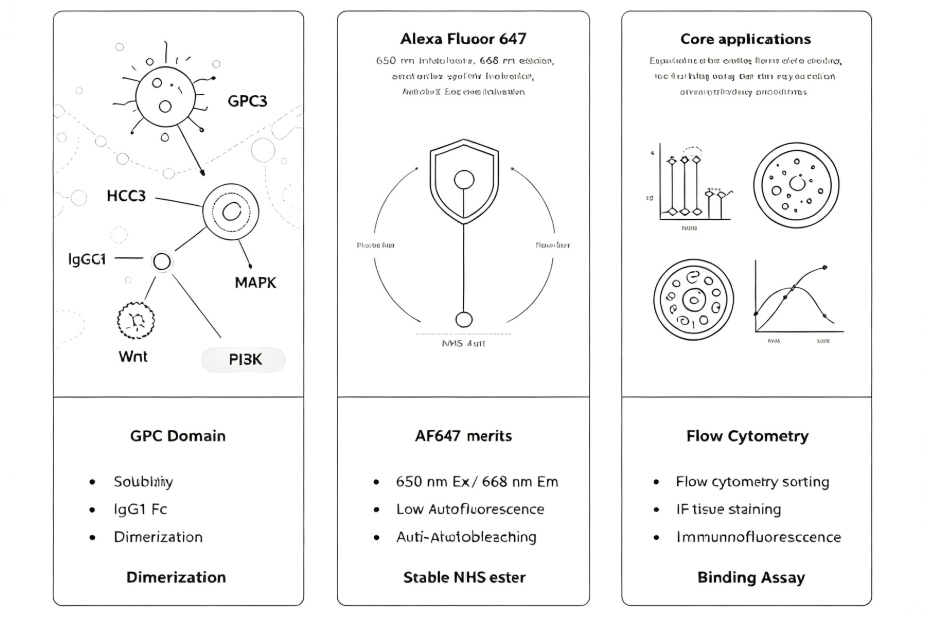
The natural full-length GPC3 protein faces technical limitations in vitro, such as poor solubility, insufficient stability, and susceptibility to degradation, making it difficult to meet standardized experimental requirements. To overcome these challenges, the GPC3 Fc chimera protein employs genetic recombination technology to fuse the extracellular functional domain of human GPC3 with the Fc fragment of human immunoglobulin G1. This design offers multiple structural advantages: first, the Fc fragment significantly enhances the protein's solubility and storage stability, extending the reagent's effective shelf life; second, the Fc tag facilitates high-purity preparation via affinity chromatography, effectively reducing interference from impurities; third, the fusion protein retains the complete targeting recognition domain of the GPC3 extracellular region, ensuring specific binding to natural GPC3 molecules on cell surfaces. Additionally, the Fc fragment-mediated dimerization structure allows the chimera protein to exist as a homodimer, mimicking the multivalent binding mode of natural ligands and enhancing target-binding affinity.
Technical Advantages of Alexa Fluor 647 Fluorescent Labeling
Alexa Fluor 647 is a high-performance near-infrared fluorescent dye with an excitation wavelength of 650 nm and an emission wavelength of 668 nm, highly compatible with the laser configurations of mainstream flow cytometers and fluorescence microscopes. Compared to traditional fluorescent dyes, Alexa Fluor 647 exhibits significant technical advantages. First, biological samples exhibit extremely low background autofluorescence in the far-infrared range, resulting in a superior signal-to-noise ratio compared to short-wavelength dyes such as FITC or PE. Second, Alexa Fluor 647 demonstrates excellent photostability, with outstanding resistance to photobleaching, enabling continuous imaging and repeated detection under prolonged laser exposure. Third, the dye's excellent water solubility minimizes protein aggregation or denaturation post-labeling, preserving the conformational integrity and biological activity of the labeled protein. The labeling process employs an NHS ester-amine covalent coupling strategy, forming stable amide bonds with the primary amine groups of lysine residues on the GPC3 Fc chimera protein surface, yielding uniform labeling products with low fluorescence loss rates.
Core Application Scenarios of Alexa Fluor 647-Labeled GPC3 Fc Chimera Protein
In flow cytometry, this labeled protein serves as a probe to accurately identify GPC3-positive hepatocellular carcinoma cell lines, such as HepG2 and Huh7, for cell phenotyping, positive cell sorting, and preliminary screening of targeted drugs. Studies show that the probe exhibits concentration-dependent binding curves in flow cytometry and effectively distinguishes between GPC3-positive and -negative cell populations. In immunofluorescence imaging, AF647-labeled chimera protein is suitable for in situ staining of cell monolayers and tissue sections, visually revealing the spatial distribution and subcellular localization of GPC3 in tumor tissues, providing experimental evidence for pathological mechanism research. Additionally, in molecular interaction studies, the probe can be used to quantitatively analyze binding kinetics parameters between GPC3 and candidate drugs, downstream ligands, or antibodies, facilitating the screening and optimization of targeted drugs.
Notably, U-爱 offers Alexa Fluor 647-Labeled GPC3 Fc Chimera Protein, Human, prepared using the HEK293 cell expression system. After fluorescent labeling, the product is supplied in lyophilized or solution form, suitable for research scenarios such as flow cytometry, immunofluorescence imaging, and protein binding assays, providing direct and convenient reagent support for the aforementioned applications.
This article is reviewed and published by the technical expert team of UA
Disclaimer: This article partially utilizes artificial intelligence assistance in its creation. If any content involves copyright or intellectual property issues, please let us know and we promise to verify and remove it as soon as possible.
Purchase recombinant protein, choose Nanjing UA-Bio
UA protein focuses on providing various protein reagents, raw materials, and services required for drug research and development, cell therapy, gene therapy, and basic scientific research, including drug target proteins, immune checkpoint proteins, cytokines, tool enzymes, customized protein expression, and full-length transmembrane protein development. Youai is committed to providing customers with high-quality products and professional services, and building a High-tech Biological Enterprise with International Competitiveness.
Target proteins | membrane proteins | cytokines | enzymes | viral antigens | protein customization
Nanjing UA Biotechnology Co., Ltd. Email:order@ua-bio.com Phone:+86-25-56221161

Product Information

Link:





©2021-2026 all rights reserved UA Biotechnology Co.,Ltd.
Privacy Policy 
网站备案号 浙ICP备2022019033号-2 浙公网安备33010202004867号
 Business license (three certificates in one)
 Tel:+86-25-56221161
E-mail:order@ua-bio.com
All products sold on this website shall not be used for clinical diagnosis or treatment of humans or animals, and shall only be used for non-medical purposes such as industrial or scientific research.
