




CD22: An Emerging Target for the Treatment of B-Cell Malignancies and Autoimmune Diseases
Author: Senior Product Manager of UA Views:76 


This article systematically elaborates on the molecular structure and functional characteristics of CD22 (Siglec-2) as an inhibitory co-receptor on the surface of B cells, its physiological role in B cell development and signal regulation, its widespread expression profile in B cell malignancies, and the clinical progress of monoclonal antibodies, antibody-drug conjugates, and CAR-T cell therapies developed based on this foundation. Additionally, it introduces the detection and application value of fluorescently labeled recombinant proteins.
- Recent Advances
- Product Information
Recent Advances
CD22: An Emerging Target for B-cell Malignancies and Autoimmune Diseases
Summary: This article systematically elaborates on the molecular structure and functional characteristics of CD22 (Siglec-2) as an inhibitory co-receptor on B-cell surfaces, its physiological role in B-cell development and signal regulation, its broad expression profile in B-cell malignancies, and the clinical progress of monoclonal antibodies, antibody-drug conjugates, and CAR-T cell therapies developed based on this target. It also introduces the detection application value of fluorescently labeled recombinant proteins.
1. Discovery and Molecular Structure of CD22
CD22, also known as Siglec-2 (sialic acid-binding immunoglobulin-type lectin 2), is a B-cell surface molecule that has garnered widespread attention in recent years. This protein belongs to the immunoglobulin superfamily and the Siglec family, with its gene located on human chromosome 19. From a structural biology perspective, CD22 is a transmembrane glycoprotein. Its extracellular region contains seven immunoglobulin-like domains, with the N-terminal first domain responsible for recognizing and binding sialic acid-containing glycans, enabling CD22 to mediate cell-cell interactions. The transmembrane region consists of a single-pass helix connecting the extracellular domains to the intracellular tail. The intracellular region contains three immunoreceptor tyrosine-based inhibitory motifs (ITIMs), which play a central role in signal transduction.
2. Physiological Functions of CD22 in B-cell Development and Signal Regulation
As one of the inhibitory co-receptors on B-cell surfaces, CD22 plays an indispensable role in the development, differentiation, and functional regulation of B-cells. During B-cell development, CD22 is first expressed in the cytoplasm of pro-B cells and pre-B cells. It gradually appears on the cell surface as B-cells mature into IgD+ cells and persists in mature B-cells until terminal differentiation into plasma cells, where its expression levels significantly decline. This expression pattern suggests that CD22 is crucial in regulating the threshold of B-cell receptor signal transduction.
From a molecular mechanism perspective, the intracellular ITIM motifs of CD22, when phosphorylated by Src family kinases (e.g., Lyn), recruit SH2 domain-containing protein tyrosine phosphatase SHP-1 and inositol phosphatase SHIP. SHP-1 dephosphorylates key kinases (e.g., Syk and Btk) in the B-cell receptor signaling pathway, effectively inhibiting downstream signal transduction. Thus, CD22 acts as a "brake" in the B-cell signaling network, preventing excessive responses to self-antigens and serving as a critical safeguard for immune tolerance. Notably, CD22 and CD19 form a balanced regulatory relationship in B-cell signaling—CD19 enhances Lyn kinase activity to regulate CD22 phosphorylation, while CD22 inhibits CD19 phosphorylation via SHP-1.
3. Expression Characteristics of CD22 in B-cell Malignancies
Studies have confirmed that CD22 is widely expressed on the surface of most B-cell malignancy cells, covering major subtypes of B-cell lineage malignancies. In acute lymphoblastic leukemia, over 90% of B-ALL cases show CD22 expression on leukemia blasts, with expression levels correlating with disease progression. In non-Hodgkin lymphoma, multiple subtypes, including diffuse large B-cell lymphoma and mantle cell lymphoma, exhibit CD22 positivity. In chronic lymphocytic leukemia, CD22 is also stably expressed on malignant B-cells. Compared to the expression profile of CD19, CD22 expression is relatively independent—clinical observations indicate that some patients who relapse after CD19 CAR-T therapy due to CD19 antigen loss still retain CD22 expression on tumor cells. This feature makes CD22 an important alternative target for addressing antigen escape after CD19-targeted therapy.
4. Unique Advantages of CD22 as a Therapeutic Target
CD22 offers multiple unique advantages as a therapeutic target. First, its expression range in the B-cell lineage lies between CD20 and CD19—it covers broader B-cell developmental stages (from pro-B to mature B-cells) than CD20 but is more restricted to the B-cell lineage than CD19, providing a reasonable therapeutic window. Second, CD22 exhibits endocytic properties—antibodies bound to CD22 can enter cells via receptor-mediated endocytosis, offering a biological basis for antibody-drug conjugates to deliver cytotoxic payloads into tumor cells. Third, CD22 expression in normal tissues is highly restricted to the B-cell lineage, with almost no expression in non-hematopoietic tissues, reducing the risk of off-target toxicity. Based on these advantages, CD22 has become an attractive target in the treatment of autoimmune diseases and B-cell malignancies.
5. Landscape of CD22-targeted Drug Development
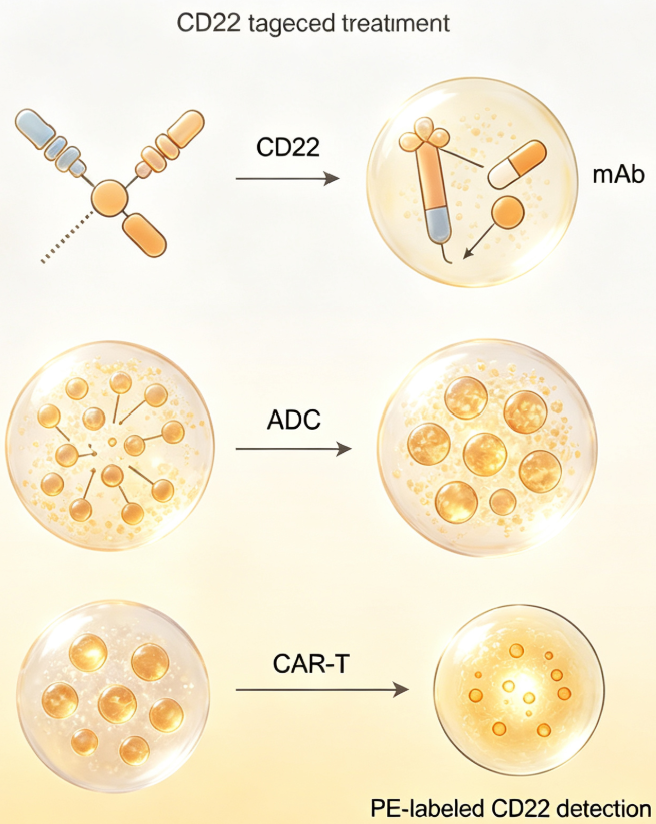
Currently, CD22-targeted therapies fall into three main categories, each with distinct mechanisms and clinical characteristics.
Monoclonal antibodies are the foundational form of CD22-targeted drugs. Anti-CD22 monoclonal antibodies specifically bind CD22 on tumor cell surfaces via their Fab regions and mediate antibody-dependent cellular cytotoxicity (ADCC) and complement-dependent cytotoxicity (CDC) through their Fc regions to eliminate tumor cells. However, due to the limited efficacy of antibody-dependent CDC and ADCC effects in clinical settings, additional mechanisms are often required to enhance antitumor activity.
Antibody-drug conjugates (ADCs) are the most mature and clinically successful category of CD22-targeted drugs. Epratuzumab, an early-developed anti-CD22 monoclonal antibody, binds to the juxtamembrane epitope of CD22, inducing CD22 internalization and modulating B-cell receptor signaling. Building on this, inotuzumab ozogamicin conjugates an anti-CD22 antibody with calicheamicin, enabling precise chemotherapeutic killing of CD22-positive tumor cells. It has been FDA-approved for treating relapsed/refractory B-ALL. Additionally, moxetumomab pasudotox, which fuses an anti-CD22 antibody with a truncated Pseudomonas exotoxin, has been approved for hairy cell leukemia. The core advantage of ADCs lies in leveraging CD22's endocytic properties to deliver highly cytotoxic payloads directly into tumor cells.
CAR-T cell therapy is the fastest-growing area in CD22-targeted treatment. Clinical studies show that CD22 CAR-T achieves overall response rates exceeding 70% in children and young adults with relapsed/refractory B-ALL. However, similar to CD19 CAR-T, single-target CD22 CAR-T faces resistance and relapse due to antigen loss. To overcome this limitation, CD19/CD22 dual-targeting CAR-T strategies have become a research focus, with multiple clinical studies actively underway.
6. Conclusion
As a key inhibitory co-receptor on B-cell surfaces, CD22 has emerged as an important new target in the treatment of autoimmune diseases and B-cell malignancies, owing to its regulatory functions throughout B-cell development, broad coverage in B-cell malignancies, unique endocytic properties, and moderate expression profile. From monoclonal antibodies and antibody-drug conjugates to CAR-T cell therapies, the landscape of CD22-targeted drug development is diversifying, with CD19/CD22 dual-targeting strategies offering effective solutions to antigen escape. Univ offers PE-Labeled Siglec-2/CD22 Fc&Avi Tag Protein, Human. This product, with its precise molecular design, Fc tag-induced dimerization advantages, Avi tag-enabled flexible detection schemes, and PE dye's high-brightness signals, provides a stable and reliable detection tool for CD22-related CAR-T cell screening, targeted drug binding activity analysis, and dual-target strategy clinical translation research.
This article is reviewed and published by the technical expert team of UA
Disclaimer: This article partially utilizes artificial intelligence assistance in its creation. If any content involves copyright or intellectual property issues, please let us know and we promise to verify and remove it as soon as possible.
Purchase recombinant protein, choose Nanjing UA-Bio
UA protein focuses on providing various protein reagents, raw materials, and services required for drug research and development, cell therapy, gene therapy, and basic scientific research, including drug target proteins, immune checkpoint proteins, cytokines, tool enzymes, customized protein expression, and full-length transmembrane protein development. Youai is committed to providing customers with high-quality products and professional services, and building a High-tech Biological Enterprise with International Competitiveness.
Target proteins | membrane proteins | cytokines | enzymes | viral antigens | protein customization
Nanjing UA Biotechnology Co., Ltd. Email:order@ua-bio.com Phone:+86-25-56221161

Product Information

Link:





©2021-2026 all rights reserved UA Biotechnology Co.,Ltd.
Privacy Policy 
网站备案号 浙ICP备2022019033号-2 浙公网安备33010202004867号
 Business license (three certificates in one)
 Tel:+86-25-56221161
E-mail:order@ua-bio.com
All products sold on this website shall not be used for clinical diagnosis or treatment of humans or animals, and shall only be used for non-medical purposes such as industrial or scientific research.
