




The ATG4B-TBK1 signaling axis: A novel mechanism in antiviral immune regulation and potential therapeutic target
Author: Senior Product Manager of UA Views:81 


This article focuses on the central role of TANK-binding kinase 1 (TBK1) in the type I interferon signaling pathway, systematically elucidates the negative regulatory mechanism of the autophagy-related protein ATG4B on TBK1, analyzes the molecular basis of ATG4B-mediated selective autophagic degradation of TBK1 through GABARAP and its pathological significance in viral infection, explores the potential therapeutic value of ATG4B inhibitors in enhancing antiviral immune responses, and introduces the detection applications of enzyme-labeled recombinant proteins in related research.
- Recent Advances
- Product Information
Recent Advances
ATG4B-TBK1 Signaling Axis: A Novel Mechanism in Antiviral Immune Regulation and Potential Therapeutic Target
Summary: This article focuses on the central role of TANK-binding kinase 1 (TBK1) in the type I interferon signaling pathway, systematically elucidating the negative regulatory mechanism of autophagy-related protein ATG4B on TBK1. It analyzes the molecular basis of ATG4B-mediated selective autophagy degradation of TBK1 through GABARAP and its pathological significance in viral infection, explores the potential therapeutic value of ATG4B inhibitors in enhancing antiviral immune responses, and introduces the application of enzyme-labeled recombinant proteins in related research.
1. The Central Role of TBK1 in Antiviral Innate Immunity.
TANK-binding kinase 1 (TBK1) is a key kinase that initiates the secretion of type I interferons, occupying an irreplaceable central hub position in the host's innate immune response against viral infections. Upon viral invasion, pathogen-associated molecular patterns are recognized by pattern recognition receptors, subsequently activating TBK1. Activated TBK1 phosphorylates the downstream signaling molecule interferon regulatory factor 3 (IRF3), promoting IRF3 dimerization and translocation to the nucleus, ultimately initiating the transcription and translation of type I interferons (including IFN-α and IFN-β) and various pro-inflammatory cytokines, thereby establishing an antiviral state.
Given TBK1's critical role in immune signal initiation, its activity is strictly regulated at multiple levels, involving various post-translational modification mechanisms such as phosphorylation, ubiquitination, SUMOylation, and acetylation. These modifications collectively form a precise and complex regulatory network, ensuring that TBK1 can be rapidly activated during early infection to initiate an effective antiviral response while being promptly inhibited during late infection or excessive activation to restore immune homeostasis and avoid excessive inflammatory damage. In recent years, how autophagy-related proteins participate in this regulatory network has become a cutting-edge question in the field.
2. Cross-Regulation Between Autophagy Pathway and Antiviral Immunity.
Autophagy is an evolutionarily highly conserved intracellular degradation process, completed through the coordinated action of multiple autophagy-related proteins. Among them, the ATG4-ATG8 family protein ubiquitin-like conjugation system constitutes the core mechanism of autophagosome formation and material degradation. After synthesis, ATG8 family members must be cleaved by ATG4 family proteins to expose the C-terminal glycine, which is then sequentially activated by the E1-like enzyme ATG7 and the E2-like enzyme ATG3, ultimately conjugated to phosphatidylethanolamine via the E3-like enzyme complex and anchored to the autophagosome membrane. Simultaneously, ATG4 can recycle ATG8 family members from the membrane through deconjugation, dynamically regulating autophagic flux.
Recent studies suggest that ATG4 family members may participate in various biological processes beyond autophagy, particularly playing a potential key role in antiviral defense. However, the specific molecular mechanisms by which ATG4 family members regulate host antiviral immunity remain incompletely understood and require further exploration.
3. Identification of ATG4B as a Negative Regulator of Type I Interferon Signaling Pathway.
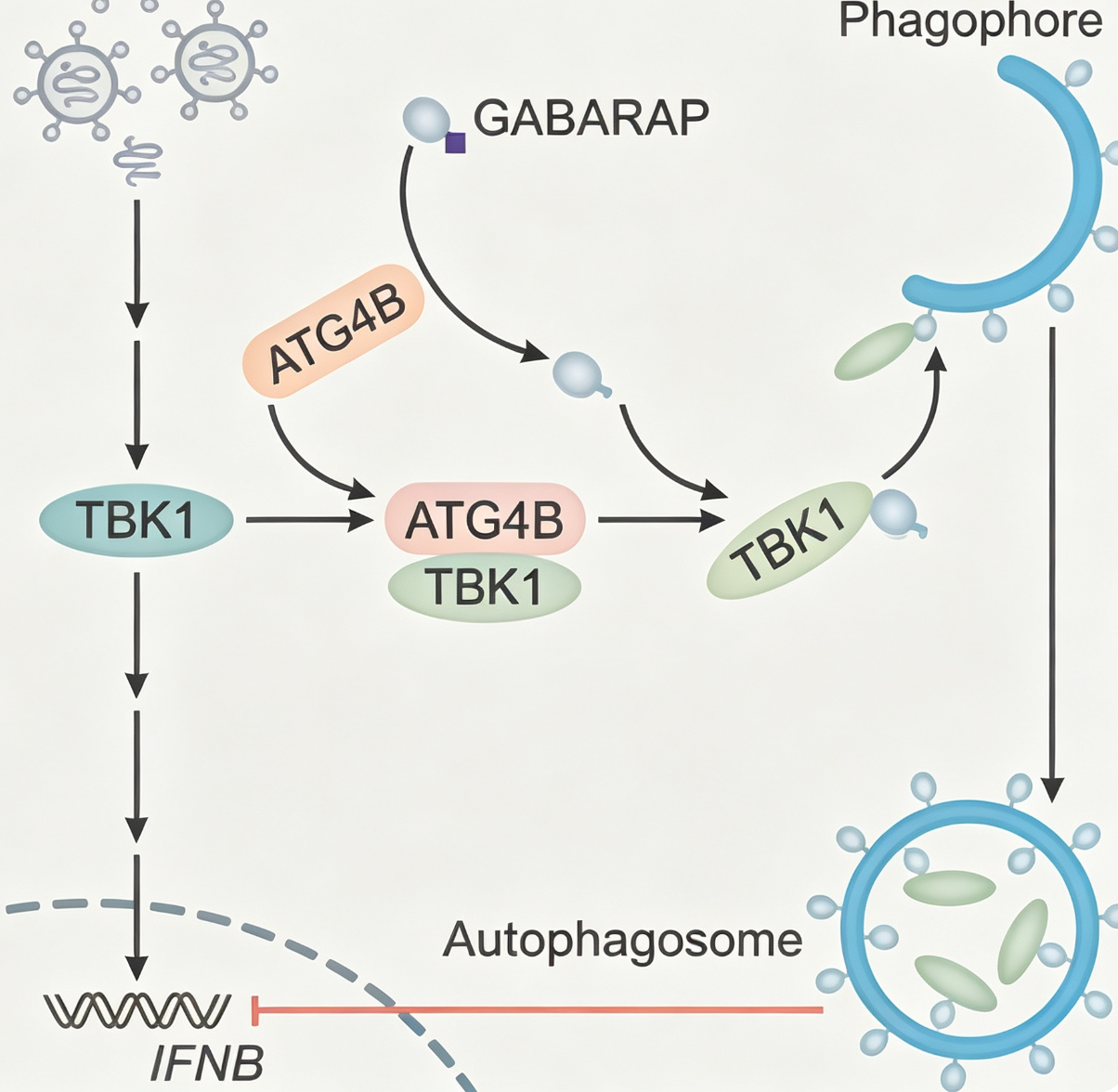
To systematically investigate the function of the ATG4 family in antiviral immunity, researchers first constructed knockout cell lines for ATG4A, ATG4B, ATG4C, and ATG4D and measured the production levels of type I interferons under viral infection conditions. The results showed that the absence of ATG4B significantly enhanced type I interferon production, suggesting that ATG4B acts as a negative regulator in the antiviral immune response. Further mechanistic exploration revealed that ATG4B does not directly act on IRF3 or its upstream kinase cascade but targets TBK1 itself, promoting TBK1 protein degradation to weaken the output intensity of type I interferon signals.
4. Molecular Mechanism: ATG4B as an Adaptor Protein Mediating Selective Autophagy Degradation of TBK1.
Through co-immunoprecipitation and protein interaction experiments, researchers elucidated the detailed molecular mechanism by which ATG4B mediates TBK1 degradation. During the late stages of viral infection, ATG4B acts as an adaptor protein, simultaneously interacting with TBK1 and GABARAP (GABA type A receptor-associated protein, an ATG8 family member). Specifically, the ULK-like domain (ULD) of TBK1 contains an LIR motif that directly binds GABARAP. ATG4B binds GABARAP through its LC3-interacting region (LIR), thereby "bridging" TBK1 to GABARAP-containing autophagosome precursor membranes and guiding TBK1 into the autophagy degradation pathway. Since this process occurs during the late stages of viral infection, its biological significance lies in timely termination of excessive immune signals to prevent persistent inflammatory responses from causing damage to the organism.
5. Validation of the Antiviral Potential of ATG4B Inhibitors.
Based on the above mechanism, researchers further explored pharmacological intervention strategies targeting ATG4B. Using the ATG4B-specific inhibitor S130 to treat cells, it was found that S130 strongly inhibits the cleavage activity of ATG4B, thereby blocking the ATG4B-dependent autophagy degradation of TBK1. In vitro cell experiments, S130 treatment significantly enhanced the protein stability of TBK1, the phosphorylation level of IRF3, and the secretion of type I interferons in virus-infected cells. More importantly, in an in vivo vesicular stomatitis virus (VSV) infection model, S130 administration similarly enhanced the antiviral response, significantly alleviated pathological damage caused by viral infection, and improved animal survival rates. These results demonstrate that ATG4B is not only an immune negative regulator but also a potential target for antiviral drug development. By inhibiting ATG4B to "protect" TBK1 from autophagy degradation, thereby enhancing the body's antiviral immune capacity, this represents a novel therapeutic strategy distinct from directly targeting viral proteins.
6. Conclusion.
As the core kinase initiating the type I interferon response, the regulation of TBK1 activity is crucial in antiviral immunity. ATG4B, in collaboration with GABARAP, targets TBK1 for selective autophagy degradation during the late stages of viral infection, thereby exerting a negative regulatory function on the immune response. The elucidation of this mechanism not only deepens the understanding of autophagy-immune cross-regulation but also provides a new intervention target for antiviral therapy. The validation of the in vitro and in vivo antiviral activity of the ATG4B inhibitor S130 further demonstrates the clinical translational potential of this strategy. UniScience offers HRP-Labeled ATG4B His Tag Protein, Human, which, with its precise molecular design, high-sensitivity enzyme labeling, and compatibility with various detection applications, provides a stable and reliable detection tool for ATG4B-related enzyme activity analysis, interaction protein screening, and inhibitor screening.
This article is reviewed and published by the technical expert team of UA
Disclaimer: This article partially utilizes artificial intelligence assistance in its creation. If any content involves copyright or intellectual property issues, please let us know and we promise to verify and remove it as soon as possible.
Purchase recombinant protein, choose Nanjing UA-Bio
UA protein focuses on providing various protein reagents, raw materials, and services required for drug research and development, cell therapy, gene therapy, and basic scientific research, including drug target proteins, immune checkpoint proteins, cytokines, tool enzymes, customized protein expression, and full-length transmembrane protein development. Youai is committed to providing customers with high-quality products and professional services, and building a High-tech Biological Enterprise with International Competitiveness.
Target proteins | membrane proteins | cytokines | enzymes | viral antigens | protein customization
Nanjing UA Biotechnology Co., Ltd. Email:order@ua-bio.com Phone:+86-25-56221161

Product Information

Link:





©2021-2026 all rights reserved UA Biotechnology Co.,Ltd.
Privacy Policy 
网站备案号 浙ICP备2022019033号-2 浙公网安备33010202004867号
 Business license (three certificates in one)
 Tel:+86-25-56221161
E-mail:order@ua-bio.com
All products sold on this website shall not be used for clinical diagnosis or treatment of humans or animals, and shall only be used for non-medical purposes such as industrial or scientific research.
