




The Molecular Basis of EGFR Mutations, Clinical Characteristics, and Their Significance in Targeted Therapy for Lung Cancer
Author: Senior Product Manager of UA Views:93 


This article systematically elucidates the physiological functions and pathological mutations of the epidermal growth factor receptor (EGFR) gene, focusing on its short-term controllable mechanisms in normal cellular signal regulation and its signal dysregulation caused by mutations in lung cancer. It analyzes the epidemiological characteristics of EGFR mutations in Chinese lung cancer patients and the structural basis of different mutation subtypes, while exploring their clinical value as biomarkers for targeted therapy.
- Recent Advances
- Product Information
Recent Advances
Molecular Basis, Clinical Characteristics, and Significance of EGFR Mutations in Targeted Therapy for Lung Cancer
Summary: This article systematically explores the physiological functions and pathological mutations of the epidermal growth factor receptor (EGFR) gene, detailing EGFR's short-term controllable mechanisms in normal cellular signal regulation and its signal dysregulation due to mutations in lung cancer. It analyzes the epidemiological characteristics of EGFR mutations in Chinese lung cancer patients and the structural basis of different mutation subtypes, while discussing their clinical value as biomarkers for targeted therapy.
1. Physiological Functions and Signal Regulation Mechanisms of EGFR
The epidermal growth factor receptor (EGFR) is a transmembrane glycoprotein encoded by the EGFR gene and a key member of the receptor tyrosine kinase family. Widely expressed on the surfaces of various epithelial cells, it plays an indispensable role under normal physiological conditions. When epidermal growth factor binds to the extracellular domain of EGFR, it induces receptor dimerization, activating its intracellular tyrosine kinase activity and initiating downstream signaling cascades, including the RAS-RAF-MEK-ERK and PI3K-AKT pathways, ultimately driving cell proliferation, differentiation, and survival. In tissue damage repair, timely activation of EGFR signaling is crucial for normal wound healing.
Notably, under normal physiological conditions, EGFR activation is strictly temporally and spatially regulated. After fulfilling its biological functions, the EGFR signaling pathway is rapidly terminated through mechanisms such as endocytic degradation, dephosphorylation by protein phosphatases, and negative feedback regulation, ensuring precise control of cell proliferation. This transient and controllable "activation-deactivation" characteristic is central to maintaining tissue homeostasis and preventing abnormal growth.
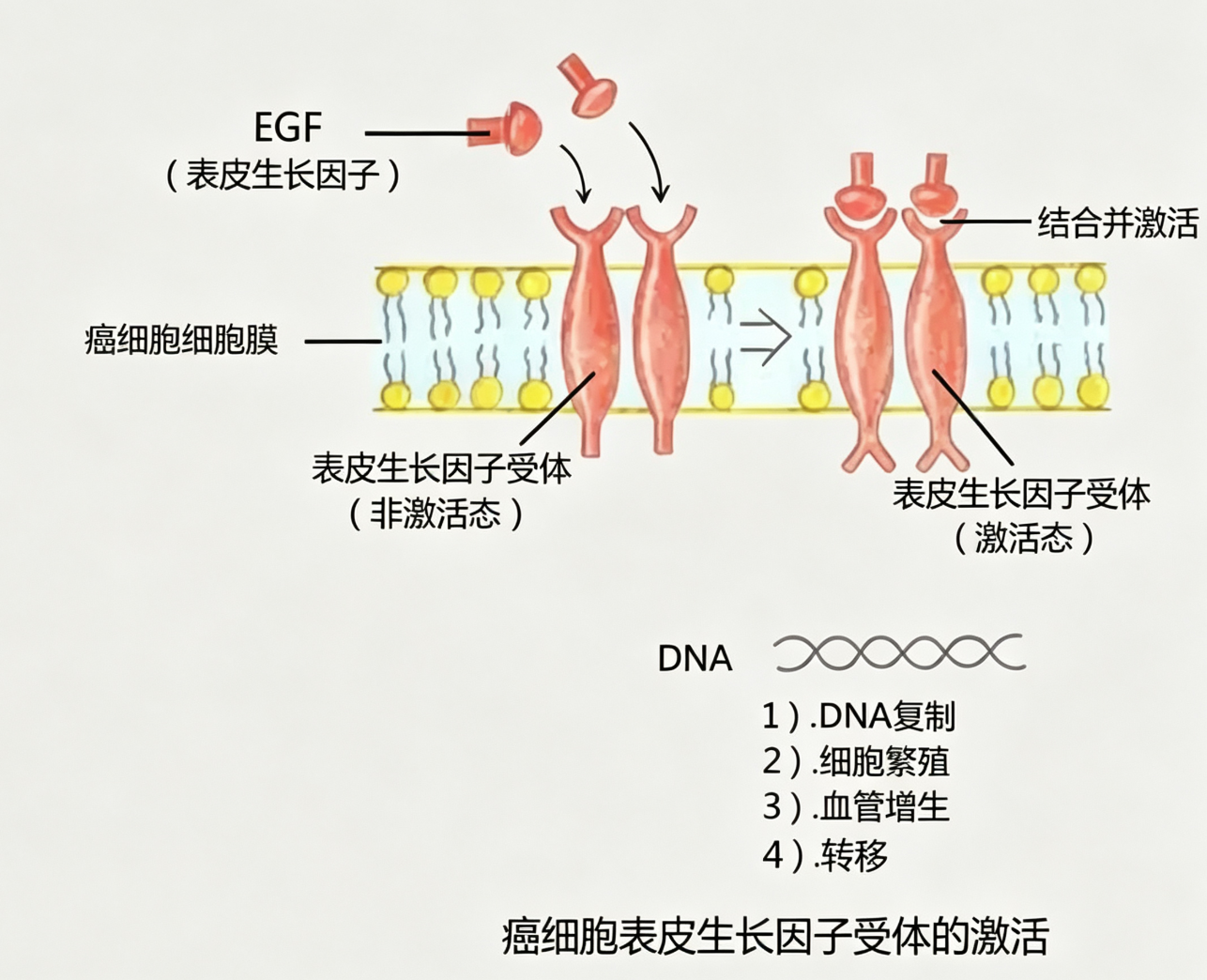
2. Pathological Mechanisms of Signal Dysregulation Caused by EGFR Mutations
In certain lung cancer cells, EGFR gene mutations confer gain-of-function alterations, fundamentally changing the structure and function of the encoded protein. These mutations primarily cluster in regions encoding the tyrosine kinase domain, resulting in constitutive activation of EGFR even in the absence of exogenous ligand stimulation and disruption of its signal termination mechanisms. Specifically, the two main mutation types—L858R point mutation and exon 19 deletion (Exon 19 Del)—alter the conformation of EGFR's kinase active center, weakening the competitive binding of ATP analogs to the kinase and interfering with receptor ubiquitination and endocytic degradation. This persistent abnormal signaling drives tumor cells to escape normal growth constraints, ultimately leading to malignant tumor development.
3. Epidemiological Characteristics of EGFR Mutations in Chinese Lung Cancer Patients
EGFR mutations exhibit significant epidemiological differences across regions and ethnic groups. Comprehensive epidemiological data estimate that approximately 30% of Chinese lung cancer patients carry EGFR mutations, a proportion significantly higher than in Caucasian populations (~10%-15%). Further subgroup analysis reveals distinct distribution preferences: mutation rates are higher in female patients than in males, in younger patients (especially those <60 years) than in older patients, and in never-smokers than in long-term smokers. Histologically, the mutation rate is significantly higher in non-small cell lung adenocarcinoma than in squamous cell carcinoma or other types.
Particularly noteworthy is the exceptionally high prevalence of EGFR mutations (~60%) among Chinese female never-smokers with lung adenocarcinoma. The reasons for this remain incompletely understood and may involve interactions among genetic background, environmental exposures (e.g., cooking fumes, secondhand smoke), and hormonal factors. From a clinical perspective, these epidemiological features indicate that a substantial proportion of Chinese lung cancer patients may benefit from EGFR-targeted therapies.
4. Molecular Subtypes and Structural Basis of EGFR Mutations
EGFR mutations are not single molecular events but encompass dozens of distinct subtypes, reflecting significant molecular heterogeneity. However, over 90% of EGFR mutations fall into two major categories. The first is the L858R point mutation, where leucine at position 858 is replaced by arginine. This residue lies near the P-loop of the kinase domain's activation loop, and its substitution alters the binding equilibrium between the kinase and ATP (or its competitive inhibitors), leading to sustained kinase activation. The second is the exon 19 deletion mutation, which removes a critical amino acid sequence (typically residues 746–750) in the intracellular kinase domain. This deletion changes the conformation of the α-C helix, stabilizing the kinase domain in an activated state.
Both mutations disrupt EGFR's autoinhibitory mechanisms to drive tumor growth. When clinically diagnosed as "EGFR mutation-positive lung cancer," the vast majority of cases involve these two mutation types. Several EGFR-targeted drugs have been approved, such as the first-generation reversible inhibitors gefitinib and erlotinib, and the third-generation irreversible inhibitor osimertinib. Different mutation subtypes exhibit varying sensitivities and resistance mechanisms to these drugs, making precise genotyping a standard clinical practice before initiating targeted therapy.
5. Conclusion
As a central node in the cellular proliferation regulatory network, EGFR's normal function relies on strict spatiotemporal activation and deactivation mechanisms. Gain-of-function mutations in the EGFR gene—particularly the L858R point mutation and exon 19 deletion—lead to constitutive pathway activation, driving the development of a significant proportion of non-small cell lung cancers. Given the high prevalence of EGFR mutations (~30%) in Chinese lung cancer patients and their exceptional enrichment in specific subgroups (never-smoking female adenocarcinoma patients), EGFR has become one of the most critical biomarkers for personalized targeted therapy in lung cancer. U爱 offers FITC-Labeled EGFR Fc Chimera Protein, Human, a product designed with precise molecular engineering, Fc tag-mediated dimerization advantages, and the high brightness and stability of FITC dyes, providing a reliable detection tool for EGFR-related target validation, drug screening, and flow cytometry applications.
This article is reviewed and published by the technical expert team of UA
Disclaimer: This article partially utilizes artificial intelligence assistance in its creation. If any content involves copyright or intellectual property issues, please let us know and we promise to verify and remove it as soon as possible.
Purchase recombinant protein, choose Nanjing UA-Bio
UA protein focuses on providing various protein reagents, raw materials, and services required for drug research and development, cell therapy, gene therapy, and basic scientific research, including drug target proteins, immune checkpoint proteins, cytokines, tool enzymes, customized protein expression, and full-length transmembrane protein development. Youai is committed to providing customers with high-quality products and professional services, and building a High-tech Biological Enterprise with International Competitiveness.
Target proteins | membrane proteins | cytokines | enzymes | viral antigens | protein customization
Nanjing UA Biotechnology Co., Ltd. Email:order@ua-bio.com Phone:+86-25-56221161

Product Information

Link:





©2021-2026 all rights reserved UA Biotechnology Co.,Ltd.
Privacy Policy 
网站备案号 浙ICP备2022019033号-2 浙公网安备33010202004867号
 Business license (three certificates in one)
 Tel:+86-25-56221161
E-mail:order@ua-bio.com
All products sold on this website shall not be used for clinical diagnosis or treatment of humans or animals, and shall only be used for non-medical purposes such as industrial or scientific research.
