




Mechanism Analysis of CD19 CAR-T-Related Neurotoxicity and Discovery of Pericyte Targets
Author: Senior Product Manager of UA Views:109 


This article systematically elaborates on the clinical manifestations and characteristics of immune effector cell-associated neurotoxicity syndrome based on the clinical efficacy of CD19-targeted CAR-T cell therapy in B-cell malignancies, analyzes the clinical significance of expressive aphasia as an early warning signal, and explores two pathological mechanism hypotheses: cytokine release syndrome and CAR-T cell central nervous system infiltration.
- Recent Advances
- Product Information
Recent Advances
Mechanistic Insights into CD19 CAR-T-Related Neurotoxicity and the Discovery of Pericyte Targets
Summary: Based on the clinical efficacy of CD19-targeted CAR-T cell therapy in B-cell malignancies, this article systematically describes the clinical manifestations and characteristics of immune effector cell-associated neurotoxicity syndrome (ICANS), analyzes the clinical significance of expressive aphasia as an early warning signal, and explores two pathological hypotheses: cytokine diffusion and CAR-T cell central infiltration.
I. Clinical Efficacy and Toxicity Challenges of CD19 CAR-T.
CD19-targeted chimeric antigen receptor T-cell therapy has achieved revolutionary progress in the treatment of B-cell leukemia and lymphoma. Numerous clinical trials have shown that even in patients who relapse after conventional chemotherapy, CD19 CAR-T can induce initial complete remission rates as high as 80%-90%, significantly improving the long-term survival prognosis of patients with relapsed/refractory B-cell malignancies. However, accompanying this breakthrough efficacy are treatment-related side effects that require high vigilance. In addition to classic cytokine release syndrome, neurological toxicity is another highly prevalent adverse reaction that severely affects patients' quality of life. Therefore, a deep understanding of its mechanisms and the search for prevention and management strategies have become key scientific issues for further expanding the clinical application of CAR-T.
II. Clinical Manifestations and Core Features of ICANS.
CD19 CAR-T therapy-induced immune effector cell-associated neurotoxicity syndrome (ICANS) presents a set of characteristic clinical manifestations. Patients typically develop neurological symptoms within days after CAR-T infusion, initially presenting with hand tremors, dysgraphia, mild expressive aphasia, apraxia, and attention deficits. Among these, expressive aphasia is one of the most hallmark early symptoms of ICANS. Data from a Phase I clinical study showed that among 22 adult B-ALL patients treated with CD19 CAR-T, 21 developed expressive aphasia, with 19 cases exhibiting this symptom as the initial manifestation of neurotoxicity.
Expressive aphasia can rapidly progress to global aphasia within hours, leaving patients with both expressive and comprehension difficulties, appearing conscious but silent and slow to respond. This "awake but silent" feature helps distinguish ICANS from other types of encephalopathy. As neurotoxicity worsens, patients may experience subclinical or clinical seizures, with a few cases progressing to diffuse cerebral edema, a life-threatening severe complication. Therefore, early recognition and timely intervention for expressive aphasia are crucial for ICANS management.
III. Two Major Hypotheses on ICANS Pathogenesis.
Currently, the precise pathophysiological basis of ICANS remains incompletely understood, but researchers have proposed two main mechanistic hypotheses. The first hypothesis suggests that cytokine diffusion into the central nervous system drives neurotoxicity. Clinical data show that patients with high-grade neurotoxicity exhibit elevated serum levels of IL-15, IL-6, IL-10, and IP-10. These inflammatory cytokines may enter the brain parenchyma through a compromised blood-brain barrier, directly affecting neurons or glial cells and triggering neurological symptoms. The second hypothesis posits that CAR-T cell infiltration into the central nervous system is the direct cause of neurotoxicity. A Phase I study involving 21 pediatric and young adult hematologic malignancy patients revealed that those with neurotoxicity had significantly higher CAR-T cell concentrations in cerebrospinal fluid compared to those without neurotoxicity. These hypotheses are not mutually exclusive; more likely, in the context of cytokine storm, increased blood-brain barrier permeability allows CAR-T cells to invade the central nervous system, with both factors synergistically exacerbating neural damage.
IV. Pericytes: Off-Target Toxicity Targets of CD19 CAR-T.
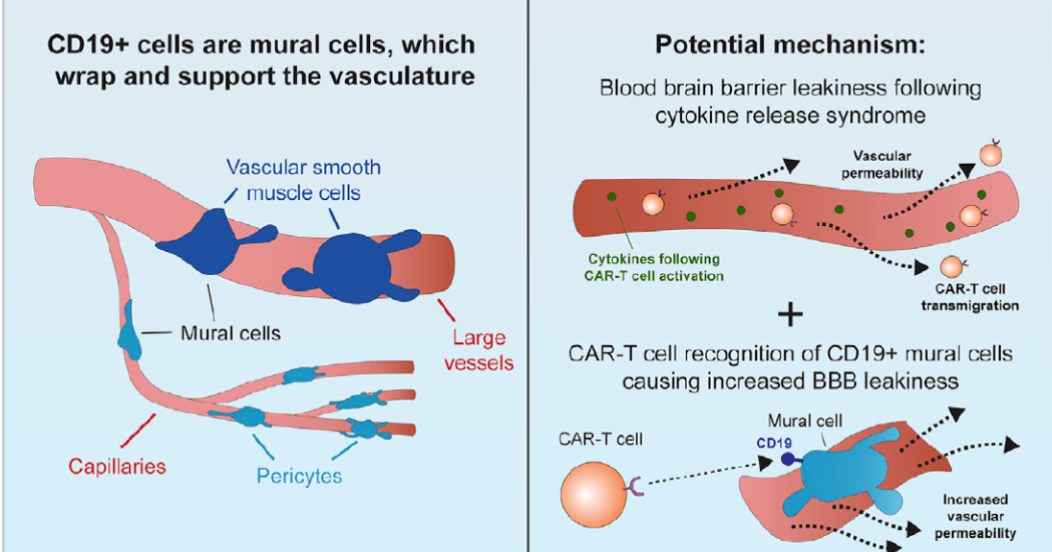
Although CD19 is considered a B-cell lineage-specific antigen with extremely limited expression in normal tissues, why CD19 CAR-T is "attracted" to the central nervous system and causes off-target toxicity has been a central mystery in the field. A groundbreaking 2020 study published in *Cell* by researchers from Stanford University and other institutions used single-cell sequencing to finely analyze brain vascular cells, revealing a critical discovery—brain pericytes (also known as mural cells) express CD19.
Using CD248 as a specific marker for pericytes, the researchers conducted cell sorting and transcriptome analysis, clearly confirming CD19 mRNA and protein expression in pericytes. Further tissue distribution analysis showed that this CD19 expression is highly central nervous system-specific—CD19 is expressed in brain pericytes but not in pericytes from other organs like the lungs, while brain endothelial cells and lung endothelial cells are also CD19-negative.
V. Potential Mechanisms and Significance of Pericyte-Mediated Neurotoxicity.
Based on the central role of pericytes in the blood-brain barrier structure—as essential components of capillary walls, pericytes tightly connect with endothelial cells to maintain blood-brain barrier integrity and permeability—the researchers proposed a plausible pathological mechanism model: CAR-T therapy-induced cytokine release syndrome first triggers systemic inflammatory responses, compromising blood-brain barrier integrity to some extent; subsequently, CAR-T cells breach the blood-brain barrier to enter the central nervous system, recognizing and attacking CD19-expressing pericytes; pericyte damage further exacerbates blood-brain barrier disruption, forming a positive feedback loop that allows large numbers of CAR-T cells to infiltrate the central nervous system, causing severe neurotoxic reactions.
This discovery not only provides direct cellular target evidence for the "off-tumor" mechanism of CD19 CAR-T neurotoxicity but, more importantly, offers a clear scientific target for clinical intervention. Protecting pericytes from CAR-T attack or enhancing blood-brain barrier stability could become novel strategies for preventing and managing ICANS, laying the foundation for safer broader application of CAR-T therapy.
VI. Conclusion.
The remarkable efficacy of CD19 CAR-T therapy in B-cell malignancies has been well-documented, but the high incidence of ICANS remains a major obstacle to its broader clinical application. Expressive aphasia, as an early hallmark symptom of ICANS, holds significant clinical warning value. Through single-cell sequencing, researchers have for the first time revealed CD19 expression in brain pericytes, which may serve as targets for CAR-T off-target attacks, providing key molecular and cellular-level evidence for understanding ICANS pathology. This discovery opens new directions for developing targeted prevention strategies and clinical management protocols. Uni offers FITC-Labeled CD19 His Tag Protein, Human, which, with its precise molecular design, native conformation assurance from human expression systems, and high brightness and stability of FITC dyes, provides a reliable detection tool for CD19-related normal tissue cross-reactivity assessment, off-target toxicity mechanism research, and CAR-T product quality control.
This article is reviewed and published by the technical expert team of UA
Disclaimer: This article partially utilizes artificial intelligence assistance in its creation. If any content involves copyright or intellectual property issues, please let us know and we promise to verify and remove it as soon as possible.
Purchase recombinant protein, choose Nanjing UA-Bio
UA protein focuses on providing various protein reagents, raw materials, and services required for drug research and development, cell therapy, gene therapy, and basic scientific research, including drug target proteins, immune checkpoint proteins, cytokines, tool enzymes, customized protein expression, and full-length transmembrane protein development. Youai is committed to providing customers with high-quality products and professional services, and building a High-tech Biological Enterprise with International Competitiveness.
Target proteins | membrane proteins | cytokines | enzymes | viral antigens | protein customization
Nanjing UA Biotechnology Co., Ltd. Email:order@ua-bio.com Phone:+86-25-56221161

Product Information

Link:





©2021-2026 all rights reserved UA Biotechnology Co.,Ltd.
Privacy Policy 
网站备案号 浙ICP备2022019033号-2 浙公网安备33010202004867号
 Business license (three certificates in one)
 Tel:+86-25-56221161
E-mail:order@ua-bio.com
All products sold on this website shall not be used for clinical diagnosis or treatment of humans or animals, and shall only be used for non-medical purposes such as industrial or scientific research.
