




Performance Limitations of Mass Spectrometry-Grade Modified Trypsin and Novel Solutions
Author: Senior Product Manager of UA Views:47 


Based on the core requirements for trypsin performance in protein mass spectrometry analysis, this article systematically elaborates on the common limitations of traditional mass spectrometry-grade trypsin in terms of non-specific cleavage, autolysis, digestion efficiency, and batch-to-batch consistency. It also introduces how improved trypsin variants, developed through novel chemical modifications and recombinant technologies, can address these issues specifically, providing a superior tool for high-precision peptide mapping analysis of biotherapeutic proteins.
- Recent Advances
- Product Information
Recent Advances
Performance Limitations of Mass Spectrometry-Grade Modified Trypsin and Novel Solutions
Overview
Based on the core requirements for trypsin performance in protein mass spectrometry analysis, this article systematically describes the common limitations of traditional mass spectrometry-grade trypsin in terms of non-specific cleavage, autolysis, digestion efficiency, and batch-to-batch stability. It also introduces how improved trypsin developed through novel chemical modification and recombinant technologies can address these issues, providing a superior tool for high-precision peptide mapping analysis of biotherapeutic proteins.
Based on the core requirements for trypsin performance in protein mass spectrometry analysis, this article systematically describes the common limitations of traditional mass spectrometry-grade trypsin in terms of non-specific cleavage, autolysis, digestion efficiency, and batch-to-batch stability. It also introduces how improved trypsin developed through novel chemical modification and recombinant technologies can address these issues, providing a superior tool for high-precision peptide mapping analysis of biotherapeutic proteins.
I. The Core Role of Trypsin in Protein Mass Spectrometry Analysis and Performance Challenges.
In top-down or bottom-up protein mass spectrometry strategies, proteolytic digestion is one of the most critical steps determining data quality and analytical depth. Among various proteases, trypsin stands out as the "gold standard" in protein mass spectrometry due to its unique advantages. Its primary benefits include: trypsin specifically cleaves peptide bonds at the carboxyl termini of lysine and arginine residues. This cleavage pattern is evenly distributed in most proteins, producing peptide fragments (typically 6-30 amino acids in length) that are well-suited for the mass detection range of mass spectrometers. Additionally, the lysine or arginine residues at the C-terminus of these peptides impart strong positive charge characteristics, significantly enhancing ionization efficiency and the richness of fragment ion information in mass spectrometry.
However, in high-end applications such as high-precision peptide mapping analysis of biotherapeutic proteins, many existing mass spectrometry-grade trypsin products often fail to deliver satisfactory performance. Specifically, these limitations manifest in the following interrelated aspects.
II. Major Limitations of Traditional Mass Spectrometry-Grade Trypsin.
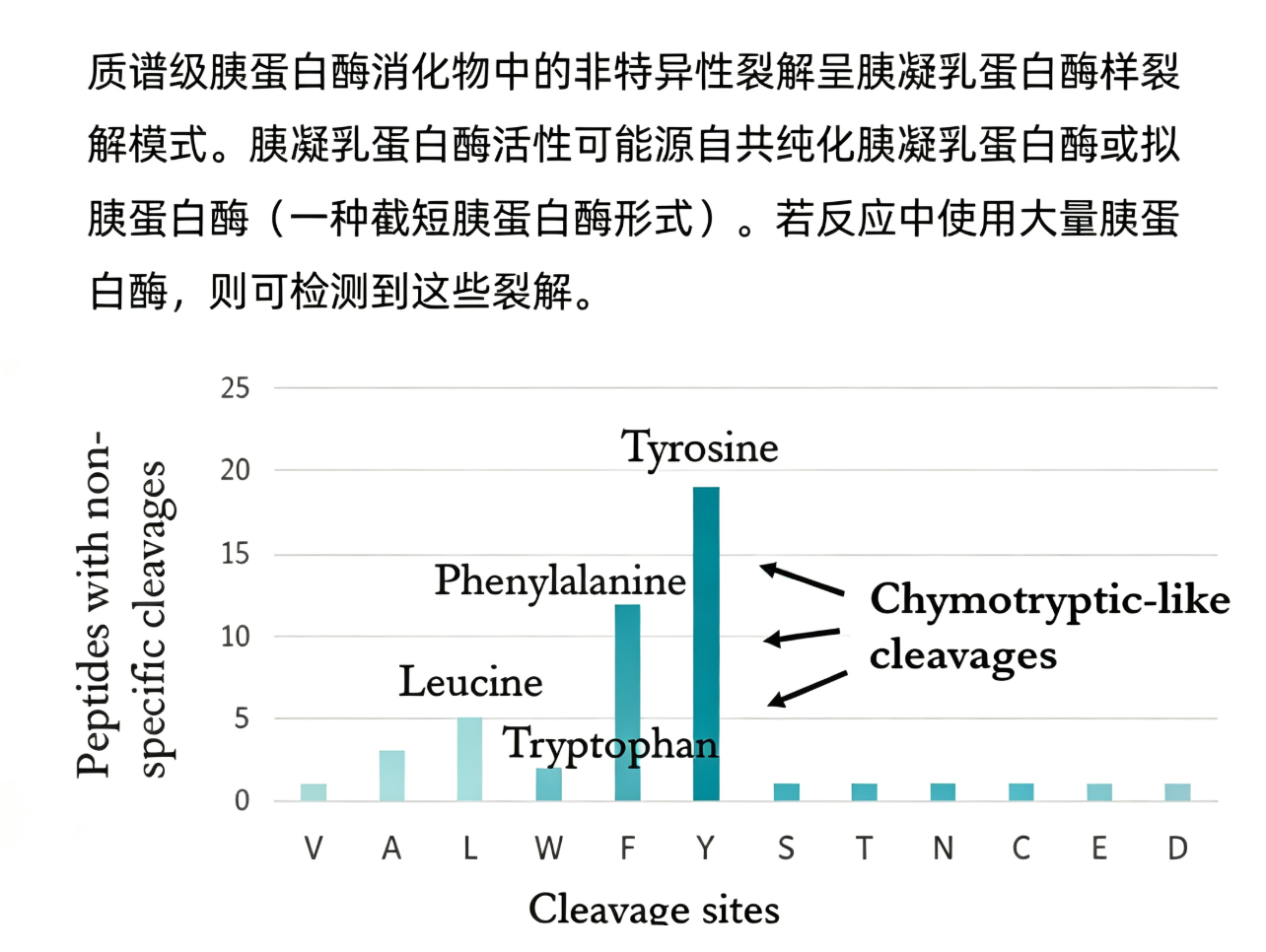
Non-specific cleavage activity and its impact. This is one of the most prominent issues affecting data quality. Ideally, trypsin should only cleave at the C-termini of lysine and arginine. However, some traditional mass spectrometry-grade trypsin products exhibit detectable chymotrypsin-like cleavage activity, leading to additional non-specific cuts. This non-specific cleavage exponentially increases the complexity of digestion products, generating numerous irrelevant peptide fragments that not only dilute target signals but also introduce significant interference in subsequent data analysis and peptide identification. Particularly when enzyme concentration or digestion time is increased to enhance cleavage efficiency at resistant sites, this "off-target" activity becomes notably pronounced, severely contaminating mass spectra.
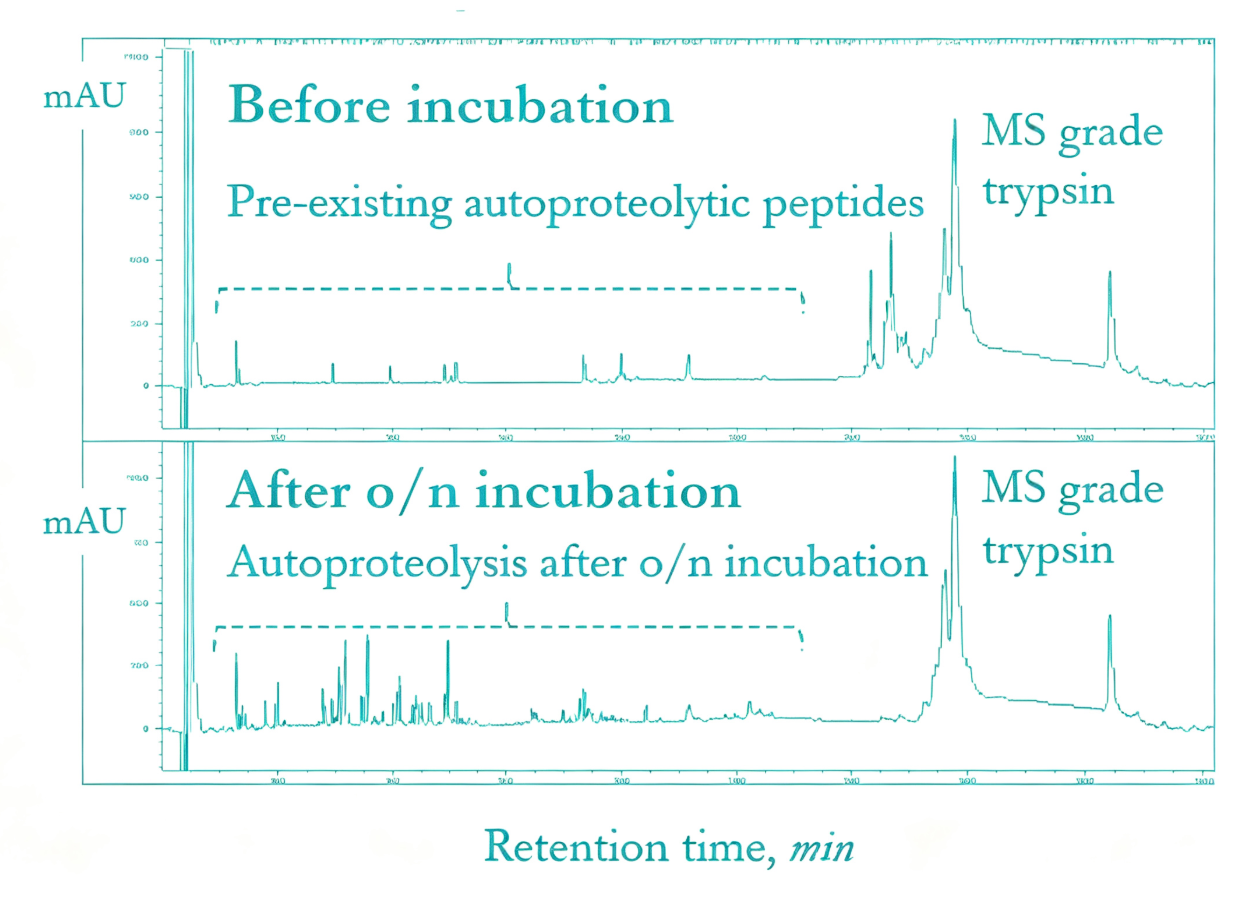
Significant autolysis phenomenon.As a protease, trypsin also undergoes self-cleavage. Although traditional products are chemically modified to inhibit autolysis, the effect is often limited. Autolysis not only consumes effective enzyme amounts but also generates trypsin-derived peptide fragments that form interference peaks in mass spectrometry analysis, further contaminating the data.
Incomplete digestion of proteolysis-resistant sites. Even at high enzyme-to-substrate ratios, traditional trypsin often inadequately cleaves certain proteolysis-resistant sites (e.g., sites with steric hindrance or specific charge configurations around lysine or arginine), leading to frequent "missed cleavages." This similarly reduces sequence coverage and analytical accuracy.
Significant batch-to-batch variability in activity. The activity of traditional mass spectrometry-grade trypsin can vary by up to 25% between batches, creating difficulties for standardized operations and long-term data comparisons that rely on precise digestion conditions. Additionally, some products may contain animal-derived contaminant proteins, affecting purity and reliability in specific applications.
III. Design Philosophy and Performance Breakthroughs of Improved Trypsin.
To address these limitations, researchers have developed significantly enhanced mass spectrometry-grade trypsin by combining novel chemical modification methods with recombinant expression technologies. This new type of trypsin aims to resolve the inherent defects of traditional products at the molecular level, with key advantages in the following aspects.
Elimination of non-specific cleavage activity. Improved trypsin effectively eliminates residual chymotrypsin-like activity in traditional products through optimized purification processes and modification strategies. Liquid chromatography-mass spectrometry analysis shows that under high-intensity conditions such as overnight digestion, its non-specific cleavage activity is undetectable, ensuring highly specific digestion products.
Significantly enhanced resistance to autolysis. Novel chemical modification methods endow improved trypsin with high resistance to autolysis. This resistance allows it to be used at relatively high concentrations without generating numerous interference peaks or rapid inactivation due to autolysis, enabling faster and more efficient digestion.
Optimized proteolytic efficiency. Improved trypsin exhibits higher proteolytic efficiency, effectively cleaving proteolysis-resistant sites that traditional products struggle with. This means even sites with significant steric hindrance can be more completely digested, markedly reducing missed cleavage rates—critical for precise characterization of biologics requiring ultra-high sequence coverage.
High purity and excellent batch-to-batch reproducibility. By employing recombinant (non-animal-derived) expression systems and stringent production processes, improved trypsin achieves high purity, free from animal-derived contaminant proteins, while ensuring highly consistent and predictable performance across batches. This meets the stringent requirements of regulatory environments for analytical methods.
IV. Conclusion.
Mass spectrometry-grade trypsin is a critical bridge connecting protein samples to high-quality mass spectrometry data. Faced with increasing demands for analytical precision and reliability in biopharmaceutical and precision medicine research, the limitations of traditional trypsin in specificity, stability, and batch-to-batch consistency have become increasingly apparent. Systematically optimized improved trypsin, by enhancing resistance to autolysis, eliminating non-specific cleavage activity, and improving digestion efficiency, provides a more reliable solution for in-depth and precise analysis of complex protein samples. It is one of the foundational tools driving protein mass spectrometry technology toward cutting-edge applications. Uni offers Modified Trypsin, Mass Spectrometry Grade, a product designed through optimized chemical modification and purification processes to provide high-specificity, high-stability enzymatic reagents for protein mass spectrometry analysis and biotherapeutic peptide mapping applications.
This article is reviewed and published by the technical expert team of UA
Disclaimer: This article partially utilizes artificial intelligence assistance in its creation. If any content involves copyright or intellectual property issues, please let us know and we promise to verify and remove it as soon as possible.
Purchase recombinant protein, choose Nanjing UA-Bio
UA protein focuses on providing various protein reagents, raw materials, and services required for drug research and development, cell therapy, gene therapy, and basic scientific research, including drug target proteins, immune checkpoint proteins, cytokines, tool enzymes, customized protein expression, and full-length transmembrane protein development. Youai is committed to providing customers with high-quality products and professional services, and building a High-tech Biological Enterprise with International Competitiveness.
Target proteins | membrane proteins | cytokines | enzymes | viral antigens | protein customization
Nanjing UA Biotechnology Co., Ltd. Email:order@ua-bio.com Phone:+86-25-56221161

Product Information

Link:





©2021-2026 all rights reserved UA Biotechnology Co.,Ltd.
Privacy Policy 
网站备案号 浙ICP备2022019033号-2 浙公网安备33010202004867号
 Business license (three certificates in one)
 Tel:+86-25-56221161
E-mail:order@ua-bio.com
All products sold on this website shall not be used for clinical diagnosis or treatment of humans or animals, and shall only be used for non-medical purposes such as industrial or scientific research.
