




ActRIIA-Targeted Drug Development: From Signaling Pathways to Enzyme Activity Inhibition Screening
Author: Senior Product Manager of UA Views:37 


This article systematically elaborates on the structural characteristics, signal transduction mechanisms, and pathological significance of ActRIIA (activin type IIA receptor) as a key receptor in the TGF-β superfamily, analyzing its potential as a drug target in various diseases.
- Recent Advances
- Product Information
Recent Advances
ActRIIA-Targeted Drug Development: From Signaling Pathways to Enzyme Activity Inhibition Screening
Brief Summary
This article systematically elucidates the structural characteristics, signal transduction mechanisms, and pathological significance of ActRIIA (Activin Receptor Type IIA) as a key receptor of the TGF-β superfamily in various diseases, and analyzes its value as a drug target.
This article systematically elucidates the structural characteristics, signal transduction mechanisms, and pathological significance of ActRIIA (Activin Receptor Type IIA) as a key receptor of the TGF-β superfamily in various diseases, and analyzes its value as a drug target.
I. Molecular Structure and Physiological Functions of ActRIIA.
ActRIIA, also known as ACVR2A or ACTRIIA, is a type I transmembrane serine/threonine kinase receptor encoded by the ACVR2A gene, belonging to the transforming growth factor-β (TGF-β) receptor superfamily. The protein consists of approximately 513 amino acids with a molecular weight of about 58 kDa. Its structure is composed of three main functional domains: an extracellular domain with ligand-binding activity (approximately 110 amino acids, cysteine-rich), a single-pass transmembrane domain (approximately 26 amino acids), and an intracellular serine/threonine kinase domain (approximately 360 amino acids).
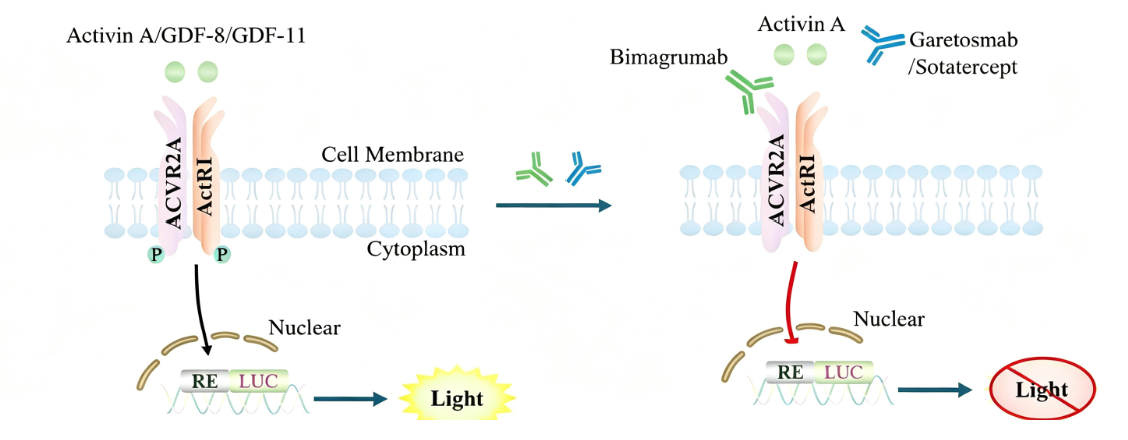
Under physiological conditions, ActRIIA serves as the core component of ligand binding, binding with high affinity to TGF-β superfamily members such as Activin A. Binding affinity measurements show that the equilibrium dissociation constant (Kd) between ActRIIA and Activin A can reach 0.023 nM, representing a high-affinity interaction. Upon ligand binding to ActRIIA, the receptor undergoes conformational changes and recruits type I receptors (such as ALK4). The type II receptor subsequently phosphorylates serine and threonine residues in the GS domain of the type I receptor, activating downstream Smad2/3-dependent signaling pathways and non-Smad pathways (such as MAPK), regulating key physiological processes including cell proliferation, differentiation, apoptosis, and metabolism.
II. Pathological Significance and Targeting Value of the ActRIIA Signaling Pathway.
Aberrant activation of the ActRIIA signaling pathway is closely associated with the development and progression of various diseases. Overactive Activin A/ActRIIA signaling can promote skeletal muscle atrophy, abnormal adipose tissue accumulation, pulmonary arterial hypertension vascular remodeling, and the progression of fibrotic lesions. Therefore, blocking downstream pathogenic signaling by inhibiting the binding of ActRIIA to its ligands has become an important direction in drug development.
Intervention strategies targeting ActRIIA primarily fall into two categories. The first is ligand traps, which use recombinant ActRIIA-Fc fusion proteins (such as Sotatercept) to competitively bind circulating ligands such as Activin A, preventing them from binding to cell surface receptors. The second is small molecule inhibitors or antibodies that directly block the ligand-binding pocket of ActRIIA or interfere with its kinase activity. Regardless of the strategy, accurate assessment of the blocking activity of candidate molecules is required at the early development stage.
III. Core Principles of ActRIIA Inhibitor Screening.
The core technical approach for ActRIIA inhibitor screening is based on the principle of ligand-receptor binding blockade. Taking the enzyme-linked immunosorbent assay (ELISA) platform as an example, the basic workflow is as follows: the natural ligand of ActRIIA (such as Activin A) is coated onto a solid-phase surface, biotin-labeled ActRIIA receptor protein is added, and incubation is carried out in an optimized buffer system to allow full ligand-receptor binding. If candidate compounds with inhibitory activity are present in the system, they competitively block receptor-ligand binding. Subsequently, the remaining binding signal is detected using streptavidin-horseradish peroxidase (SA-HRP) and a chemiluminescent substrate. The luminescence intensity is proportional to the amount of receptor-ligand binding, thereby enabling quantitative assessment of the inhibitory activity of the compounds.
IV. Conclusion.
As a key node in the TGF-β superfamily signaling network, ActRIIA's ligand-binding activation mechanism provides a clear site of action for therapeutic intervention. The enzyme activity inhibitor screening system based on the principle of ligand-receptor binding blockade offers an efficient, quantifiable evaluation tool for ActRIIA-targeted drug discovery. With a deeper understanding of ActRIIA signaling regulation and continued refinement of screening technologies, therapeutic strategies targeting this receptor are expected to achieve further breakthroughs in disease areas including pulmonary arterial hypertension, muscle atrophy, and fibrosis. UniBio provides the ActRIIA Enzyme Activity Inhibitor Screening Kit, which includes coated ligand protein, biotinylated ActRIIA, HRP-labeled detection reagents, and optimized buffer systems, suitable for high-throughput screening and evaluation of binding blockade activity of candidate molecules.
This article is reviewed and published by the technical expert team of UA
Disclaimer: This article partially utilizes artificial intelligence assistance in its creation. If any content involves copyright or intellectual property issues, please let us know and we promise to verify and remove it as soon as possible.
Purchase recombinant protein, choose Nanjing UA-Bio
UA protein focuses on providing various protein reagents, raw materials, and services required for drug research and development, cell therapy, gene therapy, and basic scientific research, including drug target proteins, immune checkpoint proteins, cytokines, tool enzymes, customized protein expression, and full-length transmembrane protein development. Youai is committed to providing customers with high-quality products and professional services, and building a High-tech Biological Enterprise with International Competitiveness.
Target proteins | membrane proteins | cytokines | enzymes | viral antigens | protein customization
Nanjing UA Biotechnology Co., Ltd. Email:order@ua-bio.com Phone:+86-25-56221161

Product Information

Link:





©2021-2026 all rights reserved UA Biotechnology Co.,Ltd.
Privacy Policy 
网站备案号 浙ICP备2022019033号-2 浙公网安备33010202004867号
 Business license (three certificates in one)
 Tel:+86-25-56221161
E-mail:order@ua-bio.com
All products sold on this website shall not be used for clinical diagnosis or treatment of humans or animals, and shall only be used for non-medical purposes such as industrial or scientific research.
