




ActRIIB: From Muscle Regulation to Drug Development – Target Mechanisms and Screening Strategies
Author: Senior Product Manager of UA Views:70 


This article systematically elaborates on the molecular structure of activin receptor type IIB (ActRIIB) as a key receptor in the TGF-β superfamily, its signal transduction mechanisms, and its core functions in muscle growth and metabolic regulation, while analyzing its potential as a drug target in disease areas and clinical development pathways.
- Recent Advances
- Product Information
Recent Advances
ActRIIB: From Muscle Regulation to Drug Development — Target Mechanisms and Screening Strategies
Brief Summary
This article systematically elucidates the molecular structure, signal transduction mechanisms, and core functions of activin receptor type IIB (ActRIIB) as a key receptor of the TGF-β superfamily in muscle growth and metabolic regulation, and analyzes its disease areas and clinical development pathways as a drug target.
This article systematically elucidates the molecular structure, signal transduction mechanisms, and core functions of activin receptor type IIB (ActRIIB) as a key receptor of the TGF-β superfamily in muscle growth and metabolic regulation, and analyzes its disease areas and clinical development pathways as a drug target.
I. Molecular Structure and Signal Transduction Mechanisms of ActRIIB.
Activin Receptor Type IIB (ActRIIB) is a type I single-pass transmembrane protein encoded by the ACVR2B gene, belonging to the serine/threonine kinase receptor family of the transforming growth factor-β (TGF-β) superfamily. The gene is located on human chromosome 3p22.2, and the encoded receptor protein consists of an extracellular ligand-binding domain, a single-pass transmembrane helix region, and an intracellular serine/threonine kinase domain.
ActRIIB binds with high affinity to multiple members of the TGF-β superfamily, including activins (Activin A, B, AB, etc.), myostatin (GDF-8), growth differentiation factor 11 (GDF-11), and Nodal. Upon ligand binding to the extracellular domain of ActRIIB, the receptor undergoes conformational changes and dimerization, subsequently recruiting and phosphorylating type I receptors (such as ALK4), activating the downstream SMAD2/3 signaling pathway, and ultimately regulating the transcription of target genes. The SMAD signaling pathway is the core pathway of TGF-β superfamily signal transduction and is broadly involved in regulating various biological processes including cell proliferation, differentiation, apoptosis, and metabolism.
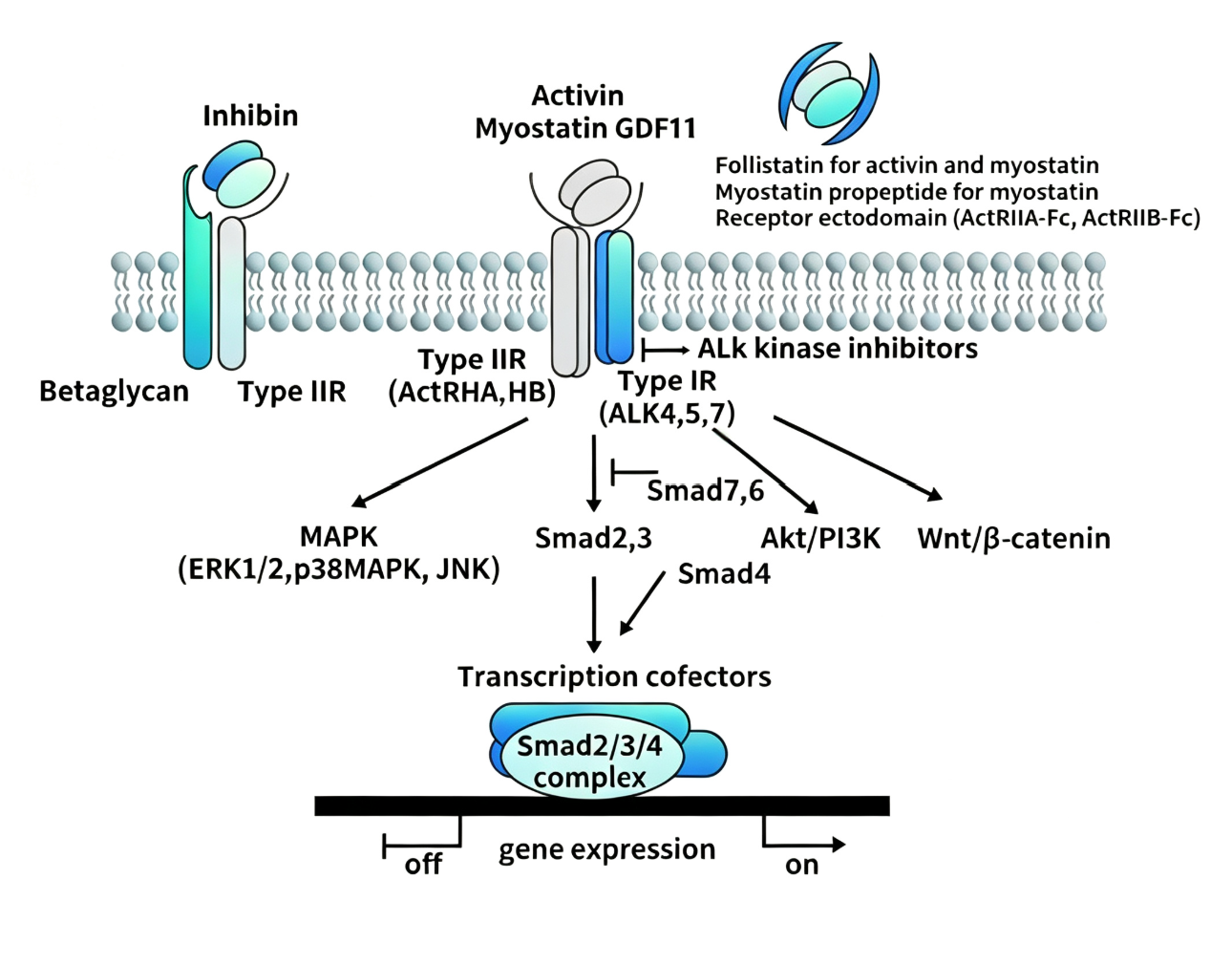
II. Tissue Distribution and Physiological Functions of ActRIIB.
ActRIIB mRNA is widely expressed in various tissues, with particularly high expression levels in skeletal muscle, cardiac muscle, and brain tissue. In skeletal muscle, ActRIIB is the primary receptor mediating myostatin signaling, whose activation inhibits the activation of muscle satellite cells and myofiber hypertrophy, exerting a negative regulatory role in maintaining muscle mass. The ActRIIB signaling pathway also participates in the regulation of fat metabolism and energy balance, with studies indicating that it can affect systemic metabolism by increasing skeletal muscle mass and improving mitochondrial function.
Compared with ActRIIA, ActRIIB plays a more dominant role in muscle tissue, making it an important target for treating muscle wasting diseases. ACVR2B gene knockout mouse models exhibit embryonic phenotypes such as left-right axis developmental abnormalities, indicating that ActRIIB also plays an indispensable role during embryonic development.
III. Disease Areas and Development Progress of ActRIIB as a Drug Target.
Based on the central role of ActRIIB in muscle growth and metabolic regulation, this receptor has become a highly sought-after target in multiple disease areas. In muscle wasting diseases, including sarcopenic obesity, cancer cachexia, amyotrophic lateral sclerosis, and Duchenne muscular dystrophy, strategies targeting ActRIIB aim to relieve its inhibition on muscle growth, thereby increasing muscle mass and strength. Laekna Therapeutics' independently developed LAE103 is a selective monoclonal antibody targeting ActRIIB, which has received FDA approval for clinical trials in the treatment of sarcopenic obesity.
In the field of metabolic diseases, animal model studies have confirmed that ActRIIB blockade can inhibit diet-induced obesity and improve glucose and lipid metabolism levels. Soluble ActRIIB receptors (ActRIIB-Fc) function as ligand traps, exerting dual effects of promoting muscle growth and improving metabolism by neutralizing overactivated myostatin and activin signaling. Additionally, the ActRIIB signaling pathway is involved in the regulation of erythropoiesis, and drugs targeting this pathway have been approved for the treatment of anemia associated with myelodysplastic syndromes.
IV. Application Value of ActRIIB Enzyme Activity Inhibitor Screening Kits.
In ActRIIB-targeted drug discovery and mechanism research, efficient screening tools are key to accelerating the R&D process. The intracellular kinase domain of ActRIIB possesses serine/threonine kinase activity, which is the core link in signal transduction and an important target of small molecule inhibitors and antibody-based therapeutics.
The ActRIIB Enzyme Activity Inhibitor Screening Kit is an analytical tool specifically designed for high-throughput screening and evaluation of inhibitors of ActRIIB kinase activity. Such kits typically employ detection principles such as homogeneous time-resolved fluorescence or chemiluminescence, quantitatively evaluating enzyme activity by measuring the phosphorylation degree of ActRIIB kinase domain on its substrates, and are used to calculate the half-maximal inhibitory concentration (IC₅₀) of test compounds. The kit supports application scenarios including small molecule inhibitor screening targeting ActRIIB kinase activity, antibody neutralization activity evaluation, and enzyme kinetic parameter determination, making it suitable for compound activity screening and structure-activity relationship studies in the early drug discovery stage.
V. Conclusion.
As a key receptor of the TGF-β superfamily, ActRIIB has emerged as a highly promising drug target in multiple disease areas including metabolic diseases, muscle wasting disorders, and anemia, by virtue of its multiple functions in muscle growth, metabolic regulation, and development. From selective antibodies to dual-target inhibitors, the drug development pathways targeting ActRIIB are increasingly diversified. The ActRIIB Enzyme Activity Inhibitor Screening Kit, serving as a bridging tool connecting target mechanism research and drug discovery, plays an indispensable role in efficiently identifying and optimizing lead compounds, providing a solid experimental foundation for the development of novel therapies for related diseases. UniBio provides the ActRIIB Enzyme Activity Inhibitor Screening Kit, an analytical tool specifically designed for high-throughput screening and evaluation of inhibitors of ActRIIB kinase activity. Such kits typically employ detection principles such as homogeneous time-resolved fluorescence, quantitatively evaluating enzyme activity by measuring the phosphorylation degree of ActRIIB kinase domain on its substrates, and are used to calculate the half-maximal inhibitory concentration of test compounds. The kit supports application scenarios including small molecule inhibitor screening targeting ActRIIB kinase activity, antibody neutralization activity evaluation, and enzyme kinetic parameter determination, making it suitable for compound activity screening and structure-activity relationship studies in the early drug discovery stage.
This article is reviewed and published by the technical expert team of UA
Disclaimer: This article partially utilizes artificial intelligence assistance in its creation. If any content involves copyright or intellectual property issues, please let us know and we promise to verify and remove it as soon as possible.
Purchase recombinant protein, choose Nanjing UA-Bio
UA protein focuses on providing various protein reagents, raw materials, and services required for drug research and development, cell therapy, gene therapy, and basic scientific research, including drug target proteins, immune checkpoint proteins, cytokines, tool enzymes, customized protein expression, and full-length transmembrane protein development. Youai is committed to providing customers with high-quality products and professional services, and building a High-tech Biological Enterprise with International Competitiveness.
Target proteins | membrane proteins | cytokines | enzymes | viral antigens | protein customization
Nanjing UA Biotechnology Co., Ltd. Email:order@ua-bio.com Phone:+86-25-56221161

Product Information

Link:





©2021-2026 all rights reserved UA Biotechnology Co.,Ltd.
Privacy Policy 
网站备案号 浙ICP备2022019033号-2 浙公网安备33010202004867号
 Business license (three certificates in one)
 Tel:+86-25-56221161
E-mail:order@ua-bio.com
All products sold on this website shall not be used for clinical diagnosis or treatment of humans or animals, and shall only be used for non-medical purposes such as industrial or scientific research.
