




FGFR4: An Emerging Target for Precision Therapy in Rhabdomyosarcoma
Author: Senior Product Manager of UA Views:98 


Based on the clinical treatment challenges of rhabdomyosarcoma (RMS), this article systematically elaborates on the high expression characteristics of fibroblast growth factor receptor 4 (FGFR4) in RMS and other malignant tumors, as well as its theoretical basis as an immunotherapy target. It analyzes the antitumor activity of FGFR4-targeted antibody-drug conjugates (ADCs) in preclinical studies and their potential advantages compared to CAR-T cell therapy.
- Recent Advances
- Product Information
Recent Advances
FGFR4: An Emerging Target for Precision Therapy in Rhabdomyosarcoma
Brief Summary
Based on the clinical treatment challenges of rhabdomyosarcoma (RMS), this article systematically describes the high expression characteristics of fibroblast growth factor receptor 4 (FGFR4) in RMS and other malignancies, as well as its theoretical basis as an immunotherapeutic target. It analyzes the antitumor activity of FGFR4-targeted antibody-drug conjugates (ADCs) in preclinical studies and their potential advantages over CAR-T cell therapy.
Based on the clinical treatment challenges of rhabdomyosarcoma (RMS), this article systematically describes the high expression characteristics of fibroblast growth factor receptor 4 (FGFR4) in RMS and other malignancies, as well as its theoretical basis as an immunotherapeutic target. It analyzes the antitumor activity of FGFR4-targeted antibody-drug conjugates (ADCs) in preclinical studies and their potential advantages over CAR-T cell therapy.
I. Current Treatment Status and Unmet Needs in Rhabdomyosarcoma.
Rhabdomyosarcoma is the most common soft tissue sarcoma in children, accounting for approximately 3% to 4% of all childhood and adolescent malignancies. The current standard treatment regimen remains surgical resection combined with chemotherapy and/or radiotherapy, which can achieve disease-free survival in over 70% of patients, but is accompanied by significant treatment-related toxicity. More critically, patients with relapse or metastasis have an extremely poor prognosis, with long-term survival rates of only 20% to 30%. Despite decades of clinical research, the treatment strategy for RMS has not undergone substantial transformation. Therefore, there is an urgent clinical need to improve outcomes in high-risk patients while reducing treatment toxicity.
II. FGFR4: A Therapeutic Target with Tumor-Specific High Expression.
Fibroblast Growth Factor Receptor 4 (FGFR4) is a type I transmembrane receptor tyrosine kinase encoded by the FGFR4 gene. Its protein structure consists of an extracellular ligand-binding domain (containing three immunoglobulin-like domains), a single-pass transmembrane helix region, and an intracellular tyrosine kinase domain. FGFR4 is widely expressed during embryonic development, participating in key physiological processes such as skeletal muscle development, but its expression levels are extremely low in adult normal tissues.
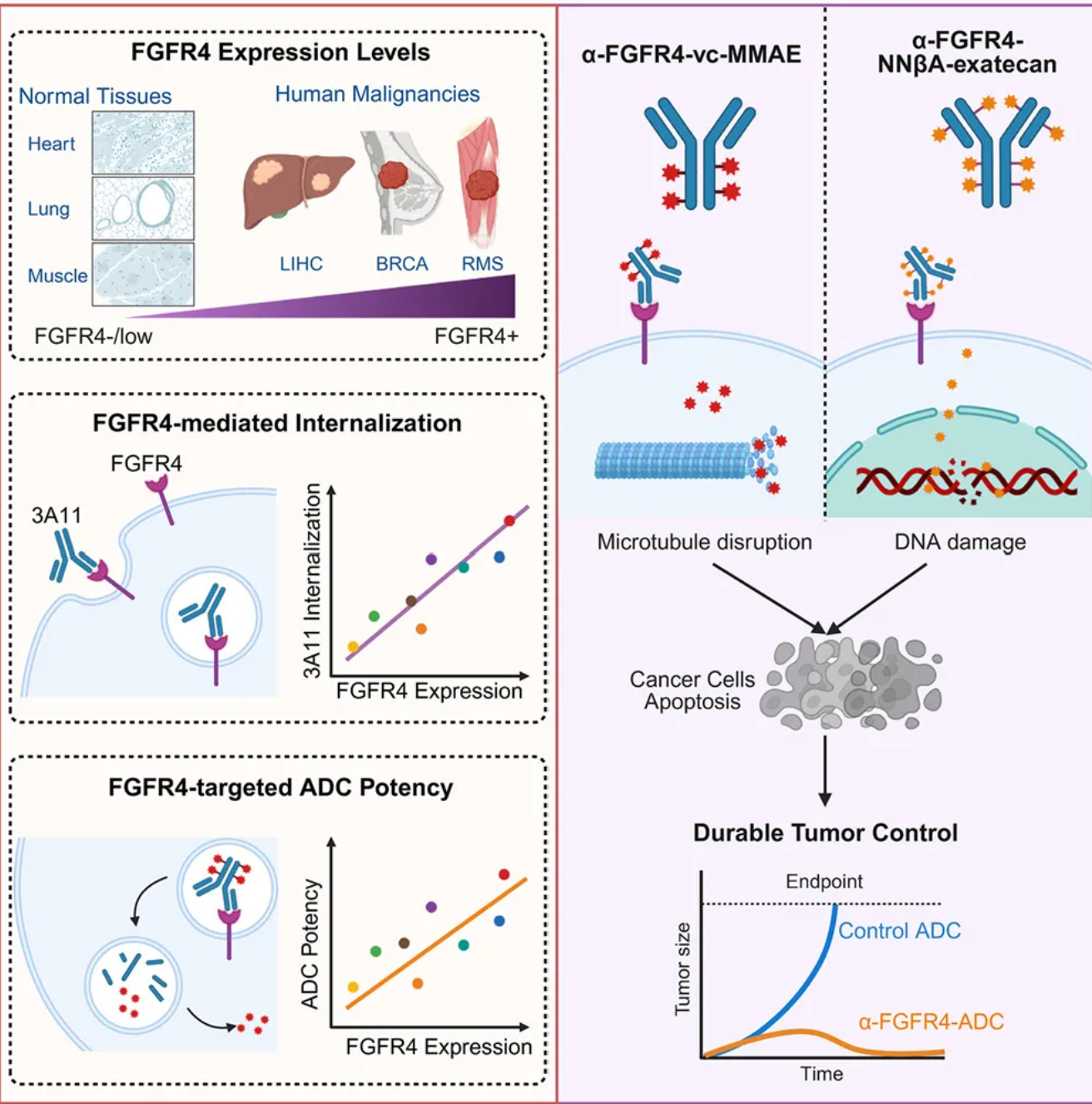
In stark contrast, FGFR4 exhibits aberrantly high expression in various malignancies. In rhabdomyosarcoma, high FGFR4 expression is particularly prominent—in fusion-positive RMS, FGFR4 is a direct transcriptional target of the PAX3-FOXO1 fusion oncogene, leading to significant upregulation of its expression; in fusion-negative RMS, approximately 10% to 15% of cases harbor activating mutations in the FGFR4 kinase domain. Studies have confirmed that high FGFR4 expression is closely associated with advanced disease status and poor survival prognosis in RMS patients. Beyond RMS, FGFR4 is also overexpressed in hepatocellular carcinoma, breast cancer, ovarian cancer, gastric cancer, colon cancer, and other tumors, with its expression levels correlated with tumor aggressiveness and patient prognosis. This distribution pattern of "high expression in tumors, low expression in normal tissues" makes FGFR4 a highly attractive immunotherapeutic target.
III. Antibody-Drug Conjugate Strategies Targeting FGFR4.
Antibody-drug conjugates (ADCs) are an innovative therapeutic modality that combines the targeting specificity of monoclonal antibodies with highly potent cytotoxic drugs. ADC drugs specifically recognize and bind to target antigens on the surface of tumor cells via the antibody component, are internalized through receptor-mediated endocytosis, and are degraded in lysosomes to release the cytotoxic payload, thereby achieving precise killing of tumor cells.
Compared with chimeric antigen receptor T-cell therapy, ADC drugs offer several unique potential advantages: first, ADCs are off-the-shelf drugs that do not require individualized preparation, significantly shortening patient waiting time; second, ADCs are not limited by patient T cell quantity or functional status, making them applicable to a broader patient population; third, the immune-related side effects of ADCs are generally more manageable than those of CAR-T; fourth, ADC manufacturing processes are relatively standardized, enabling large-scale production and supporting multiple dosing.
Targeting the FGFR4 antigen, researchers utilized the high-affinity anti-FGFR4 monoclonal antibody 3A11 to develop two ADC drugs conjugated with the microtubule inhibitor MMAE and the DNA topoisomerase I inhibitor Exatecan derivative, respectively. In vitro experiments confirmed that both FGFR4-ADCs could be rapidly internalized by FGFR4-positive tumor cells, producing FGFR4 expression-dependent potent cytotoxicity. In subcutaneously implanted RMS xenograft models, both ADCs demonstrated significant antitumor activity and markedly prolonged survival. In breast cancer animal models, the Exatecan-ADC also achieved effective tumor control and completely eradicated recurrent tumors through repeat dosing. Currently, an FGFR4 CAR-T cell therapy based on the same 3A11 antibody has been approved for a Phase I clinical trial (NCT06865664) in relapsed/refractory RMS at the National Institutes of Health (NCI), further validating the clinical translation potential of FGFR4-targeted strategies.
IV. Application of FGFR4 Recombinant Protein in Research and Drug Development.
In basic research and drug development for FGFR4-targeted therapy, high-quality FGFR4 recombinant proteins are indispensable core tools. Such proteins can be used in applications including anti-FGFR4 antibody screening and binding activity evaluation, ADC drug target binding and internalization efficiency analysis, and establishment of immunoassays for FGFR4 expression level detection.
V. Conclusion.
FGFR4, by virtue of its high expression characteristics in rhabdomyosarcoma and various other malignancies, and its low expression distribution in normal tissues, has emerged as a highly promising precision therapy target. ADC drugs developed based on anti-FGFR4 monoclonal antibodies have demonstrated potent and durable antitumor activity in preclinical studies, providing a novel therapeutic strategy for RMS and other FGFR4-expressing tumors. With the advancement of FGFR4-targeted CAR-T clinical trials and the continued optimization of ADC drugs, the clinical translation prospects of FGFR4-targeted therapy are promising. UniBio provides FGF R4 Fc Chimera Protein, Human, which can be used in FGFR4-related basic research and drug discovery experiments.
This article is reviewed and published by the technical expert team of UA
Disclaimer: This article partially utilizes artificial intelligence assistance in its creation. If any content involves copyright or intellectual property issues, please let us know and we promise to verify and remove it as soon as possible.
Purchase recombinant protein, choose Nanjing UA-Bio
UA protein focuses on providing various protein reagents, raw materials, and services required for drug research and development, cell therapy, gene therapy, and basic scientific research, including drug target proteins, immune checkpoint proteins, cytokines, tool enzymes, customized protein expression, and full-length transmembrane protein development. Youai is committed to providing customers with high-quality products and professional services, and building a High-tech Biological Enterprise with International Competitiveness.
Target proteins | membrane proteins | cytokines | enzymes | viral antigens | protein customization
Nanjing UA Biotechnology Co., Ltd. Email:order@ua-bio.com Phone:+86-25-56221161

Product Information

Link:





©2021-2026 all rights reserved UA Biotechnology Co.,Ltd.
Privacy Policy 
网站备案号 浙ICP备2022019033号-2 浙公网安备33010202004867号
 Business license (three certificates in one)
 Tel:+86-25-56221161
E-mail:order@ua-bio.com
All products sold on this website shall not be used for clinical diagnosis or treatment of humans or animals, and shall only be used for non-medical purposes such as industrial or scientific research.
