




The critical regulatory role of Plectin in the growth and metastasis of prostate cancer
Author: Senior Product Manager of UA Views:68 


This article systematically elucidates the high expression characteristics of Plectin in prostate cancer, analyzing its molecular mechanisms in promoting tumor growth and metastasis by regulating cytoskeleton, extracellular matrix interactions, and metabolic pathways.
- Recent Advances
- Product Information
Recent Advances
The Critical Regulatory Role of Plectin in Prostate Cancer Growth and Metastasis
Brief Summary
This article systematically elaborates on the high expression characteristics of Plectin protein in prostate cancer and analyzes its molecular mechanisms in promoting tumor growth and metastasis by regulating the cytoskeleton, extracellular matrix interactions, and metabolic pathways.
This article systematically elaborates on the high expression characteristics of Plectin protein in prostate cancer and analyzes its molecular mechanisms in promoting tumor growth and metastasis by regulating the cytoskeleton, extracellular matrix interactions, and metabolic pathways.
I. Treatment Challenges and Research Background of Prostate Cancer
Prostate cancer is the most common non-cutaneous malignant tumor affecting men's health worldwide. Although treatment methods for early-stage localized prostate cancer continue to improve, once it progresses to metastatic disease, the 5-year survival rate drops sharply from nearly 100% to approximately 30%. Bone is the most common site of distant metastasis in prostate cancer, followed by the lungs, lymph nodes, and liver, with liver metastasis being the most lethal. Current treatment strategies for metastatic prostate cancer include androgen receptor-targeted therapy, taxane-based chemotherapy, and immunotherapy, but these approaches are unable to cure metastatic disease. Therefore, elucidating the key regulatory molecules driving prostate cancer growth and metastasis is of significant clinical importance for developing new treatment strategies.
II. High Expression Characteristics of Plectin in Prostate Cancer
Plectin (PLEC) is an important member of the plakin family, a massive cytoskeletal linker protein with a molecular weight exceeding 500 kDa. Its structure is dumbbell-shaped, consisting of a central α-helical coiled-coil rod domain flanked by globular domains, enabling it to simultaneously bind various cytoskeletal elements such as intermediate filaments, actin microfilaments, and microtubules. Plectin is widely expressed in multiple tissues, particularly in those subjected to significant mechanical stress (e.g., skin, skeletal muscle, and blood vessels).
A study led by Stanford University and published in *Oncogene* revealed that compared to benign prostate tissues, Plectin exhibits high levels of expression in both localized and metastatic prostate cancer tissues. This finding suggests that abnormal upregulation of Plectin may play a crucial role in the initiation and progression of prostate cancer.
III. Inhibitory Effects of Plectin Knockout on Prostate Cancer Growth
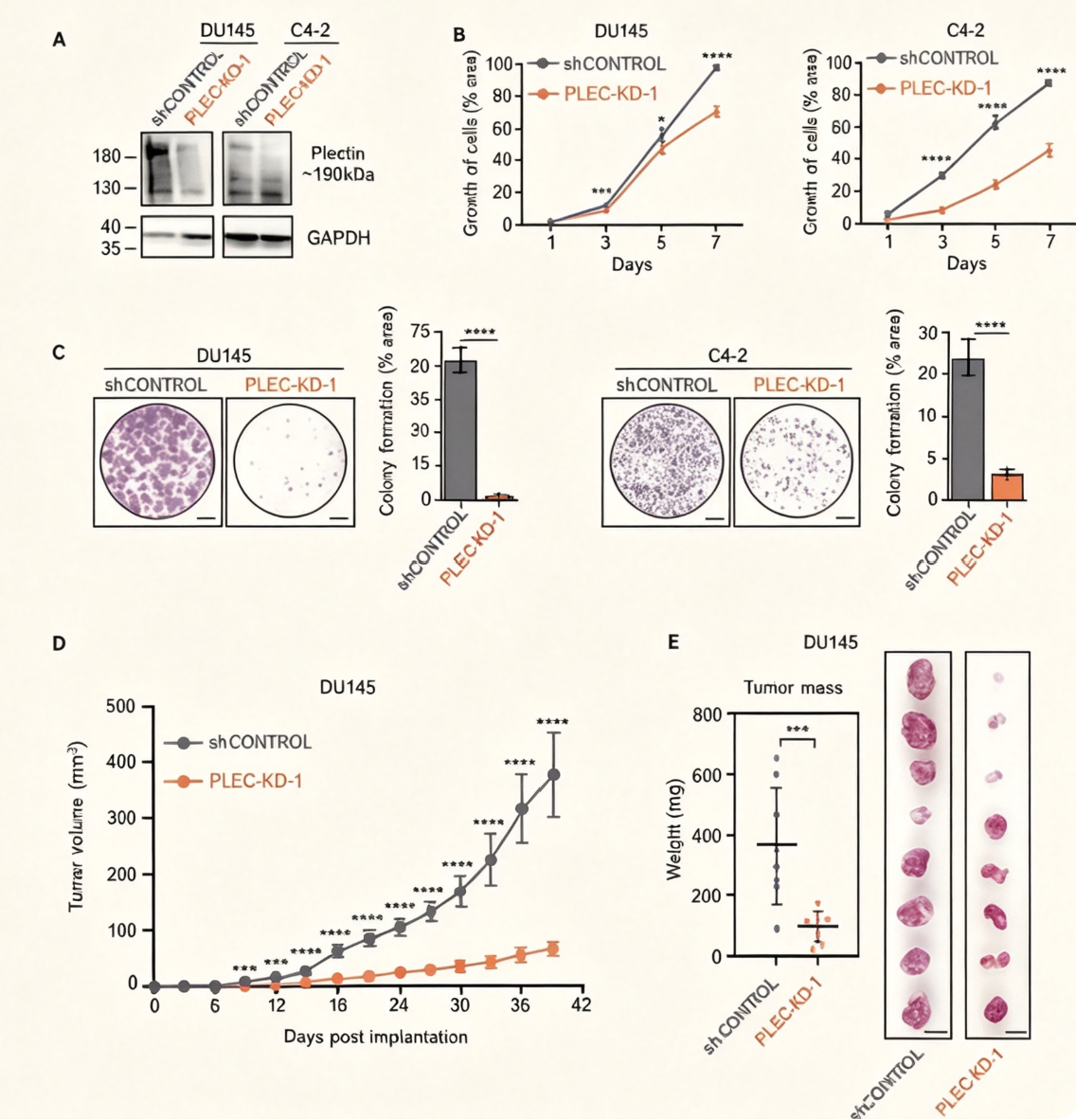
To investigate the function of Plectin in prostate cancer, researchers silenced Plectin expression in prostate cancer cells using gene knockdown techniques. Experimental results showed that Plectin knockout significantly inhibited the growth rate and clonogenic ability of prostate cancer cells in vitro. In vivo xenograft models similarly demonstrated that Plectin knockout effectively suppressed prostate cancer tumor growth.
At the cellular behavior level, Plectin deficiency further impaired the invasive phenotype of cancer cells—assessed through migration assays, invasion assays, and wound healing assays, Plectin knockout cells exhibited significantly reduced migration and invasion capabilities. This indicates that Plectin is not only a regulator of cell proliferation but also a key molecule in maintaining the invasive and motile abilities of cancer cells.
IV. Impact of Plectin on Prostate Cancer Metastasis
Researchers further evaluated the role of Plectin in prostate cancer metastasis. Experimental results showed that Plectin knockout cells exhibited severely impaired distant metastatic colonization abilities. In multiple organs, including the liver, lungs, kidneys, bones, and genitourinary system, the number of metastatic foci in the Plectin knockout group was significantly reduced, with an overall lower metastatic burden. These results confirm that Plectin is a key regulator of multi-organ metastasis in prostate cancer, and its presence is essential for the survival and colonization of tumor cells in distant organs.
V. Molecular Mechanisms of Plectin in Regulating Tumor Growth
To gain deeper insights into the mechanisms of Plectin, researchers conducted proteomic analyses on Plectin knockout xenograft tumor tissues. Gene set enrichment analysis revealed that Plectin deficiency led to changes in multiple biological pathways: proteins related to extracellular matrix and laminin interactions were upregulated, while proteins regulating amino acid metabolism, cytoskeletal components, and cellular stress responses were significantly downregulated.
As a cytoskeletal linker protein, Plectin deficiency disrupts the functional connections between intermediate filaments and actin stress fibers, compromising cytoskeletal integrity and thereby inhibiting cell migration and invasion. Additionally, Plectin modulates various signaling pathways, including the MAP kinase pathway involved in cellular stress responses and migration. Studies have reported that Plectin can bind and regulate actin organization; during CD95-mediated apoptosis, activated caspase 8 cleaves Plectin, triggering the disassembly of the actin cytoskeleton.
VI. Conclusion
As a cytoskeletal linker protein, Plectin plays a critical role in promoting prostate cancer proliferation, invasion, and multi-organ metastasis by maintaining cytoskeletal integrity, regulating extracellular matrix interactions, and influencing metabolic and stress response pathways. Its high expression in metastatic prostate cancer suggests that Plectin may serve as an important molecular marker for assessing tumor aggressiveness and metastatic risk, providing new insights for developing targeted therapies that modulate the cytoskeleton.
In basic research on prostate cancer and other tumors, high-quality recombinant Plectin protein is an essential tool for mechanistic exploration and drug screening. To meet this demand, Uni offers Plectin His Tag Protein, Human, suitable for studying Plectin-related protein interactions, antibody screening, and structural-functional analyses.
This article is reviewed and published by the technical expert team of UA
Disclaimer: This article partially utilizes artificial intelligence assistance in its creation. If any content involves copyright or intellectual property issues, please let us know and we promise to verify and remove it as soon as possible.
Purchase recombinant protein, choose Nanjing UA-Bio
UA protein focuses on providing various protein reagents, raw materials, and services required for drug research and development, cell therapy, gene therapy, and basic scientific research, including drug target proteins, immune checkpoint proteins, cytokines, tool enzymes, customized protein expression, and full-length transmembrane protein development. Youai is committed to providing customers with high-quality products and professional services, and building a High-tech Biological Enterprise with International Competitiveness.
Target proteins | membrane proteins | cytokines | enzymes | viral antigens | protein customization
Nanjing UA Biotechnology Co., Ltd. Email:order@ua-bio.com Phone:+86-25-56221161

Product Information

Link:





©2021-2026 all rights reserved UA Biotechnology Co.,Ltd.
Privacy Policy 
网站备案号 浙ICP备2022019033号-2 浙公网安备33010202004867号
 Business license (three certificates in one)
 Tel:+86-25-56221161
E-mail:order@ua-bio.com
All products sold on this website shall not be used for clinical diagnosis or treatment of humans or animals, and shall only be used for non-medical purposes such as industrial or scientific research.
