

KRAS G12V Mutation: From an "Undruggable" Target to the Frontier of Immunotherapy
Author: Senior Product Manager of UA Views:168 


This article systematically elucidates the molecular characteristics and clinical significance of KRAS G12V, one of the most common oncogenic mutations, detailing its high-frequency distribution in pancreatic cancer, colorectal cancer, and non-small cell lung cancer, as well as its mechanisms in driving tumorigenesis and progression. It also analyzes the challenges in developing traditional small-molecule drugs targeting this mutation.
- Recent Advances
- Product Information
Recent Advances
KRAS G12V Mutation: From "Undruggable" Target to New Frontiers in Immunotherapy
Summary
This article focuses on the molecular characteristics and clinical significance of KRAS G12V, one of the most common oncogenic mutations. It systematically explains its high-frequency distribution in pancreatic cancer, colorectal cancer, and non-small cell lung cancer, as well as its mechanisms driving tumorigenesis and development, while analyzing the challenges in developing traditional small-molecule drugs targeting this mutation.
This article focuses on the molecular characteristics and clinical significance of KRAS G12V, one of the most common oncogenic mutations. It systematically explains its high-frequency distribution in pancreatic cancer, colorectal cancer, and non-small cell lung cancer, as well as its mechanisms driving tumorigenesis and development, while analyzing the challenges in developing traditional small-molecule drugs targeting this mutation.
1. Molecular Characteristics and Tumor Distribution of KRAS G12V Mutation
The KRAS gene is one of the most common and lethal driver genes in cancer. The KRAS protein functions as a molecular switch, transitioning between the GDP-bound (inactive) and GTP-bound (active) states to regulate cell proliferation, differentiation, and survival signals. When the G12V mutation occurs—where the 12th amino acid glycine is replaced by valine—the KRAS protein loses its regulatory capacity from upstream signals, remaining locked in the GTP-bound active state. This continuously stimulates downstream signaling pathways such as PI3K and RAF-MEK-ERK, driving uncontrolled proliferation and metastasis of tumor cells.
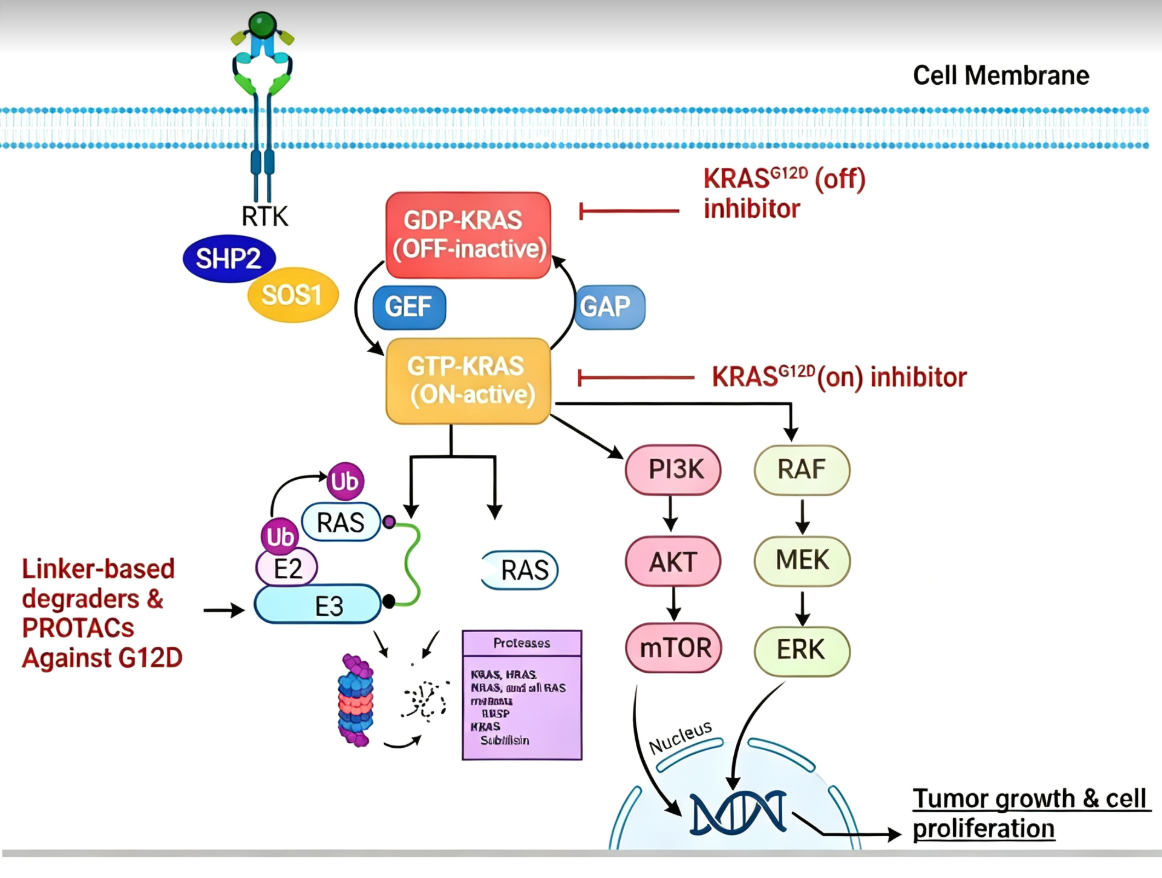
KRAS G12V is one of the most prevalent oncogenic mutations of the KRAS gene. In pancreatic ductal adenocarcinoma, approximately 29% of tumors carry the KRAS G12V mutation; in colorectal cancer, about 9% of cases are G12V-positive; and in non-small cell lung cancer, around 6% of adenocarcinoma cases harbor this mutation. Overall, KRAS G12V accounts for about 25% of all KRAS mutations, with an estimated annual incidence of over 50,000 new cases eligible for treatment in China.
2. Clinical Features and Prognostic Significance of KRAS G12V
KRAS G12V-mutated non-small cell lung cancer exhibits distinct clinical and molecular characteristics. A retrospective study of 636 patients revealed that the vast majority (94.2%) were smokers, with a median tobacco exposure of 40 pack-years. Co-mutations were common, most frequently involving TP53 (40.2%), STK11 (30.2%), and KEAP1 (29.3%). Notably, patients treated with immune checkpoint inhibitors showed higher response rates and longer survival, suggesting that KRAS G12V mutation may be associated with high PD-L1 expression and CD8+ T-cell infiltration.
3. From "Undruggable" to Immunotherapy Breakthrough: A Paradigm Shift in Targeting Strategies
For four decades, the KRAS protein was considered an "undruggable" target. Its smooth surface, lack of deep drug-binding pockets, and extremely high affinity for GTP (with dissociation constants in the picomolar range) made it difficult for traditional small-molecule inhibitors to intervene effectively. Since the approval of the first KRAS G12C inhibitor in 2021, five drugs targeting G12C have been approved, but developing drugs for G12V mutations remains a significant challenge—G12V lacks the covalent binding properties of the cysteine residue in G12C mutations, making the same small-molecule strategies inapplicable.
TCR-T cell therapy offers a novel approach to targeting KRAS G12V. This strategy does not rely on the intact structure of the KRAS protein but instead targets mutant peptide fragments presented on the cell surface by HLA after proteasomal degradation. The KRAS G12V mutant peptide (e.g., KLVVVGAVGV, corresponding to amino acids 5-14) can be presented by HLA class I molecules such as HLA-A*0201. Studies have confirmed that TCR-T cells designed against this neoantigen can specifically recognize the G12V mutant peptide without cross-reacting with wild-type KRAS, significantly inhibiting tumor growth and prolonging survival in pancreatic cancer xenograft models.
4. Conclusion
As a high-frequency driver mutation in multiple solid tumors, the "undruggable" barrier of KRAS G12V is gradually being overcome by immunotherapy. TCR-T cell therapy, by targeting HLA-presented mutant peptide neoantigens, opens a new path for precision treatment of G12V mutations. The HLA-A*0201/KLVVVGAVGV tetramer, as a key detection tool in this field, will continue to advance the discovery and validation of antigen-specific TCRs.
In the development of TCR-T cell therapies, MHC-peptide tetramers are essential tools for screening and identifying antigen-specific T cells. To meet the research needs for KRAS G12V targeting, UA provides the UA-MHC HLA-A*0201/KLVVVGAVGV KRAS G12V Tetramer-PE Labelled. This product is a PE-labeled tetramer complex that can be directly used for flow cytometry detection and sorting of KRAS G12V neoantigen-specific CD8+ T cells. It holds significant value in TCR screening, affinity evaluation, and vaccine immune monitoring.
This article is reviewed and published by the technical expert team of UA
Disclaimer: This article partially utilizes artificial intelligence assistance in its creation. If any content involves copyright or intellectual property issues, please let us know and we promise to verify and remove it as soon as possible.
Purchase recombinant protein, choose 
UA protein focuses on providing various protein reagents, raw materials, and services required for drug research and development, cell therapy, gene therapy, and basic scientific research, including drug target proteins, immune checkpoint proteins, cytokines, tool enzymes, customized protein expression, and full-length transmembrane protein development. Nanjing Univ is committed to providing customers with high-quality products and professional services, and building a High-tech Biological Enterprise with International Competitiveness.
Target proteins | membrane proteins | cytokines | enzymes | viral antigens | protein customization
Nanjing UNIV Biotechnology Co., Ltd. Email:order@ua-bio.com Phone:+86-25-56221161

Product Information

Link:





©2021-2026 all rights reserved UNIV Biotechnology Co.,Ltd.
Privacy Policy
网站备案号 苏ICP备2025207586号-2 浙公网安备33010202004867号
 Business license (three certificates in one)
 Tel:+86-25-56221161
E-mail:order@ua-bio.com
All products sold on this website shall not be used for clinical diagnosis or treatment of humans or animals, and shall only be used for non-medical purposes such as industrial or scientific research.