Epidermal Growth Factor: Molecular Basis and Application Boundaries from Wound Healing to Skin Regeneration
Author: Senior Product Manager of UA Views:173 


This article focuses on the molecular characteristics and biological functions of epidermal growth factor (EGF), systematically elaborating its core mechanism of activating EGFR to initiate intracellular signaling cascades and promote epidermal cell proliferation and migration. It also analyzes the significant therapeutic effects of EGF in wound healing and its limitations in non-invasive skincare.
- Recent Advances
- Product Information
Recent Advances
Epidermal Growth Factor: Molecular Basis from Wound Healing to Skin Regeneration and Its Application Boundaries
Overview
This article focuses on the molecular characteristics and biological functions of epidermal growth factor (EGF), systematically elaborating its core mechanism of activating intracellular signaling cascades through EGFR to promote epidermal cell proliferation and migration. It analyzes the significant therapeutic effects of EGF in wound healing and its limitations in non-invasive skincare.
This article focuses on the molecular characteristics and biological functions of epidermal growth factor (EGF), systematically elaborating its core mechanism of activating intracellular signaling cascades through EGFR to promote epidermal cell proliferation and migration. It analyzes the significant therapeutic effects of EGF in wound healing and its limitations in non-invasive skincare.
I. Molecular Structure of EGF and Its Receptor Activation Mechanism.
Epidermal growth factor is a single-chain polypeptide composed of 53 amino acid residues, with a molecular weight of approximately 6 kDa and an isoelectric point of about 4.6. Its molecular structure is stabilized by three intramolecular disulfide bonds (Cys⁶-Cys²⁰, Cys¹⁴-Cys³¹, Cys³³-Cys⁴²), forming a characteristic β-folded conformation that confers high structural stability. EGF is encoded by the EGF gene located in the q25 region of chromosome 4. The precursor protein is hydrolyzed by proteases to release the mature active peptide. In skin tissue, EGF is primarily synthesized and secreted by keratinocytes, fibroblasts, and platelets in response to injury stimuli.
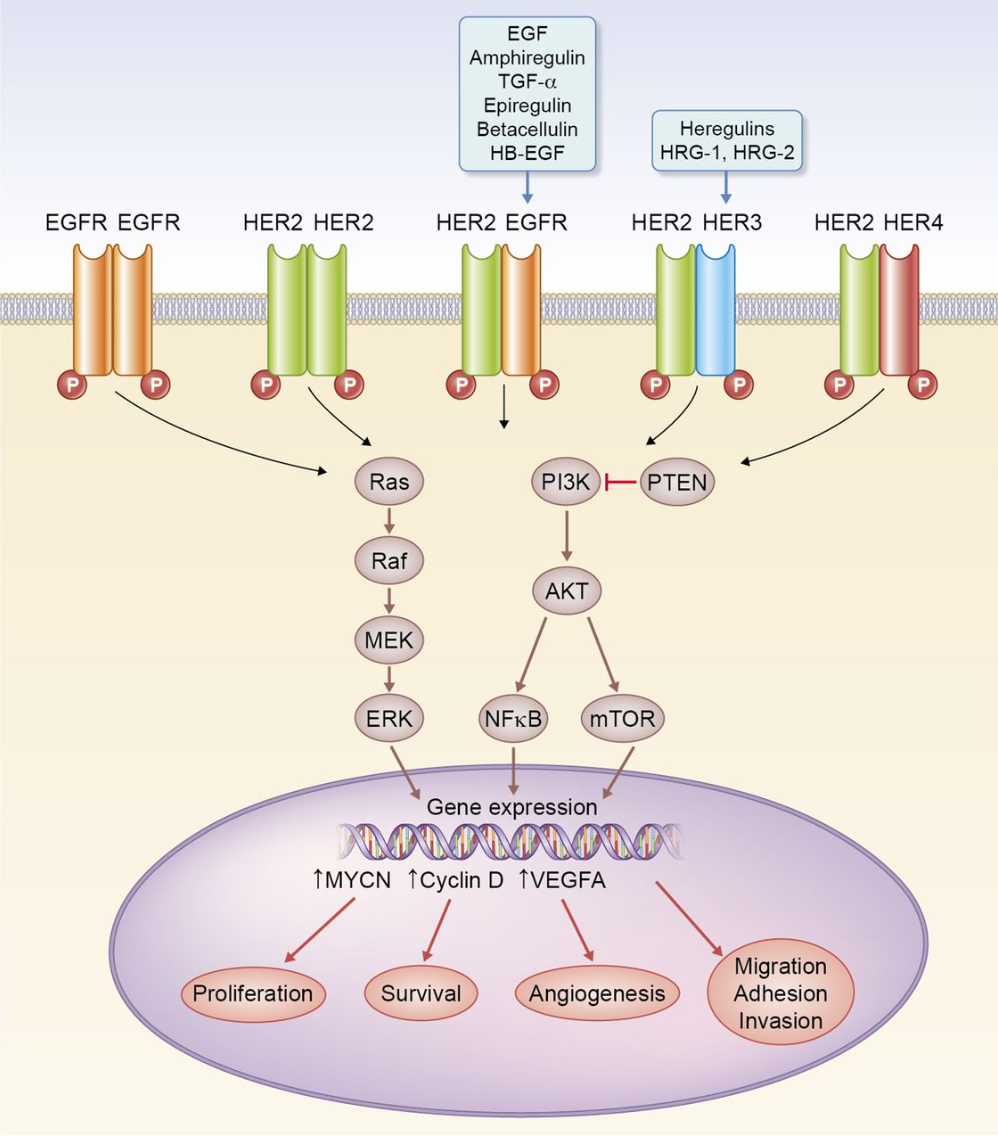
EGF initiates signal transduction by binding to the epidermal growth factor receptor (EGFR, also known as ErbB1/HER1) on the cell membrane. EGFR is a 170 kDa transmembrane receptor tyrosine kinase expressed on the surface of keratinocytes in the epidermal basal layer, outer root sheath cells of hair follicles, and dermal fibroblasts. When EGF binds to the extracellular domain of EGFR, it induces receptor homodimerization or heterodimerization, activating the intracellular tyrosine kinase domain and leading to autophosphorylation of tyrosine residues. This recruits and activates multiple downstream signaling pathways, including Ras/MAPK, PI3K/AKT, and PLCγ. The coordinated activation of these pathways ultimately drives cell cycle progression, proliferation, and migration.
II. Significant Therapeutic Effects of EGF in Wound Healing.
The role of EGF in wound healing has been widely recognized. When the skin is injured, platelets degranulate and release EGF and TGF-α, while damaged keratinocytes also upregulate EGF expression, creating a local microenvironment with high EGF concentration. Studies have confirmed that exogenous EGF can significantly accelerate the healing process of corneal epithelial defects and promote re-epithelialization of surgical incisions and burn wounds. The pro-healing effects of EGF are primarily achieved by stimulating the migration and proliferation of keratinocytes, which is crucial for wound closure. In hospital cosmetic surgeries, EGF is often used to prevent scarring and promote wound healing. For skin trauma, the disruption of the epidermal barrier allows EGF to penetrate the epidermis and reach target cells in the basal layer. Therefore, for traumatized skin, EGF can easily access target cells and exert its biological effects.
III. Efficacy Boundaries of EGF in Non-Invasive Skincare.
Unlike wound healing, the efficacy of EGF in non-invasive daily skincare faces significant physical barrier challenges. The outermost stratum corneum of normal skin consists of multiple layers of dense keratinocytes and intercellular lipids, forming an effective molecular barrier. This physical barrier poses a penetration challenge for hydrophilic molecules with a molecular weight greater than 500 Da. Given that EGF has a molecular weight of 6 kDa, it is clearly difficult for such a large molecule to passively diffuse across the stratum corneum barrier. Some researchers argue that large molecules like EGF are unlikely to penetrate the skin barrier and reach the basal and spinous layers where its receptors are located, making it difficult to exert its effects on promoting epidermal cell proliferation. Therefore, whether EGF can be effectively absorbed through the skin and reach its target sites in non-traumatized skin remains a major scientific controversy in this field.
IV. Conclusion.
As a key growth factor regulating epidermal cell proliferation and regeneration, EGF plays an important role in wound healing and postoperative recovery. By binding to EGFR and initiating intracellular signaling cascades, it drives the migration and proliferation of keratinocytes, accelerating the re-epithelialization process of wounds. However, in non-invasive skincare, the contradiction between the molecular size of EGF and the stratum corneum barrier creates significant uncertainty about its efficacy. A deeper understanding of EGF's mechanism of action and its transdermal limitations is of great significance for rationally evaluating its application value in different skin conditions. Human recombinant EGF protein, as a key tool for basic research and product development, will continue to provide essential support for exploring the biological functions of EGF and its application boundaries.
In EGF-related basic research and drug screening, high-quality human recombinant EGF protein is a critical tool for conducting cell proliferation experiments, receptor binding analysis, and signaling pathway studies. To meet this research need, Uni offers EGF Protein, Human, suitable for proliferation studies of human keratinocytes and fibroblasts, exploration of EGFR signaling pathways, and in vitro evaluation of EGF-EGFR binding activity.
This article is reviewed and published by the technical expert team of UA
Disclaimer: This article partially utilizes artificial intelligence assistance in its creation. If any content involves copyright or intellectual property issues, please let us know and we promise to verify and remove it as soon as possible.
Purchase recombinant protein, choose 
UA protein focuses on providing various protein reagents, raw materials, and services required for drug research and development, cell therapy, gene therapy, and basic scientific research, including drug target proteins, immune checkpoint proteins, cytokines, tool enzymes, customized protein expression, and full-length transmembrane protein development. Nanjing Univ is committed to providing customers with high-quality products and professional services, and building a High-tech Biological Enterprise with International Competitiveness.
Target proteins | membrane proteins | cytokines | enzymes | viral antigens | protein customization
Nanjing UNIV Biotechnology Co., Ltd. Email:order@ua-bio.com Phone:+86-25-56221161

Product Information

Link:





©2021-2026 all rights reserved UNIV Biotechnology Co.,Ltd.
Privacy Policy
网站备案号 苏ICP备2025207586号-2 浙公网安备33010202004867号
 Business license (three certificates in one)
 Tel:+86-25-56221161
E-mail:order@ua-bio.com
All products sold on this website shall not be used for clinical diagnosis or treatment of humans or animals, and shall only be used for non-medical purposes such as industrial or scientific research.