【IF 14.3】Targeting FAP/OLN: Deciphering Senescent Fibroblast-Driven Bone Damage in Periodontitis
Author: Senior Product Manager of UA Views:149 


Recent research published in *Advanced Science* (IF=14.3) revealed that in periodontitis, gingival fibroblast senescence is accompanied by overactivation of the mTOR pathway, leading to upregulated FAP expression and reduced endogenous inhibitor OLN, resulting in a FAP/OLN imbalance.
- Recent Advances
- Product Information
Recent Advances
Targeting FAP/OLN: Deciphering Senescent Fibroblast-Driven Bone Damage in Periodontitis
A recent study published in Advanced Science (IF=14.3) revealed that gingival fibroblast senescence in periodontitis is accompanied by excessive activation of the mTOR pathway, leading to upregulated FAP expression and decreased endogenous inhibitor OLN, resulting in FAP/OLN imbalance. Single-cell sequencing showed enhanced communication between FAP⁺ fibroblasts and macrophages. Mechanistically, FAP promotes macrophage polarization toward pro-inflammatory and osteoclastogenic phenotypes, exacerbating periodontal tissue inflammation and bone resorption. Local periodontal injection of the selective FAP small-molecule inhibitor (Ac-Gly-BoroPro) effectively reduced alveolar bone loss and collagen degradation. U&I's recombinant mouse FAP protein (UA010165) was used to stimulate macrophages in vitro, confirming FAP's role in promoting osteoclast differentiation marker expression and suppressing repair gene expression, providing a key model for elucidating FAP's regulatory mechanism on macrophage phenotypes. This study offers a new strategy for FAP-targeted therapy in periodontitis.
Title: Senescent Fibroblasts Drive FAP/OLN Imbalance Through mTOR Signaling to Exacerbate Inflammation and Bone Resorption in Periodontitis
Journal: Advanced Science (IF=14.3)
Publication Date: December 24, 2024
DOI: 10.1002/advs.202409398
Key Reagent: FAP His Tag Protein, Human #UA010165
Journal: Advanced Science (IF=14.3)
Publication Date: December 24, 2024
DOI: 10.1002/advs.202409398
Key Reagent: FAP His Tag Protein, Human #UA010165
【Research Rationale】Senescent Fibroblasts Drive FAP/OLN Imbalance via mTOR Signaling to Exacerbate Inflammation and Bone Resorption in Periodontitis
1. Mendelian randomization analysis combined with clinical samples and periodontitis mouse models confirmed that elevated FAP levels are positively correlated with periodontitis susceptibility. Periodontitis tissues exhibited upregulated FAP expression and downregulated endogenous inhibitor OLN, forming FAP/OLN imbalance. Single-cell sequencing identified gingival fibroblasts as the primary source of FAP and OLN, with periodontitis-associated fibroblasts displaying features of elevated ROS, cellular senescence, and mTOR pathway activation.
2. In vitro H₂O₂-induced fibroblast senescence models and mTOR pathway inhibition by rapamycin confirmed that cellular senescence drives FAP/OLN imbalance via mTOR signaling. In vivo senescent cell clearance experiments further validated that removing senescent cells restores FAP/OLN balance, clarifying the molecular mechanism of "fibroblast senescence → mTOR activation → FAP/OLN imbalance."
3. CellChat interaction analysis revealed enhanced communication between FAP⁺ fibroblasts and macrophages in periodontitis. U&I's recombinant mouse FAP protein (UA010165) was used to stimulate macrophages in vitro, demonstrating that FAP promotes osteoclast differentiation markers (CTSK, OSCAR) and suppresses repair-related genes (IL10, TGFB1), confirming FAP's role in inducing pro-inflammatory and osteoclastogenic macrophage phenotypes that exacerbate periodontal tissue destruction. Local periodontal injection of the selective FAP inhibitor (Ac-Gly-BoroPro) effectively reduced alveolar bone loss and collagen degradation.
4. This study reveals a novel mechanism of periodontitis progression: "fibroblast senescence → mTOR → FAP/OLN imbalance → macrophage polarization," and provides a new strategy for FAP-targeted therapy in periodontitis.
【Experimental Results and Key Findings】
1. Validation of FAP/OLN Imbalance in Periodontitis
Mendelian randomization confirmed that elevated FAP levels are positively associated with periodontitis risk (OR=1.096, p=0.027). Clinical samples and LIP mouse models showed significantly upregulated FAP and downregulated OLN in periodontitis tissues, forming FAP/OLN imbalance. Single-cell sequencing identified gingival fibroblasts as the primary source of FAP and OLN.
Mendelian randomization confirmed that elevated FAP levels are positively associated with periodontitis risk (OR=1.096, p=0.027). Clinical samples and LIP mouse models showed significantly upregulated FAP and downregulated OLN in periodontitis tissues, forming FAP/OLN imbalance. Single-cell sequencing identified gingival fibroblasts as the primary source of FAP and OLN.
2. Senescent Fibroblasts Drive FAP/OLN Imbalance via mTOR Signaling
Single-cell sequencing revealed enrichment of senescence and mTOR pathway signatures in periodontitis-associated fibroblasts. In vitro H₂O₂-induced senescence models confirmed that senescent fibroblasts exhibit upregulated FAP, downregulated OLN, mTOR pathway activation, and elevated P16/P21 expression. Rapamycin inhibition of mTOR reversed FAP/OLN imbalance and attenuated senescence. In vivo senescent cell clearance (ABT263) restored FAP/OLN balance.
Single-cell sequencing revealed enrichment of senescence and mTOR pathway signatures in periodontitis-associated fibroblasts. In vitro H₂O₂-induced senescence models confirmed that senescent fibroblasts exhibit upregulated FAP, downregulated OLN, mTOR pathway activation, and elevated P16/P21 expression. Rapamycin inhibition of mTOR reversed FAP/OLN imbalance and attenuated senescence. In vivo senescent cell clearance (ABT263) restored FAP/OLN balance.
3. FAP Exacerbates Periodontal Tissue Destruction by Regulating Macrophage Phenotypes
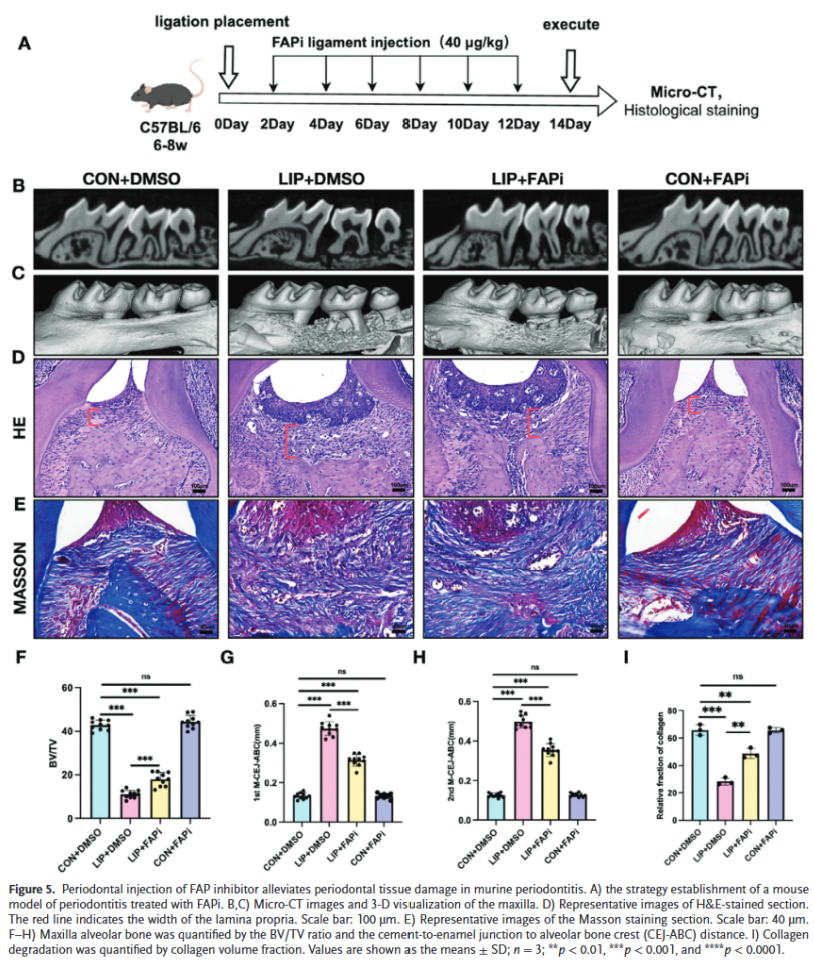
CellChat analysis showed enhanced communication between FAP⁺ fibroblasts and macrophages in periodontitis. Stimulation of macrophages with U&I's recombinant mouse FAP protein (UA010165) increased osteoclast differentiation markers (CTSK, OSCAR) and suppressed repair genes (IL10, TGFB1). The selective FAP inhibitor (Ac-Gly-BoroPro) reversed these effects and reduced alveolar bone loss and collagen degradation.
CellChat analysis showed enhanced communication between FAP⁺ fibroblasts and macrophages in periodontitis. Stimulation of macrophages with U&I's recombinant mouse FAP protein (UA010165) increased osteoclast differentiation markers (CTSK, OSCAR) and suppressed repair genes (IL10, TGFB1). The selective FAP inhibitor (Ac-Gly-BoroPro) reversed these effects and reduced alveolar bone loss and collagen degradation.
4. Conclusion
This study reveals a novel mechanism of periodontitis progression: "fibroblast senescence → mTOR → FAP/OLN imbalance → macrophage polarization," identifying FAP as a potential therapeutic target for periodontitis.
This study reveals a novel mechanism of periodontitis progression: "fibroblast senescence → mTOR → FAP/OLN imbalance → macrophage polarization," identifying FAP as a potential therapeutic target for periodontitis.
【Literature Summary】
Addressing the therapeutic challenge of inflammation and bone destruction in periodontitis, this study reveals that senescent fibroblasts drive FAP/OLN imbalance via mTOR signaling, promoting macrophage polarization toward pro-inflammatory and osteoclastogenic phenotypes and exacerbating periodontal tissue destruction. The selective FAP inhibitor (Ac-Gly-BoroPro) effectively reduced alveolar bone loss and collagen degradation. U&I's recombinant mouse FAP protein (UA010165) was used to stimulate macrophages in vitro, confirming FAP's role in promoting osteoclast differentiation markers (CTSK, OSCAR) and suppressing repair genes (IL10, TGFB1), providing a key experimental model for elucidating FAP's regulatory mechanism on macrophage phenotypes. This study offers a new strategy for targeted therapy in periodontitis.
```
This article is reviewed and published by the technical expert team of UA
Disclaimer: This article partially utilizes artificial intelligence assistance in its creation. If any content involves copyright or intellectual property issues, please let us know and we promise to verify and remove it as soon as possible.
Purchase recombinant protein, choose 
UA protein focuses on providing various protein reagents, raw materials, and services required for drug research and development, cell therapy, gene therapy, and basic scientific research, including drug target proteins, immune checkpoint proteins, cytokines, tool enzymes, customized protein expression, and full-length transmembrane protein development. Nanjing Univ is committed to providing customers with high-quality products and professional services, and building a High-tech Biological Enterprise with International Competitiveness.
Target proteins | membrane proteins | cytokines | enzymes | viral antigens | protein customization
Nanjing UNIV Biotechnology Co., Ltd. Email:order@ua-bio.com Phone:+86-25-56221161

Product Information

Link:





©2021-2026 all rights reserved UNIV Biotechnology Co.,Ltd.
Privacy Policy
网站备案号 苏ICP备2025207586号-2 浙公网安备33010202004867号
 Business license (three certificates in one)
 Tel:+86-25-56221161
E-mail:order@ua-bio.com
All products sold on this website shall not be used for clinical diagnosis or treatment of humans or animals, and shall only be used for non-medical purposes such as industrial or scientific research.