AMP Precision Quantification Technology: An Innovative Platform for Enzymatic Analysis and Drug Screening
Author: Senior Product Manager of UA Views:124 


This article focuses on the central role of adenosine monophosphate (AMP) as a key metabolite and product of multiple enzymatic reactions, systematically elaborating on the principles, advantages, and application scope of AMP quantitative detection technology based on the chemiluminescence method. It analyzes its unique value in enzyme activity determination, inhibitor screening, and mechanistic studies.
- Recent Advances
- Product Information
Recent Advances
AMP Precision Quantification Technology: An Innovative Platform for Enzymatic Analysis and Drug Screening
Summary
This article focuses on adenosine monophosphate (AMP) as a key metabolite and the central product of various enzymatic reactions. It systematically elaborates on the principles, advantages, and applications of chemiluminescence-based AMP quantification technology, analyzing its unique value in enzyme activity assays, inhibitor screening, and mechanistic studies.
This article focuses on adenosine monophosphate (AMP) as a key metabolite and the central product of various enzymatic reactions. It systematically elaborates on the principles, advantages, and applications of chemiluminescence-based AMP quantification technology, analyzing its unique value in enzyme activity assays, inhibitor screening, and mechanistic studies.
I. The Significance of AMP Detection in Life Science Research
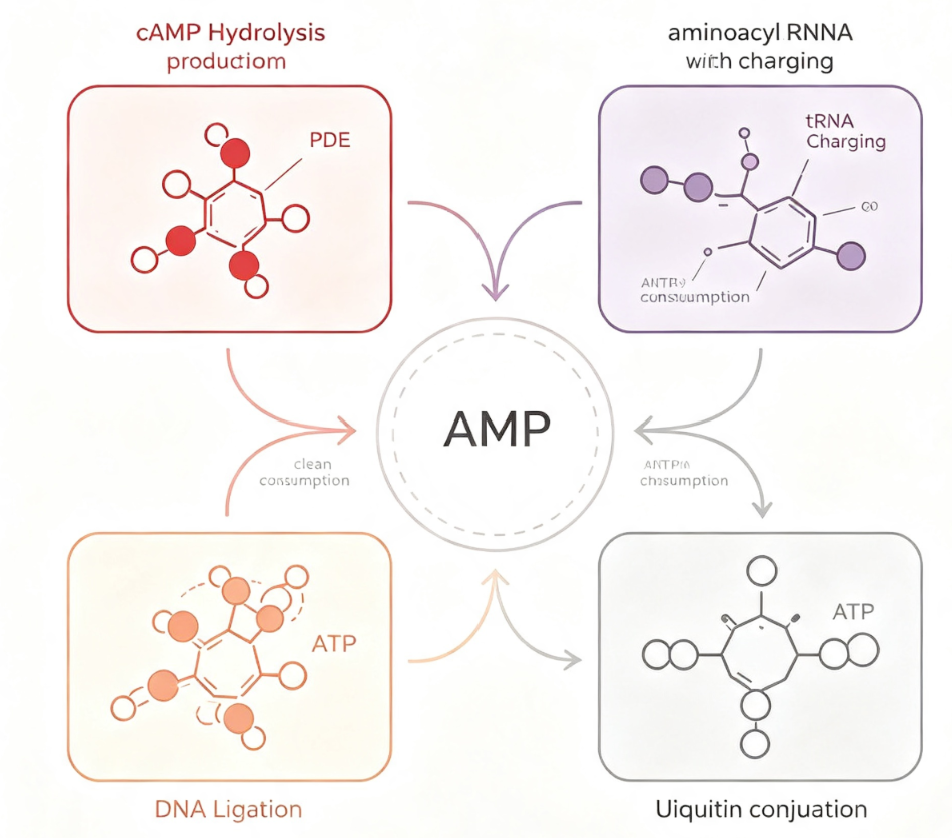
Adenosine monophosphate (AMP) is a core metabolite in cellular energy metabolism and signal transduction networks. As the product of ATP losing two phosphate groups, AMP is not only the direct product of enzymatic reactions catalyzed by adenylate kinase (AK) and 5'-nucleotidase but also appears as a product in many important enzymatic reactions. This makes AMP quantification a critical indicator for assessing the activity of these enzymes. Examples include: cyclic nucleotide phosphodiesterase (PDE) hydrolyzing cAMP to generate AMP, aminoacyl-tRNA synthetase producing AMP while consuming ATP during tRNA-amino acid linkage, DNA ligase generating AMP during DNA fragment joining, and E3 ubiquitin ligase releasing AMP during ubiquitination. Therefore, establishing a sensitive, universal, and stable AMP quantification method is essential for enzymatic mechanism studies and drug discovery.
II. Detection Principle of AMP Assay Reagent
The UA-Glo® AMP Assay Kit employs an innovative coupled enzyme-chemiluminescence two-step method for highly sensitive AMP quantification. The detection process consists of two key steps. First, the AMP GR reagent is added to the enzymatic reaction sample to terminate the reaction, completely remove residual ATP, and convert AMP to ADP. This step effectively eliminates interference from initial ATP in the system. Second, the AMP Detection Reagent is added to convert the generated ADP into ATP, which reacts with luciferin under the catalysis of luciferase to produce a stable and intense luminescent signal. Under optimized conditions, the luminescence intensity shows a strong linear correlation with AMP concentration in the range of 25 nM to 50 μM, with an R² ≥ 0.9995, achieving ultra-sensitive and precise AMP quantification.
III. Core Advantages and Broad Applicability
The UA-Glo® AMP Assay Kit provides a robust technological platform for AMP-based enzymatic analysis and drug screening, with the following key advantages:
Exceptional versatility. The kit accurately quantifies AMP regardless of whether the enzymatic reaction consumes ATP, enabling the same platform to cover diverse targets such as PDEs, ligases, synthetases, E3 ligases, and ADP-ribosyltransferases.
Ultra-high sensitivity and wide linear range. The enzyme-chemiluminescence coupled system offers significantly higher sensitivity than traditional colorimetric methods, enabling precise detection of trace AMP changes in low-activity enzyme samples. The flexible linear range accommodates diverse experimental scenarios.
Strong anti-interference capability. The chemiluminescence detection method is unaffected by fluorescent compounds, and the optimized reagent formulation minimizes interference from common compound library components, ensuring data accuracy and stability in complex drug screening systems.
Homogeneous operation for high-throughput compatibility. The "add-mix-detect" homogeneous mode requires no separation steps, perfectly adapting to 96/384-well plates with a Z´ factor > 0.7, meeting high-throughput screening demands.
IV. Key Applications and Performance Validation
The AMP Assay Kit has been widely applied in various enzymatic research and drug discovery scenarios, including inhibitor screening for targets like PDE4a, ubiquitination/ligase analysis, and immuno-oncology target studies (e.g., CD73, CD39). For performance validation, linear gradient experiments with different ATP or AMP concentrations yield standard curves with a linear regression coefficient R² > 0.9995.
V. Product Information and Key Operational Notes
To address the above AMP quantification needs, U-A offers the UA-Glo® AMP Assay Kit. The product is shipped on dry ice and should be stored at -20°C or below, protected from light, with a shelf life of 12 months. The kit includes AMP GR Reagent, AMP Detection Reagent, ATP and AMP standards, and supports 1,000 (96-well plate) or 10,000 assays.
Core operational workflow: After enzymatic reaction, equilibrate the reaction plate to room temperature; add an equal volume of AMP GR Reagent, mix, and incubate at room temperature for 40 minutes; add 2x volume of AMP Detection Reagent, mix, and incubate for 30-60 minutes; read luminescence signals using a plate reader. Note: Ensure reagents and samples are equilibrated to room temperature for uniform temperature; avoid using metal chelators (e.g., EDTA) to terminate reactions; aliquot after first use to avoid repeated freeze-thaw cycles.
VI. Conclusion
AMP detection technology, with its ultra-high sensitivity, exceptional versatility, and robust anti-interference capability, has evolved from a mere metabolite detection method into an indispensable innovative platform for enzymatic mechanism studies and modern drug discovery. The UA-Glo® AMP Assay Kit provides a sensitive, reliable, and standardized solution for such research, continuously advancing the discovery and validation of novel drug targets such as PDEs and E3 ubiquitin ligases.
This article is reviewed and published by the technical expert team of UA
Disclaimer: This article partially utilizes artificial intelligence assistance in its creation. If any content involves copyright or intellectual property issues, please let us know and we promise to verify and remove it as soon as possible.
Purchase recombinant protein, choose 
UA protein focuses on providing various protein reagents, raw materials, and services required for drug research and development, cell therapy, gene therapy, and basic scientific research, including drug target proteins, immune checkpoint proteins, cytokines, tool enzymes, customized protein expression, and full-length transmembrane protein development. Nanjing Univ is committed to providing customers with high-quality products and professional services, and building a High-tech Biological Enterprise with International Competitiveness.
Target proteins | membrane proteins | cytokines | enzymes | viral antigens | protein customization
Nanjing UNIV Biotechnology Co., Ltd. Email:order@ua-bio.com Phone:+86-25-56221161

Product Information

Link:





©2021-2026 all rights reserved UNIV Biotechnology Co.,Ltd.
Privacy Policy
网站备案号 苏ICP备2025207586号-2 浙公网安备33010202004867号
 Business license (three certificates in one)
 Tel:+86-25-56221161
E-mail:order@ua-bio.com
All products sold on this website shall not be used for clinical diagnosis or treatment of humans or animals, and shall only be used for non-medical purposes such as industrial or scientific research.