

Chemiluminescence-based AMP detection technology: A versatile platform for high-throughput enzymatic analysis and drug discovery
Author: Senior Product Manager of UA Views:126 


This article systematically elucidates the detection principle of AMP quantitative assay based on chemiluminescence, which converts AMP into ATP through coupled enzymatic reactions and generates light signals using luciferase. It also analyzes its versatile application value in various enzymatic systems, including cyclic nucleotide phosphodiesterase, DNA ligase, and E3 ubiquitin ligase.
- Recent Advances
- Product Information
Recent Advances
Chemiluminescent AMP Detection Technology: A Versatile Platform for High-Throughput Enzymatic Analysis and Drug Discovery
Overview
This article systematically elaborates on the principle of AMP quantification technology based on chemiluminescence, which converts AMP into ATP through coupled enzymatic reactions and utilizes luciferase to generate light signals. It also analyzes its universal applicability in various enzymatic systems, including cyclic nucleotide phosphodiesterases, DNA ligases, and E3 ubiquitin ligases.
This article systematically elaborates on the principle of AMP quantification technology based on chemiluminescence, which converts AMP into ATP through coupled enzymatic reactions and utilizes luciferase to generate light signals. It also analyzes its universal applicability in various enzymatic systems, including cyclic nucleotide phosphodiesterases, DNA ligases, and E3 ubiquitin ligases.
I. AMP as a Critical Detection Target in Enzymatic Reactions
In the fields of biochemistry and drug discovery, adenosine monophosphate (AMP) is not only an intermediate metabolite in energy metabolism but also a key product of various enzymatic reactions. For example: Cyclic nucleotide phosphodiesterases (PDEs) hydrolyze cAMP into AMP, which is a crucial step in regulating intracellular cAMP levels and a popular target for drugs treating inflammation, cardiovascular diseases, and depression. DNA ligases consume ATP and produce AMP during DNA strand ligation. E3 ubiquitin ligases release AMP during the transfer of ubiquitin to substrate proteins, and their dysfunction is closely associated with various cancers and neurodegenerative diseases. Additionally, aminoacyl-tRNA synthetases generate AMP during the first step of protein translation when activating amino acids, and ADP-ribosyltransferases (PARP family) also release AMP during ADP-ribosylation modifications.
Since one of the common features of these enzymatic reactions is the generation of AMP, establishing a universal, sensitive, and high-throughput-compatible AMP quantification method can effectively monitor the activity of these target enzymes, which is of great significance for both basic enzymology research and drug screening.
II. Detection Principle of Dual-Enzyme Coupled Chemiluminescence
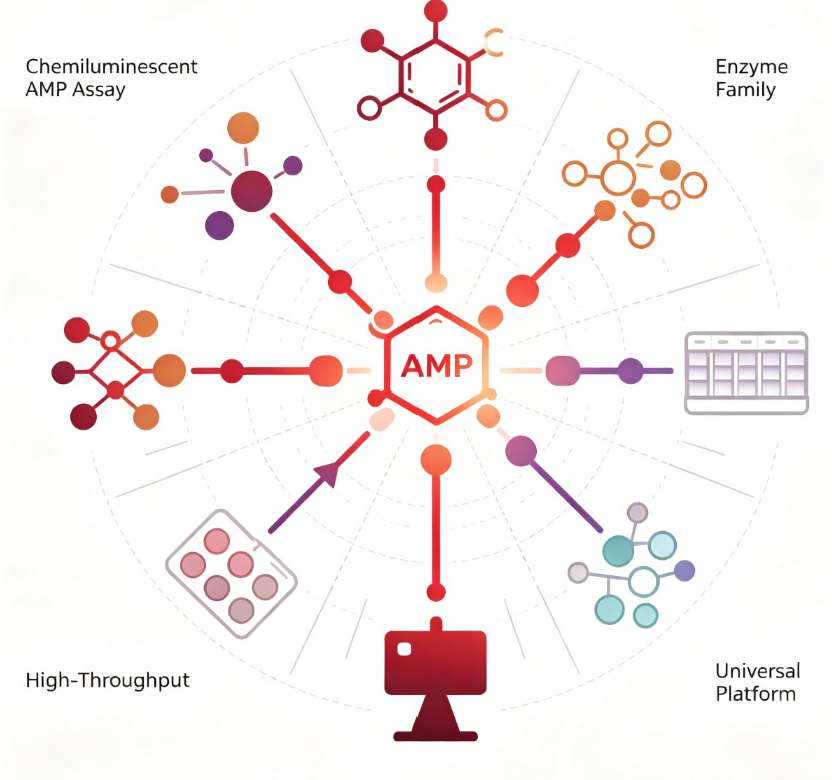
The UA-Glo® AMP Assay Kit employs a chemiluminescent detection strategy based on dual-enzyme coupled reactions, converting AMP concentration into high signal-to-noise luminescence. The workflow can be operationally divided into two steps, but it involves a sophisticated coupled enzymatic catalysis process. First, the AMP GR reagent is added to the sample containing AMP. The enzyme system in this reagent thoroughly removes residual ATP in the sample and quantitatively converts AMP into ADP. Second, the AMP detection reagent is added, and the enzyme system within it reconverts the generated ADP into ATP. The newly formed ATP reacts with luciferin under the catalysis of luciferase to produce a stable and intense light signal. Under optimized conditions, the luminescence intensity of the sample is proportional to the initial AMP concentration within a certain range (typically nanomolar to micromolar levels).
III. Key Performance Parameters and Technical Features
The UA-Glo® AMP Assay Kit is systematically optimized for various commonly used enzymatic systems, with its core features reflected in the following aspects. In terms of universality, the kit is suitable for PDE family enzymes, ligases, E3 ubiquitin ligases, adenylate kinases, aminoacyl-tRNA synthetases, and ADP-ribosyltransferases, among other enzymatic systems that involve ATP or AMP as substrates/products. In terms of interference control, the two-step reaction design effectively eliminates background ATP signals from the enzymatic reaction system before detection, ensuring that the measured signal truly originates from newly generated AMP. The Z′ factor typically exceeds 0.7.
IV. Experimental Design and Optimization Strategies
When using this kit for enzyme activity determination or inhibitor screening, the following experimental strategies are recommended. First, the enzyme reaction system must be compatible with the kit. The detection reagents in the kit tolerate common components in reaction buffers (e.g., Tris-HCl, HEPES, NaCl, MgCl₂, DMSO) but should avoid high concentrations of metal chelators (e.g., EDTA) to terminate reactions, as they may interfere with the activity of the coupled enzyme system. In experimental design, it is advisable to include positive controls (using enzymes with known activity or recombinant enzymes) and negative controls (without enzymes or substrates) to validate the reaction system and assess background signals. For inhibitor screening, inhibitors should be added during the enzyme reaction stage, followed by transferring an appropriate amount of the reaction mixture to the detection plate for AMP quantification. To further reduce data variability, replicate wells are recommended, and a microplate reader with luminescence detection capability should be used for measurements.
V. Product Characteristics and Application Scope of UA-Glo® AMP Assay Kit
To address the aforementioned AMP quantification needs, UA-Glo® AMP Assay Kit is provided. This kit employs an optimized chemiluminescent detection system with the following key features: stable "glow-type" chemiluminescent signals with a half-life exceeding 2 hours, offering excellent tolerance for timing; homogeneous operation mode without washing or separation steps; complete elimination of AMP background, detecting only newly generated AMP from enzymatic reactions; good tolerance to reaction buffer components; a dynamic range covering 4 orders of magnitude for AMP concentration, with detection limits as low as nanomolar levels; compatibility with high-throughput formats, supporting multiple 96/384-well plate experiments per kit. The kit is suitable for PDE family enzyme inhibitor screening, E3 ubiquitin ligase activity analysis and compound evaluation, DNA ligase activity detection, and mechanistic studies of various enzymatic systems where AMP is a product.
VI. Conclusion
Enzymatic systems producing AMP play a significant role in modern drug discovery, and their activity evaluation and inhibitor screening urgently require sensitive, universal, and high-throughput-compatible detection methods. The AMP detection technology based on dual-enzyme coupled chemiluminescence effectively addresses the limitations of traditional methods, such as low sensitivity, limited throughput, and background interference, providing a stable and reliable technical platform for mechanistic research and drug development targeting PDEs, E3 ubiquitin ligases, ligases, and other targets. With its optimized enzymatic coupling system and simple workflow, the UA-Glo® AMP Assay Kit has broad application prospects in novel drug target discovery and validation.
This article is reviewed and published by the technical expert team of UA
Disclaimer: This article partially utilizes artificial intelligence assistance in its creation. If any content involves copyright or intellectual property issues, please let us know and we promise to verify and remove it as soon as possible.
Purchase recombinant protein, choose 
UA protein focuses on providing various protein reagents, raw materials, and services required for drug research and development, cell therapy, gene therapy, and basic scientific research, including drug target proteins, immune checkpoint proteins, cytokines, tool enzymes, customized protein expression, and full-length transmembrane protein development. Nanjing Univ is committed to providing customers with high-quality products and professional services, and building a High-tech Biological Enterprise with International Competitiveness.
Target proteins | membrane proteins | cytokines | enzymes | viral antigens | protein customization
Nanjing UNIV Biotechnology Co., Ltd. Email:order@ua-bio.com Phone:+86-25-56221161

Product Information

Link:





©2021-2026 all rights reserved UNIV Biotechnology Co.,Ltd.
Privacy Policy
网站备案号 苏ICP备2025207586号-2 浙公网安备33010202004867号
 Business license (three certificates in one)
 Tel:+86-25-56221161
E-mail:order@ua-bio.com
All products sold on this website shall not be used for clinical diagnosis or treatment of humans or animals, and shall only be used for non-medical purposes such as industrial or scientific research.