The Dual Role of Caspase-3/7 in Intestinal Inflammation and Tumorigenesis and Its Application in High-Sensitivity Detection
Author: Senior Product Manager of UA Views:167 


This article systematically elucidates the central role of Caspase-3/7 in intestinal homeostasis and disease, highlighting its anti-inflammatory barrier function by inhibiting GSDMD-mediated pyroptosis and ensuring the regenerative capacity of intestinal stem cells, while also exploring its "double-edged sword" effect in inflammation-driven tumor initiation.
- Recent Advances
- Product Information
Recent Advances
The Dual Role of Caspase-3/7 in Intestinal Inflammation and Tumorigenesis and Its High-Sensitivity Detection Applications
Summary
This article systematically elucidates the central role of Caspase-3/7 in intestinal homeostasis and disease, highlighting its anti-inflammatory barrier function by inhibiting GSDMD-mediated pyroptosis and ensuring intestinal stem cell regenerative capacity, as well as its "double-edged sword" effect in inflammation-driven tumor initiation.
This article systematically elucidates the central role of Caspase-3/7 in intestinal homeostasis and disease, highlighting its anti-inflammatory barrier function by inhibiting GSDMD-mediated pyroptosis and ensuring intestinal stem cell regenerative capacity, as well as its "double-edged sword" effect in inflammation-driven tumor initiation.
I. The Dominant Role of Caspase-3/7 in the Regulatory Network of Intestinal Epithelial Cell Death.
Inflammatory bowel disease is characterized by dysfunction of the intestinal epithelial barrier, with dysregulated cell death programs being a direct driver of barrier disruption. Under physiological homeostasis, apoptosis and anoikis work synergistically to maintain the orderly turnover of intestinal epithelial cells along the crypt-villus axis. In pathological stress states such as IBD, non-classical regulated cell death pathways—including necroptosis, pyroptosis, and ferroptosis—are specifically activated, exacerbating mucosal damage by amplifying inflammatory signals and disrupting epithelial continuity.
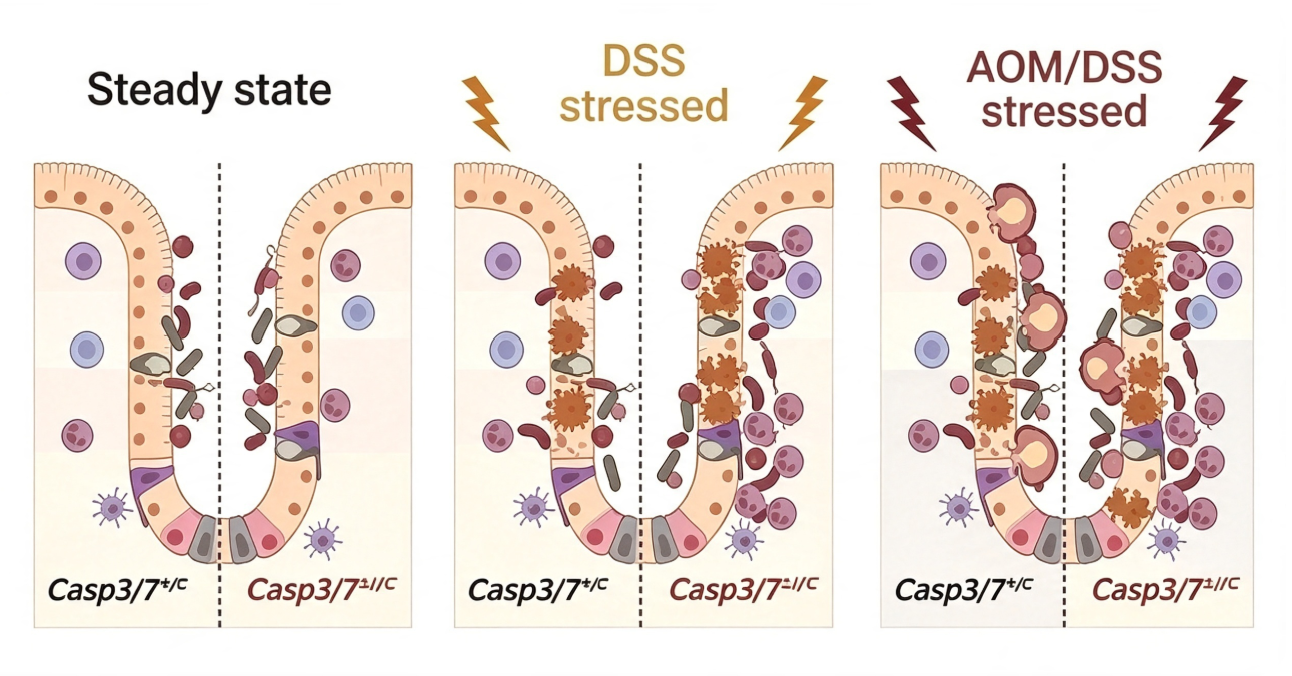
However, the functional contributions of different cell death pathways in colitis progression remain poorly understood. A study published in Science Advances systematically quantified these contributions using intestinal epithelial cell-specific conditional knockout mouse models, including apoptosis (Casp3/7ΔIEC), necroptosis (MlklΔIEC), pyroptosis (GsdmdΔIEC, GsdmeΔIEC), and ferroptosis (Gpx4ΔIEC) pathways, in a DSS colitis model. The study found that only Casp3/7ΔIEC mice exhibited significantly worsened colitis phenotypes—increased weight loss, higher disease activity index, shortened colon length, and enhanced intestinal barrier permeability—while other knockout mice showed no significant differences. These results establish the non-redundant and dominant protective role of Caspase-3/7-dependent apoptosis in maintaining intestinal epithelial barrier homeostasis.
II. The Dual Role of Caspase-3/7: Anti-Inflammatory Barrier and Tumor Initiation as a "Double-Edged Sword".
Caspase-3/7's role extends far beyond that of a simple "apoptosis executor." Studies show that the increased colitis susceptibility of Casp3/7ΔIEC mice is not due to accumulated death load caused by blocked apoptosis—TUNEL staining and Annexin V/PI dual staining revealed no significant increase in overall cell mortality. Mechanistically, Caspase-3/7 deficiency leads to specific alterations in GSDMD protein cleavage patterns: the active p20 fragment is entirely absent, while the p30 precursor proportion increases, suggesting that Caspase-3/7 limits pyroptosis-driven inflammatory amplification by inhibiting GSDMD activation. More importantly, Caspase-3/7 deficiency selectively impairs the regenerative capacity of intestinal stem cells and transit-amplifying cells, with significantly reduced numbers of Ki67⁺ proliferating cells and Lgr5⁺ intestinal stem cells, as well as diminished organoid budding and structural reconstruction efficiency.
In the AOM/DSS-induced colitis-associated colorectal cancer model, however, Casp3/7ΔIEC mice exhibited significantly reduced tumor burden—fewer tumors, smaller volumes, and a lower proportion of high-grade dysplasia. This phenomenon reveals the functional duality of Caspase-3/7 in the intestinal microenvironment: during the inflammatory phase, it exerts protective effects by inhibiting pyroptosis and ensuring stem cell regeneration; during tumor initiation, it provides the necessary regenerative microenvironment for inflammation-driven clonal expansion. This finding raises an important caution for Caspase-3/7-targeted therapeutic strategies—long-term systemic inhibition may alleviate active colitis but could disrupt physiological epithelial renewal dependent on intestinal stem cells, increasing the risk of malignant transformation.
III. Technical Principles and Applications of Caspase-3/7 Activity Detection.
As the most central executioner proteins of the apoptosis pathway, the activation of Caspase-3 and Caspase-7 is a definitive marker of irreversible cell death. Both recognize and cleave the same DEVD tetrapeptide sequence, making them typically co-detected in apoptosis assays.
The UA-Glo® Caspase 3/7 Assay employs a homogeneous chemiluminescence-based detection system. Its core design features a highly specific luminescent substrate for Caspase-3/7—containing a DEVD sequence linked to an aminoluciferin precursor molecule. In its uncleaved state, this precursor cannot generate effective luminescence; when activated Caspase-3/7 cleaves the DEVD sequence, free aminoluciferin is released, producing a "glow-type" chemiluminescent signal under the optimized luciferase system in the reagent. The signal intensity correlates with Caspase-3/7 activity in the sample, enabling precise quantification.
The kit features an ultra-simple "add-mix-measure" workflow: no washing, no media change, and no cell lysis required, perfectly suited for high-throughput 96/384-well plate formats, with Z′ factors typically exceeding 0.7. The luminescent signal is stable with a half-life exceeding 2 hours, offering superior tolerance to timing control compared to traditional fluorescence methods.
IV. Features and Application Scenarios of UA-Glo® Caspase 3/7 Assay.
To address the aforementioned apoptosis detection needs, UA-Glo® Caspase 3/7 Assay is provided. This kit employs a chemiluminescence detection system with the following features: homogeneous operation mode requiring no washing or cell separation steps; exceptional signal-to-noise ratio and broad dynamic range in both pure enzyme and cellular assays; optimized formulation with good tolerance to common reaction buffer components; stable signals supporting batch processing; and compatibility with automation platforms. The kit is suitable for efficacy evaluation of anticancer and chemotherapeutic drugs, cytotoxicity and safety assessments, apoptosis signaling pathway mechanism studies, and functional genomics screening.
V. Conclusion.
As the core executioners of the apoptosis pathway, Caspase-3/7 play a "double-edged sword" role in intestinal inflammation and tumorigenesis—serving as both a key protective factor for the barrier and a driver of tumor initiation. Chemiluminescence-based Caspase-3/7 detection technology, with its high sensitivity, simplicity, and high-throughput compatibility, provides a reliable quantitative tool for in-depth analysis of Caspase-3/7's functional mechanisms in complex pathological networks, offering broad application value in anticancer drug screening, toxicity evaluation, and apoptosis mechanism research.
This article is reviewed and published by the technical expert team of UA
Disclaimer: This article partially utilizes artificial intelligence assistance in its creation. If any content involves copyright or intellectual property issues, please let us know and we promise to verify and remove it as soon as possible.
Purchase recombinant protein, choose 
UA protein focuses on providing various protein reagents, raw materials, and services required for drug research and development, cell therapy, gene therapy, and basic scientific research, including drug target proteins, immune checkpoint proteins, cytokines, tool enzymes, customized protein expression, and full-length transmembrane protein development. Nanjing Univ is committed to providing customers with high-quality products and professional services, and building a High-tech Biological Enterprise with International Competitiveness.
Target proteins | membrane proteins | cytokines | enzymes | viral antigens | protein customization
Nanjing UNIV Biotechnology Co., Ltd. Email:order@ua-bio.com Phone:+86-25-56221161

Product Information

Link:





©2021-2026 all rights reserved UNIV Biotechnology Co.,Ltd.
Privacy Policy
网站备案号 苏ICP备2025207586号-2 浙公网安备33010202004867号
 Business license (three certificates in one)
 Tel:+86-25-56221161
E-mail:order@ua-bio.com
All products sold on this website shall not be used for clinical diagnosis or treatment of humans or animals, and shall only be used for non-medical purposes such as industrial or scientific research.