

The "Double-Edged Sword" of Apoptosis: Functional Analysis of Caspase-37 in Intestinal Inflammation and Tumors and Its Application in High-Sensitivity Detection
Author: Senior Product Manager of UA Views:130 


This article systematically elucidates the dual role of Caspase-3/7 in intestinal diseases, highlighting its anti-inflammatory and protective effects by inhibiting pyroptosis and ensuring stem cell regeneration to maintain intestinal epithelial barrier homeostasis, while also exploring its contribution to inflammation-driven tumor initiation.
- Recent Advances
- Product Information
Recent Advances
The Double-Edged Sword of Apoptosis: Functional Analysis of Caspase-3/7 in Intestinal Inflammation and Tumors, and Applications in High-Sensitivity Detection
Summary
This article systematically explores the dual functions of Caspase-3/7 in intestinal diseases, highlighting its anti-inflammatory protective role in maintaining intestinal epithelial barrier homeostasis by inhibiting pyroptosis and supporting stem cell regeneration, while also contributing to inflammation-driven tumor initiation.
This article systematically explores the dual functions of Caspase-3/7 in intestinal diseases, highlighting its anti-inflammatory protective role in maintaining intestinal epithelial barrier homeostasis by inhibiting pyroptosis and supporting stem cell regeneration, while also contributing to inflammation-driven tumor initiation.
I. Re-evaluating Cell Death Pathways in Intestinal Diseases
In inflammatory bowel disease (IBD) and related intestinal disorders, cell death has long been considered a key driver of tissue damage and exacerbated inflammation. However, the actual roles of different types of cell death in disease progression remain highly controversial. Numerous studies have confirmed that various programmed cell death pathways—including apoptosis, necroptosis, pyroptosis, and ferroptosis—are abnormally activated in IBD patients and experimental colitis models. Yet, the functional hierarchy, temporal characteristics, and interaction networks of these pathways still lack systematic comparative analysis.
Intestinal epithelial cells are the core structures maintaining the intestinal barrier and immune homeostasis, with their renewal relying on a dynamic balance between stem cell proliferation, differentiation, and controlled cell death. In IBD, aberrant cell death is regarded as one of the critical pathological mechanisms. However, a study using DSS-induced colitis and AOM/DSS colorectal cancer models, through parallel comparisons of multiple gene knockout mouse models, arrived at a surprising conclusion: the classical apoptosis execution factors Caspase-3/7 are not "inflammatory instigators" but rather key protective factors for maintaining intestinal homeostasis, while also promoting tumorigenesis. This finding redefines the functional boundaries of cell death in intestinal diseases.
II. The Protective Role of Caspase-3/7 in Intestinal Homeostasis
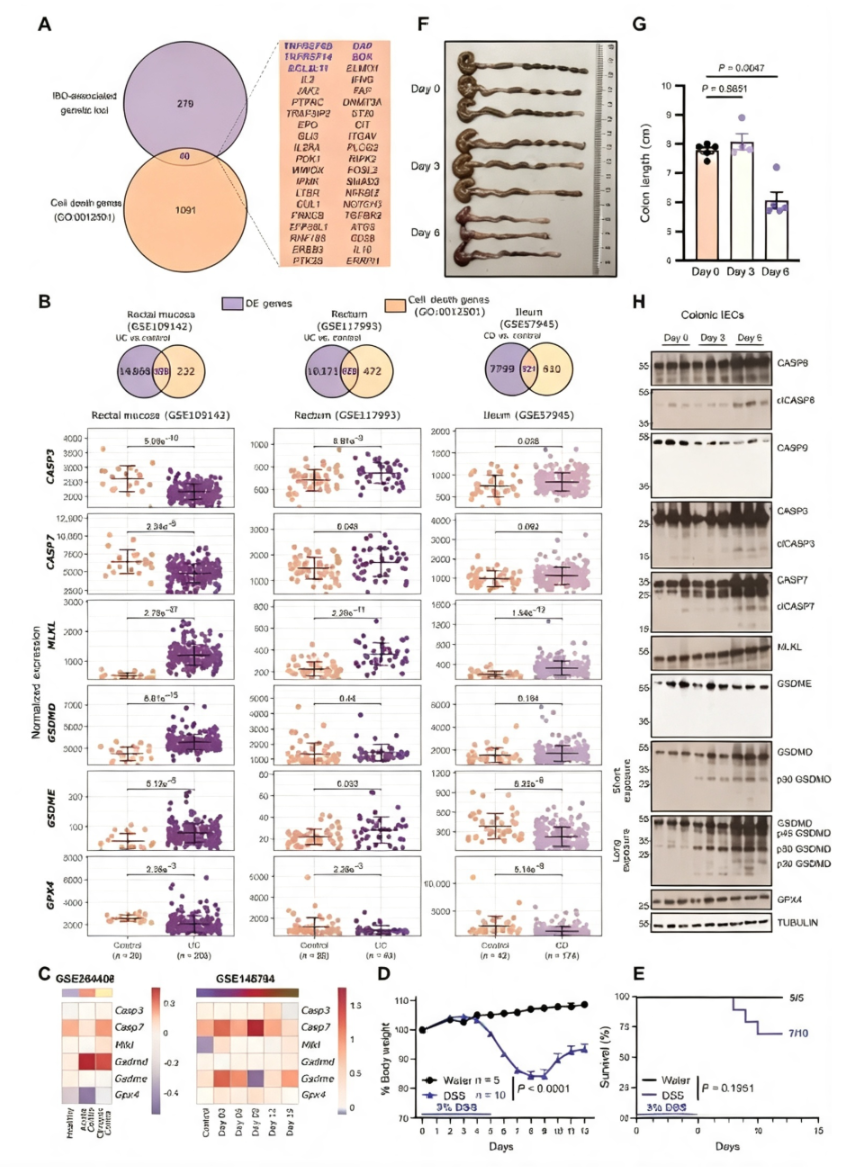
The study first integrated IBD-related genetic loci and patient transcriptome data, revealing widespread abnormalities in multiple cell death-related pathways in inflammatory bowel disease, suggesting a systemic imbalance in the cell death network in IBD. To systematically dissect the causal contributions of these pathways, the researchers constructed intestinal epithelial cell-specific conditional knockout mouse models, covering apoptosis (Casp3/7ΔIEC), necroptosis (MlklΔIEC), pyroptosis (GsdmdΔIEC, GsdmeΔIEC), and ferroptosis (Gpx4ΔIEC) pathways.
In the DSS-induced acute colitis model, only Caspase-3/7-deficient mice exhibited significantly aggravated disease phenotypes—including more rapid weight loss, higher disease activity index, pronounced colon shortening, and structural tissue damage. In contrast, the absence of MLKL, GSDMD, GSDME, or GPX4 did not lead to significant changes. This result established that Caspase-3/7-dependent apoptosis plays a non-redundant and dominant protective role in maintaining intestinal epithelial barrier homeostasis.
Further mechanistic studies found that Caspase-3/7 deletion did not significantly alter the overall death levels of intestinal epithelial cells but markedly changed the composition of death types. The pyroptosis-related molecule GSDMD's active fragment (p20) significantly increased, while its inhibitory cleavage form disappeared, suggesting that apoptosis deficiency leads to enhanced inflammatory cell death. This "death mode switch" is a critical factor in exacerbating inflammation—Caspase-3/7 acts as a hierarchical regulatory switch between apoptosis and pyroptosis by inhibiting GSDMD-mediated pyroptosis.
At the tissue regeneration level, RNA sequencing and immunohistochemical analysis revealed that Caspase-3/7 deletion significantly suppressed the proliferative capacity of intestinal stem cells and transit-amplifying cells. The expression of stem cell marker Lgr5 and cell cycle-related genes markedly decreased, Ki67-positive cell numbers declined, and organoid budding capacity was significantly impaired. These results demonstrate that apoptosis is not merely a "cell clearance mechanism" but also a key regulatory node in maintaining intestinal epithelial renewal capacity.
III. Counterintuitive Phenomena: Enhanced Inflammation but Reduced Tumors
In the AOM/DSS-induced colorectal cancer model, Caspase-3/7-deficient mice exhibited significantly reduced tumor burden—fewer tumors, smaller volumes, and a lower proportion of high-grade dysplasia. This result starkly contrasts with the enhanced inflammation phenotype, suggesting that inflammation is not the sole determinant of tumorigenesis. Further analysis indicated that tumor suppression primarily stemmed from diminished stem cell proliferative capacity, thereby limiting the foundation for tumor initiation. This finding reveals the "double-edged sword" effect of Caspase-3/7 in the intestinal microenvironment: during inflammation, it exerts protective effects by inhibiting pyroptosis and supporting stem cell regeneration; during tumor initiation, it provides the necessary regenerative microenvironment for inflammation-driven clonal expansion. Additionally, analyses using GPX4-deficient models and radiation injury models showed that ferroptosis does not play a significant role in intestinal inflammation and tumor systems, highlighting the context-specific functions of different cell death pathways in various tissues and disease backgrounds.
IV. Application of UA-Glo® Caspase 3/7 Assay in Apoptosis Research
In drug screening, apoptosis mechanism studies, and cytotoxicity assessments related to Caspase-3/7, sensitive and reliable detection methods are essential prerequisites for experiments. As core executioner proteins of the apoptosis pathway, both Caspase-3 and Caspase-7 recognize and cleave the same DEVD tetrapeptide sequence, making them typically co-detected in apoptosis assays. To meet this detection need, UA-Glo® Caspase 3/7 Assay is provided. This kit employs a homogeneous detection system based on chemiluminescence, with its core design featuring a highly specific luminescent substrate for Caspase-3/7—this substrate consists of the DEVD sequence linked to an aminoluciferin precursor molecule. In its uncleaved state, the precursor molecule cannot generate an effective luminescent signal. When activated Caspase-3/7 cleaves the DEVD sequence, free aminoluciferin is released, producing a "glow-type" chemiluminescent signal under an optimized luciferase system. The signal intensity is proportional to Caspase-3/7 activity.
V. Conclusion
The functions of Caspase-3/7 in intestinal diseases extend far beyond its classical role as an "apoptosis executioner"—it is both a protective factor for the intestinal epithelial barrier and a driver of tumorigenesis. By inhibiting GSDMD-mediated pyroptosis and maintaining intestinal stem cell regenerative capacity, it regulates the balance between inflammation and regeneration. This discovery provides new perspectives for understanding the interactive regulation of cell death pathways and poses challenges for the cautious evaluation of therapeutic strategies targeting Caspase-3/7. High-sensitivity Caspase-3/7 detection technologies will serve as critical tools for in-depth mechanistic studies and the development of targeted intervention strategies.
This article is reviewed and published by the technical expert team of UA
Disclaimer: This article partially utilizes artificial intelligence assistance in its creation. If any content involves copyright or intellectual property issues, please let us know and we promise to verify and remove it as soon as possible.
Purchase recombinant protein, choose 
UA protein focuses on providing various protein reagents, raw materials, and services required for drug research and development, cell therapy, gene therapy, and basic scientific research, including drug target proteins, immune checkpoint proteins, cytokines, tool enzymes, customized protein expression, and full-length transmembrane protein development. Nanjing Univ is committed to providing customers with high-quality products and professional services, and building a High-tech Biological Enterprise with International Competitiveness.
Target proteins | membrane proteins | cytokines | enzymes | viral antigens | protein customization
Nanjing UNIV Biotechnology Co., Ltd. Email:order@ua-bio.com Phone:+86-25-56221161

Product Information

Link:





©2021-2026 all rights reserved UNIV Biotechnology Co.,Ltd.
Privacy Policy
网站备案号 苏ICP备2025207586号-2 浙公网安备33010202004867号
 Business license (three certificates in one)
 Tel:+86-25-56221161
E-mail:order@ua-bio.com
All products sold on this website shall not be used for clinical diagnosis or treatment of humans or animals, and shall only be used for non-medical purposes such as industrial or scientific research.