

MHC tetramer technology: the gold standard for antigen-specific T cell detection
Author: Senior Product Manager of UA Views:298 


This article focuses on the core principles and experimental methods of MHC tetramer technology, systematically explaining how the technology overcomes the technical bottleneck of insufficient affinity between TCR and pMHC monomers through multivalent design. It analyzes the operational workflow and core advantages of this technology on the flow cytometry platform and introduces its wide applications in research fields such as tumor immunology, infectious diseases, and autoimmune diseases.
- Recent Advances
- Product Information
Recent Advances
MHC Tetramer Technology: The Gold Standard for Antigen-Specific T Cell Detection
Overview
This article systematically elaborates on the core principles and experimental methodologies of MHC tetramer technology, explaining how its multivalent design overcomes the technical bottleneck of low affinity between TCR and pMHC monomers. It analyzes the operational workflow and key advantages of this technology in flow cytometry platforms, and introduces its wide applications in tumor immunology, infectious diseases, and autoimmune disease research.
This article systematically elaborates on the core principles and experimental methodologies of MHC tetramer technology, explaining how its multivalent design overcomes the technical bottleneck of low affinity between TCR and pMHC monomers. It analyzes the operational workflow and key advantages of this technology in flow cytometry platforms, and introduces its wide applications in tumor immunology, infectious diseases, and autoimmune disease research.
I. Technical Origins and Core Principles
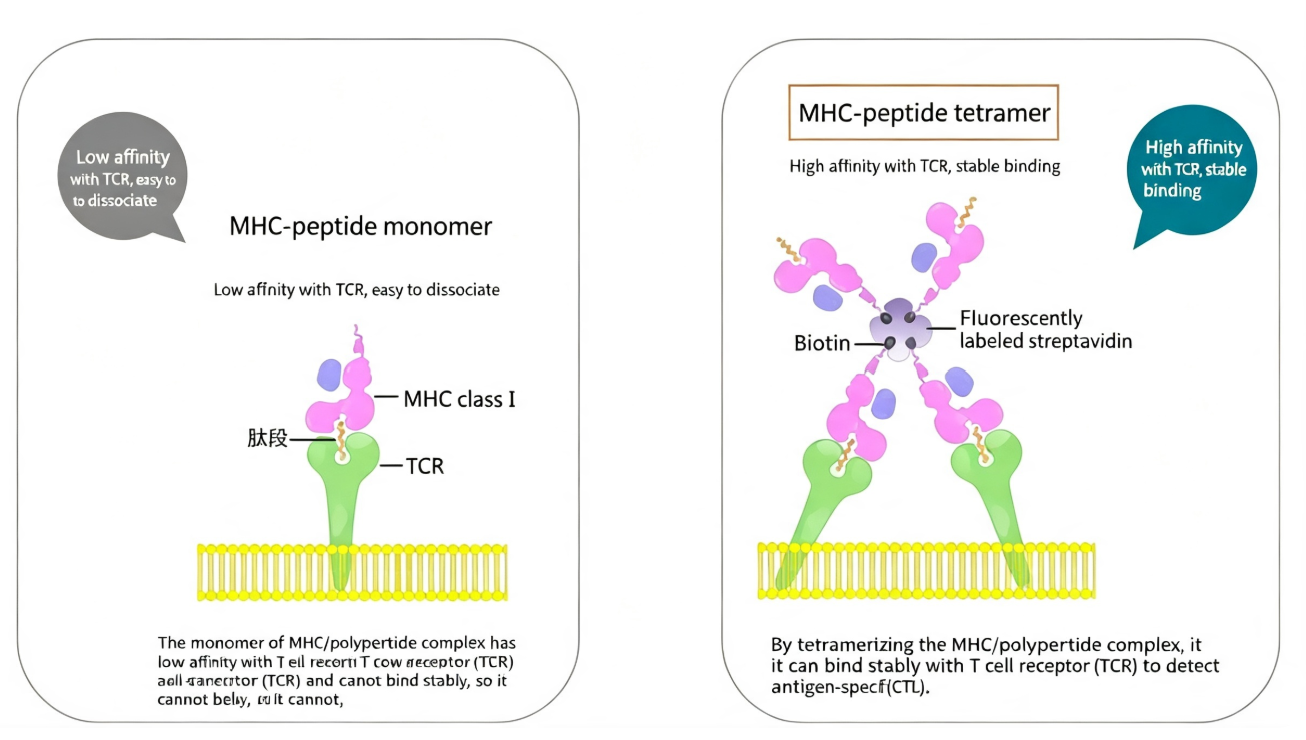
MHC tetramer technology addresses the issues of low affinity and short half-life between T cell receptors and MHC-peptide monomer complexes. Since the binding force between a single pMHC monomer and TCR is weak and rapidly dissociates, it cannot be directly used for stable labeling of antigen-specific T cells. Tetramer technology utilizes the biotin-streptavidin system to combine four biotin-labeled pMHC monomers with a fluorescently labeled streptavidin molecule, forming a stable tetramer complex. A single tetramer molecule can simultaneously bind to three or four TCRs on the same T cell surface, significantly enhancing overall affinity through multivalent effects, thereby enabling direct identification and stable labeling of antigen-specific T cells.
II. Experimental Workflow and Operational Methods
The basic workflow of MHC tetramer detection includes four main steps: sample preparation, tetramer staining, flow cytometry analysis, and data processing. In the sample preparation stage, heparin-anticoagulated whole blood or peripheral blood mononuclear cells are typically used as test samples. The tetramer staining step is the core of this technology—PE or other fluorescently labeled MHC tetramers are incubated with the sample at room temperature in the dark, along with lineage marker antibodies such as anti-CD3, CD4, and CD8. Using the "surface staining-fixation-lysis" protocol, after staining is completed, fixation and red blood cell lysis are performed before proceeding to detection.
In result analysis, a "gating" strategy is typically employed: first, the lymphocyte population is identified in the FSC/SSC scatter plot, followed by sequential gating of the CD3⁺CD8⁺T cell subset, and finally, the proportion and fluorescence intensity of tetramer-positive cells within the CD8⁺T cells are analyzed. The detection sensitivity of this method can reach antigen-specific T cell frequencies of 0.01% to 0.1%.
III. Technical Advantages and Application Fields
MHC tetramer technology offers several key advantages in antigen-specific T cell detection. In terms of high specificity, this technology directly identifies TCRs on antigen peptide-specific CD8⁺T cells and is internationally recognized as the gold standard for antigen-specific T cell detection. In terms of high sensitivity, tetramers exhibit strong affinity with TCRs and low background noise, providing superior detection sensitivity compared to traditional methods. In terms of detection efficiency, no in vitro antigen peptide stimulation or expansion is required, and the entire process can be completed in 3 to 4 hours when combined with flow cytometry. In terms of quantitative accuracy, no cell stimulation or expansion pretreatment is needed, enabling direct T cell detection, which simplifies the workflow and avoids biases introduced by in vitro operations.
This technology has broad applications. In tumor research, MHC tetramers can evaluate neoantigen-specific T cell responses, screen dominant CTL epitopes, and monitor the proportion of TCR-positive cells in TCR-T cell therapy products. In infectious disease research, it can be used for antigen-specific T cell detection and vaccine efficacy evaluation for pathogens such as SARS-CoV-2, influenza virus, EBV, and HIV. In transplantation medicine, it can monitor the immune reconstitution status of donor-specific T cells for common viruses (e.g., CMV, EBV). In autoimmune disease research, it can be used for qualitative and quantitative analysis of autoreactive T cells in conditions such as type 1 diabetes and multiple sclerosis.
IV. Conclusion
Given the widespread use of MHC tetramers in tumor immunology and infectious disease research, U-Array offers the PE-labeled UA-MHC HLA-A0201/KLTNTGLYNL HPV18.E6 Tetramer-PE Labelled, which covers the HPV18 E6 protein amino acid sequence KLTNTGLYNL (positions 92-101). Validated by flow cytometry, this tetramer specifically recognizes HLA-A*0201-restricted HPV18.E6-specific CD8⁺T cells. The product uses PE as the fluorescent label, making it highly compatible with the PE channel of flow cytometers, and is suitable for antigen-specific T cell detection and sorting in HPV-related cervical cancer and head and neck squamous cell carcinoma research.
MHC tetramer technology effectively addresses the detection challenge of low affinity between TCR and MHC monomers through multivalent binding strategies, providing a reliable technical platform for direct quantitative analysis of antigen-specific T cells. Its broad applications in tumor immunology, infectious diseases, and transplantation monitoring fully demonstrate its value as a core tool in both basic research and clinical translation.
This article is reviewed and published by the technical expert team of UA
Disclaimer: This article partially utilizes artificial intelligence assistance in its creation. If any content involves copyright or intellectual property issues, please let us know and we promise to verify and remove it as soon as possible.
Purchase recombinant protein, choose 
UA protein focuses on providing various protein reagents, raw materials, and services required for drug research and development, cell therapy, gene therapy, and basic scientific research, including drug target proteins, immune checkpoint proteins, cytokines, tool enzymes, customized protein expression, and full-length transmembrane protein development. Nanjing Univ is committed to providing customers with high-quality products and professional services, and building a High-tech Biological Enterprise with International Competitiveness.
Target proteins | membrane proteins | cytokines | enzymes | viral antigens | protein customization
Nanjing UNIV Biotechnology Co., Ltd. Email:order@ua-bio.com Phone:+86-25-56221161

Product Information

Link:





©2021-2026 all rights reserved UNIV Biotechnology Co.,Ltd.
Privacy Policy
网站备案号 苏ICP备2025207586号-2 浙公网安备33010202004867号
 Business license (three certificates in one)
 Tel:+86-25-56221161
E-mail:order@ua-bio.com
All products sold on this website shall not be used for clinical diagnosis or treatment of humans or animals, and shall only be used for non-medical purposes such as industrial or scientific research.