Comprehensive Analysis of the GPRC5D Target Arena: Bispecific Antibodies, CAR-T, and Trispecific Antibodies Compete on the Same Stage
Author: Senior Product Manager of UA Views:301 


Multiple Myeloma (MM) is the second most common malignant tumor in the hematopoietic system. Despite continuous advancements in existing treatments, the majority of patients will ultimately face the challenges of relapse or drug resistance.
- Recent Advances
- Product Information
Recent Advances
Comprehensive Analysis of the GPRC5D Target Landscape: Bispecific Antibodies, CAR-T, and Trispecific Antibodies Compete on the Same Stage
Multiple Myeloma (MM) is the second most common hematologic malignancy. Despite continuous advancements in existing treatments, most patients eventually face relapse or resistance. Against this backdrop, G protein-coupled receptor class C group 5 member D (GPRC5D), a novel target highly and specifically expressed on myeloma cells, is rapidly emerging as the most promising research direction after BCMA, offering new therapeutic pathways for relapsed/refractory patients.
Mechanism of GPRC5D: The Biological Basis of an Ideal Target
GPRC5D is a seven-transmembrane G protein-coupled receptor encoded by a gene located on the short arm of chromosome 12, belonging to the class C GPCR family. Its core advantage lies in its unique expression profile: extremely low in normal plasma cells but significantly elevated on malignant myeloma cells. Importantly, its expression pattern does not fully overlap with BCMA, meaning GPRC5D provides an independent and viable "salvage" target for patients resistant to or relapsing after BCMA-targeted therapy. Studies confirm that GPRC5D CAR-T can induce deep and durable responses even in patients progressing after BCMA-targeted therapies, establishing its status as a clinically validated salvage target.
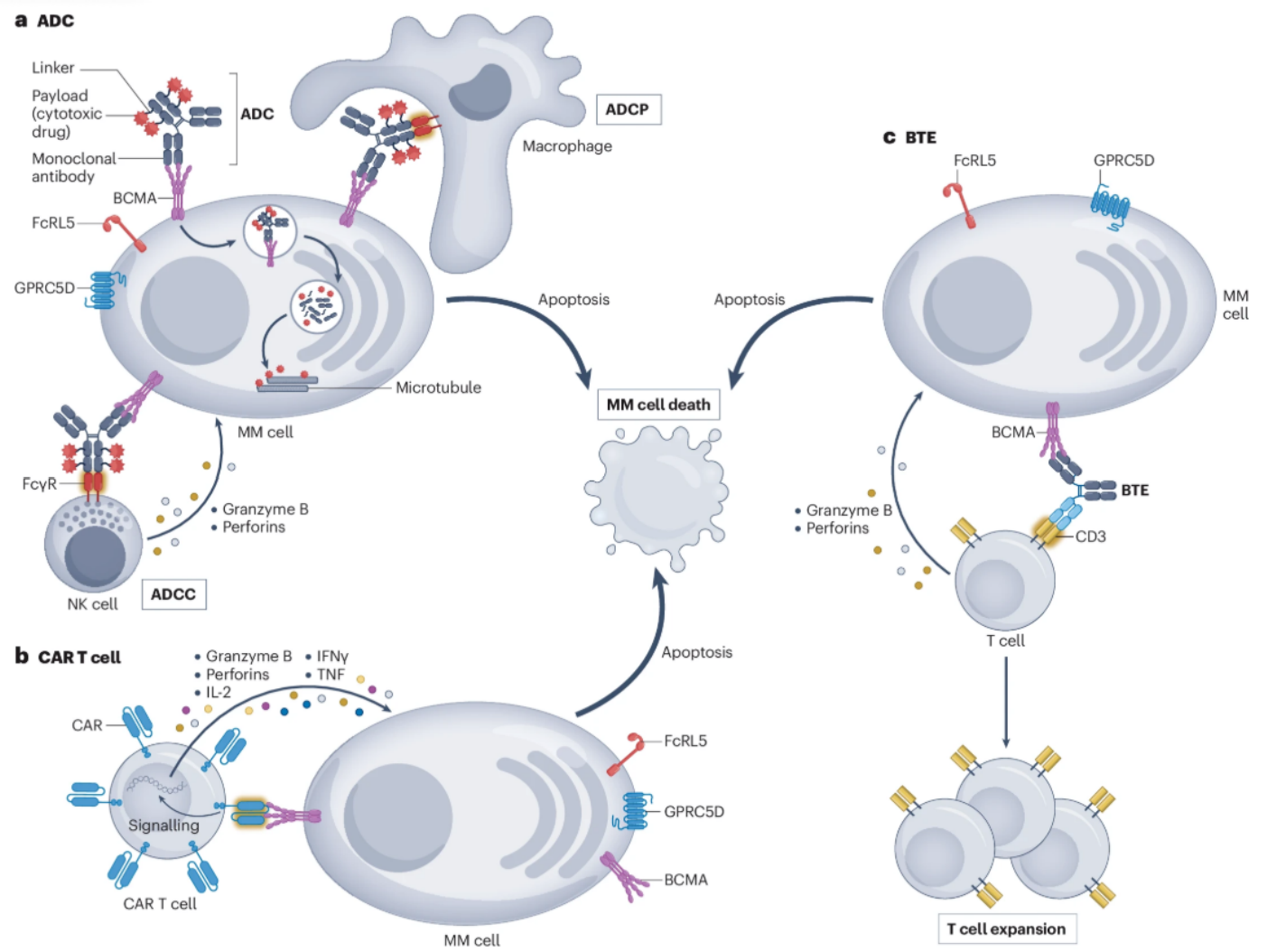 Source: Targeted Therapy for Multiple Myeloma: GPRC5D
Diverse Clinical Strategies: From Bispecific to Trispecific Antibodies
Around the GPRC5D target, academia and industry have developed a diversified immunotherapy pipeline, including bispecific antibodies, CAR-T cell therapies, and next-generation trispecific antibodies.
- Bispecific Antibodies (BsAb): Frontrunners and Game-Changers
Talquetamab is currently the only approved GPRC5D-targeted therapy, primarily for BCMA-refractory patients. Its pivotal MonumenTAL-1 study demonstrated significant antitumor activity. Building on this, next-generation bispecific antibodies are evolving toward "higher affinity and stronger efficacy." For example, Roche's Forimtamig employs an innovative "2+1" structure (bivalent binding to GPRC5D and monovalent binding to CD3), enhancing tumor antigen affinity to induce more stable immune synapse formation, maintaining potent cytotoxicity even on tumor cells with low target antigen expression. Domestic companies are also progressing rapidly, with Qilu Pharmaceutical's QLS32015, the first domestic GPRC5D/CD3 bispecific antibody to enter Phase III trials, achieving an objective response rate (ORR) of 90.0% and a deep response rate (≥VGPR) of 80.0% at the recommended dose in heavily pretreated patients, showcasing breakthrough potential comparable to CAR-T.
Talquetamab is currently the only approved GPRC5D-targeted therapy, primarily for BCMA-refractory patients. Its pivotal MonumenTAL-1 study demonstrated significant antitumor activity. Building on this, next-generation bispecific antibodies are evolving toward "higher affinity and stronger efficacy." For example, Roche's Forimtamig employs an innovative "2+1" structure (bivalent binding to GPRC5D and monovalent binding to CD3), enhancing tumor antigen affinity to induce more stable immune synapse formation, maintaining potent cytotoxicity even on tumor cells with low target antigen expression. Domestic companies are also progressing rapidly, with Qilu Pharmaceutical's QLS32015, the first domestic GPRC5D/CD3 bispecific antibody to enter Phase III trials, achieving an objective response rate (ORR) of 90.0% and a deep response rate (≥VGPR) of 80.0% at the recommended dose in heavily pretreated patients, showcasing breakthrough potential comparable to CAR-T.
- CAR-T Cell Therapy: The "Second Vehicle" in the Post-BCMA Era
Multiple GPRC5D-targeted CAR-T products have shown high response rates in Phase I trials. Notably, the RD118 study (a fully human anti-GPRC5D CAR-T) published in *Blood* reported a 100% overall response rate in aggressive patients with a median of 6 prior lines of therapy (mostly resistant to BCMA therapies), including 90% achieving stringent complete remission (sCR), with a median progression-free survival exceeding 18 months. The safety profile also improved compared to earlier studies, with no cerebellar toxicity observed, and target-related toxicities (e.g., skin, nail) mostly being Grade 1-2 and manageable.
Multiple GPRC5D-targeted CAR-T products have shown high response rates in Phase I trials. Notably, the RD118 study (a fully human anti-GPRC5D CAR-T) published in *Blood* reported a 100% overall response rate in aggressive patients with a median of 6 prior lines of therapy (mostly resistant to BCMA therapies), including 90% achieving stringent complete remission (sCR), with a median progression-free survival exceeding 18 months. The safety profile also improved compared to earlier studies, with no cerebellar toxicity observed, and target-related toxicities (e.g., skin, nail) mostly being Grade 1-2 and manageable.
- Trispecific Antibodies: Combating Antigen Escape with Combination Strategies
To address antigen loss resistance mechanisms after single-target therapy, dual-target strategies (BCMA × GPRC5D) have emerged. Johnson & Johnson's Ramantamig (JNJ-79635322) is the first BCMA/GPRC5D/CD3 trispecific antibody to enter Phase III trials globally. Phase I data showed a 100% ORR in the recommended Phase II dose group for patients naïve to BCMA/GPRC5D-targeted therapies, with 96.3% of patients maintaining progression-free survival beyond 12 months at a median follow-up of 15 months. This "dual insurance" design aims to cover two distinct tumor antigens, reducing resistance risk from single-target downregulation and potentially moving treatment earlier in the sequence.
To address antigen loss resistance mechanisms after single-target therapy, dual-target strategies (BCMA × GPRC5D) have emerged. Johnson & Johnson's Ramantamig (JNJ-79635322) is the first BCMA/GPRC5D/CD3 trispecific antibody to enter Phase III trials globally. Phase I data showed a 100% ORR in the recommended Phase II dose group for patients naïve to BCMA/GPRC5D-targeted therapies, with 96.3% of patients maintaining progression-free survival beyond 12 months at a median follow-up of 15 months. This "dual insurance" design aims to cover two distinct tumor antigens, reducing resistance risk from single-target downregulation and potentially moving treatment earlier in the sequence.
Challenges and Solutions: Balancing Efficacy, Safety, and Resistance
Despite its bright prospects, the widespread application of GPRC5D-targeted therapies faces three core challenges.
1. Unique Toxicity Profile (On-target off-tumor toxicity).
Due to GPRC5D's physiological expression in keratinized tissues (e.g., hair follicles, nails, oral epithelium), targeted therapies often cause specific adverse effects, such as skin reactions (rash, pruritus), nail changes, dysgeusia, and oral mucositis. While mostly low-grade and manageable, these remain key clinical concerns. Additionally, cerebellar toxicity (a dose-limiting toxicity) was observed in ~12% of first-generation GPRC5D CAR-T patients but not in newer designs like RD118, suggesting antibody structure design is closely tied to safety.
Due to GPRC5D's physiological expression in keratinized tissues (e.g., hair follicles, nails, oral epithelium), targeted therapies often cause specific adverse effects, such as skin reactions (rash, pruritus), nail changes, dysgeusia, and oral mucositis. While mostly low-grade and manageable, these remain key clinical concerns. Additionally, cerebellar toxicity (a dose-limiting toxicity) was observed in ~12% of first-generation GPRC5D CAR-T patients but not in newer designs like RD118, suggesting antibody structure design is closely tied to safety.
2. Antigen Escape Mechanisms.
Under therapeutic pressure, tumor cells can downregulate target antigens via biallelic GPRC5D gene loss or epigenetic silencing, leading to relapse. Unlike BCMA therapy, where relapse is often antigen-positive, GPRC5D-targeted relapse is more frequently antigen-negative. This has driven the development of dual-target (BCMA×GPRC5D) combination therapies, such as Forimtamig combined with BCMA bispecific antibodies or immunomodulatory drugs (IMiDs), which effectively prevent GPRC5D-negative relapse.
Under therapeutic pressure, tumor cells can downregulate target antigens via biallelic GPRC5D gene loss or epigenetic silencing, leading to relapse. Unlike BCMA therapy, where relapse is often antigen-positive, GPRC5D-targeted relapse is more frequently antigen-negative. This has driven the development of dual-target (BCMA×GPRC5D) combination therapies, such as Forimtamig combined with BCMA bispecific antibodies or immunomodulatory drugs (IMiDs), which effectively prevent GPRC5D-negative relapse.
3. Optimizing Treatment Sequencing and Combination Strategies.
Currently, Talquetamab is mainly used post-BCMA therapy, but expert consensus notes there is no biological rationale for delaying GPRC5D-targeted therapy until BCMA therapies fail entirely. Determining the optimal "driving order" for these two high-efficacy targeted therapies and exploring combination strategies (e.g., with daratumumab or lenalidomide) to enhance efficacy and delay resistance are central to future Phase III trials (e.g., Trilogy-4).
Currently, Talquetamab is mainly used post-BCMA therapy, but expert consensus notes there is no biological rationale for delaying GPRC5D-targeted therapy until BCMA therapies fail entirely. Determining the optimal "driving order" for these two high-efficacy targeted therapies and exploring combination strategies (e.g., with daratumumab or lenalidomide) to enhance efficacy and delay resistance are central to future Phase III trials (e.g., Trilogy-4).
Future Outlook
GPRC5D's success lies not only in providing myeloma patients with a new effective target but also in reshaping the landscape of MM immunotherapy. From pursuing deep responses to innovative designs like dual-target trispecific antibodies that balance efficacy and resistance prevention, GPRC5D-targeted therapies offer a clear "battle blueprint" for the post-BCMA era. As more Phase III data emerge and biomarker-guided personalized dosing regimens are established, GPRC5D is poised to become a core pillar of MM therapy, standing alongside BCMA.
Related Product Recommendations
GPRC5D Flag&His Tag Full Length Protein, Human(Detergent) Catalog No.: UA060039
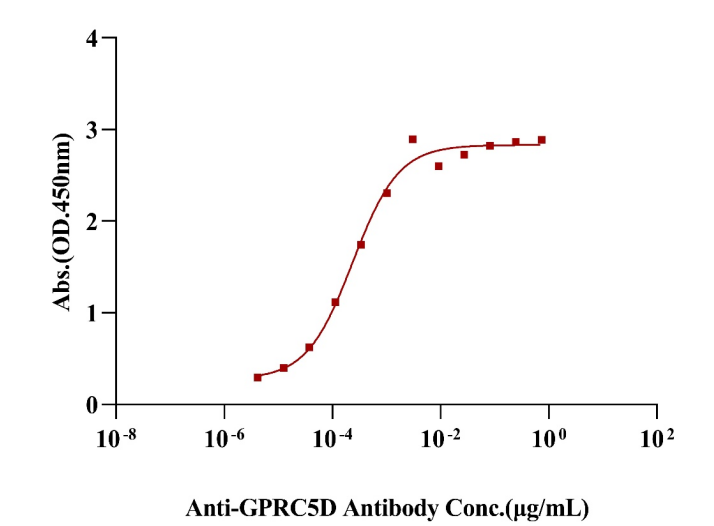 Immobilized Human GPRC5D Protein at 5 μg/mL (100 μL/well) on Nickel coated plate can bind Anti-Human GPRC5D Antibody (LM-305 antibody), Human IgG1, with a linear range of 0.15-0.35 ng/mL.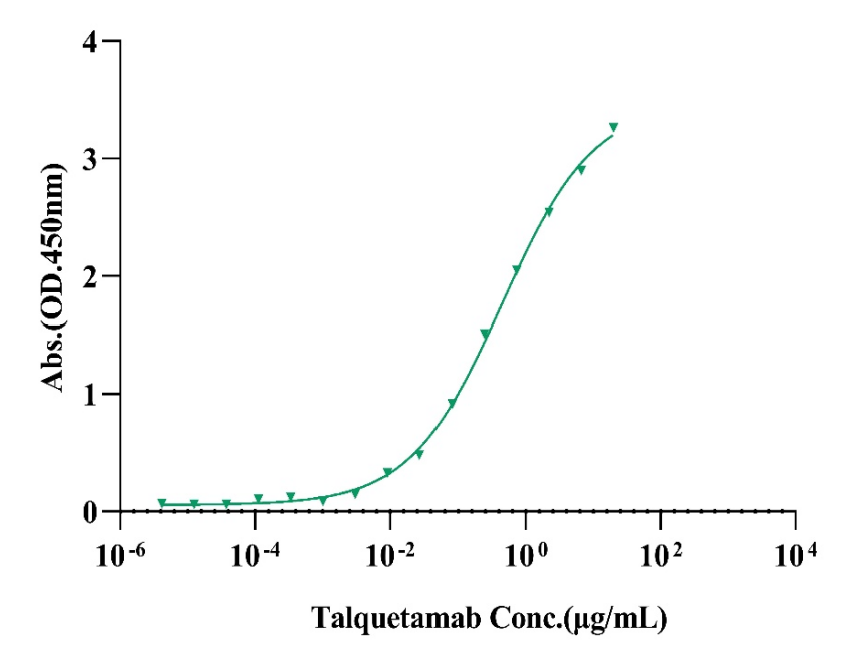
Immobilized Human GPRC5D Protein at 2 μg/mL (100 μL/well) on Nickel coated plate can bind Talquetamab, with a linear range of 0.36-0.58 μg/mL.
This article is reviewed and published by the technical expert team of UA
Disclaimer: This article partially utilizes artificial intelligence assistance in its creation. If any content involves copyright or intellectual property issues, please let us know and we promise to verify and remove it as soon as possible.
Purchase recombinant protein, choose 
UA protein focuses on providing various protein reagents, raw materials, and services required for drug research and development, cell therapy, gene therapy, and basic scientific research, including drug target proteins, immune checkpoint proteins, cytokines, tool enzymes, customized protein expression, and full-length transmembrane protein development. Nanjing Univ is committed to providing customers with high-quality products and professional services, and building a High-tech Biological Enterprise with International Competitiveness.
Target proteins | membrane proteins | cytokines | enzymes | viral antigens | protein customization
Nanjing UNIV Biotechnology Co., Ltd. Email:order@ua-bio.com Phone:+86-25-56221161

Product Information

Link:





©2021-2026 all rights reserved UNIV Biotechnology Co.,Ltd.
Privacy Policy
网站备案号 苏ICP备2025207586号-2 浙公网安备33010202004867号
 Business license (three certificates in one)
 Tel:+86-25-56221161
E-mail:order@ua-bio.com
All products sold on this website shall not be used for clinical diagnosis or treatment of humans or animals, and shall only be used for non-medical purposes such as industrial or scientific research.