FLT3 and its ligand FLT3L: Key Molecules in Hematopoietic Regulation and Leukemia Targeted Therapy
Author: Senior Product Manager of UA Views:293 


This article systematically elaborates on the molecular characteristics and biological functions of the FLT3 receptor and its ligand FLT3L, focusing on the regulatory role of FLT3 as a type III tyrosine kinase receptor in hematopoietic progenitor cell development. It also analyzes the pathological mechanisms by which FLT3 mutations drive abnormal proliferation in acute myeloid leukemia (AML).
- Recent Advances
- Product Information
Recent Advances
FLT3 and Its Ligand FLT3L: Key Molecules in Hematopoietic Regulation and Targeted Therapy for Leukemia
Overview
This article focuses on the molecular characteristics and biological functions of the FLT3 receptor and its ligand FLT3L, systematically elaborating on the regulatory role of FLT3 as a type III tyrosine kinase receptor in hematopoietic progenitor cell development, and analyzing the pathological mechanisms by which FLT3 mutations drive abnormal proliferation in acute myeloid leukemia (AML).
This article focuses on the molecular characteristics and biological functions of the FLT3 receptor and its ligand FLT3L, systematically elaborating on the regulatory role of FLT3 as a type III tyrosine kinase receptor in hematopoietic progenitor cell development, and analyzing the pathological mechanisms by which FLT3 mutations drive abnormal proliferation in acute myeloid leukemia (AML).
I. Molecular Structure and Family Classification of FLT3.
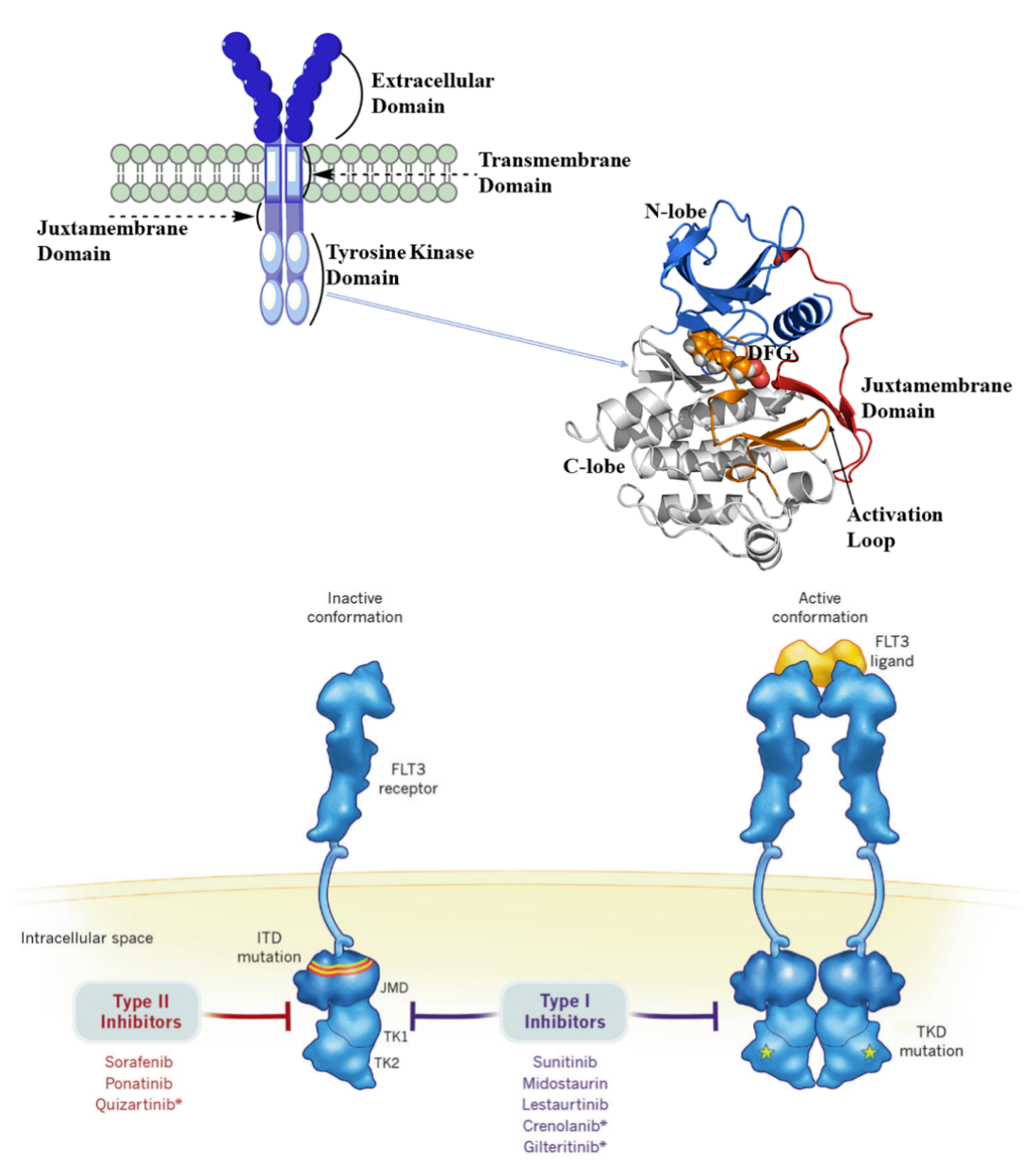
FLT3 (FMS-like tyrosine kinase 3, also known as CD135 or STK-1) is a member of the type III receptor tyrosine kinase family. This family also includes key molecules such as KIT, FMS, and PDGFR, all characterized by extracellular domains containing five immunoglobulin-like domains and intracellular domains with tyrosine kinase domains separated by insertion sequences. The human FLT3 gene is located on chromosome 13 at the q12 region, encoding a protein composed of 993 amino acid residues with a molecular weight of approximately 153 kDa, making it a type I transmembrane protein.
The extracellular ligand-binding domain of FLT3 contains five immunoglobulin-like domains responsible for recognizing and binding its specific ligand FLT3L. The juxtamembrane region (JM) plays a critical role in the negative regulation of receptor activity and is the primary site for internal tandem duplication mutations (FLT3-ITD). The intracellular tyrosine kinase domain is divided into N-terminal and C-terminal segments by a kinase insert sequence, responsible for phosphorylating downstream signaling molecules.
Under normal conditions, FLT3 expression is strictly spatiotemporally restricted, primarily limited to hematopoietic progenitor cells and stem cells in the bone marrow, thymus, and lymph nodes, with minimal expression in mature blood cells. This restricted expression pattern ensures precise regulatory functions of FLT3 signaling during hematopoietic development.
II. Molecular Characteristics and Expression Distribution of FLT3L.
FLT3 ligand (FLT3L) is the natural ligand of the FLT3 receptor, encoded by the FLT3LG gene. Human FLT3L exists in two forms: a transmembrane-bound form and a soluble form. The soluble FLT3L consists of 235 amino acid residues with a molecular weight of approximately 36 kDa, primarily functioning in paracrine regulation in vivo. FLT3L is widely expressed in bone marrow stromal cells, fibroblasts, and various epithelial cells, with its expression regulated by hematopoietic microenvironment homeostasis.
FLT3L binding to FLT3 is highly specific. FLT3L binds to the immunoglobulin-like domains of the FLT3 extracellular region as a dimer, inducing FLT3 dimerization and autophosphorylation, thereby activating downstream signaling pathways such as PI3K/AKT, RAS/MAPK, and JAK/STAT, collectively regulating the survival, proliferation, and differentiation of hematopoietic progenitor cells.
III. Physiological Functions of FLT3 in Normal Hematopoiesis.
The FLT3/FLT3L signaling axis plays an irreplaceable role in normal hematopoietic regulation. FLT3L synergizes with stem cell factor to promote the survival and proliferation of early hematopoietic progenitor cells. FLT3 signaling inhibits apoptosis of hematopoietic progenitor cells by activating the downstream PI3K/AKT pathway while driving cell cycle progression via the RAS/MAPK pathway. During the early stages of B-lymphocyte development, FLT3 signaling is crucial for the generation and differentiation of lymphoid progenitor cells. FLT3 gene knockout mice exhibit reduced numbers of hematopoietic progenitor cells in the bone marrow, impaired development of B lymphocytes and dendritic cells, but overall hematopoietic function remains intact, indicating that FLT3 signaling has non-redundant regulatory roles in certain hematopoietic lineages.
IV. FLT3 Mutations and the Pathogenesis of Acute Myeloid Leukemia.
Abnormal activation of FLT3 is one of the most common molecular events in the initiation and progression of acute myeloid leukemia. FLT3 internal tandem duplication (ITD) mutations are the most prevalent type of FLT3 mutation, accounting for approximately 20% to 25% of AML cases. These mutations involve partial duplication of the coding sequence in the juxtamembrane region, altering its length and amino acid composition, thereby disrupting the autoinhibitory function of the juxtamembrane region on kinase activity and leading to ligand-independent constitutive activation of FLT3. This constitutive activation drives abnormal proliferation and survival of leukemia cells through downstream STAT5, PI3K/AKT, and MAPK signaling pathways, closely associated with poor prognosis in AML patients. FLT3-TKD mutations, primarily occurring at the D835 and I836 residues in the activation loop, account for approximately 5% to 10% of AML cases and similarly result in sustained kinase activity. Overexpression of FLT3 can also lead to abnormal cell proliferation and tumorigenesis.
Given the high frequency and clinical relevance of FLT3 mutations in AML, FLT3 has become one of the core targets for AML targeted therapy. Several FLT3 small-molecule inhibitors have been approved for clinical treatment of AML.
V. Conclusion.
As a key member of the type III tyrosine kinase receptor family, FLT3 plays a crucial role in normal hematopoietic regulation, and its mutation-induced abnormal activation is one of the most common molecular drivers of acute myeloid leukemia. FLT3L, as its natural ligand, has an irreplaceable function in maintaining hematopoietic homeostasis. Recombinant human FLT3L protein, as an essential tool for basic research and drug development, will continue to provide critical support for in-depth exploration of the FLT3 signaling network and its mechanisms in leukemia pathogenesis.
In FLT3/FLT3L-related basic research and drug screening, high-quality recombinant human FLT3L protein is a core tool for receptor binding analysis, hematopoietic stem cell culture, and signaling pathway studies. To meet this research demand, Uni offers FLT-3L Protein, Human, suitable for applications such as expansion and differentiation studies of human hematopoietic progenitor cells, analysis of FLT3 and FLT3L binding activity, and exploration of FLT3 signaling mechanisms.
This article is reviewed and published by the technical expert team of UA
Disclaimer: This article partially utilizes artificial intelligence assistance in its creation. If any content involves copyright or intellectual property issues, please let us know and we promise to verify and remove it as soon as possible.
Purchase recombinant protein, choose 
UA protein focuses on providing various protein reagents, raw materials, and services required for drug research and development, cell therapy, gene therapy, and basic scientific research, including drug target proteins, immune checkpoint proteins, cytokines, tool enzymes, customized protein expression, and full-length transmembrane protein development. Nanjing Univ is committed to providing customers with high-quality products and professional services, and building a High-tech Biological Enterprise with International Competitiveness.
Target proteins | membrane proteins | cytokines | enzymes | viral antigens | protein customization
Nanjing UNIV Biotechnology Co., Ltd. Email:order@ua-bio.com Phone:+86-25-56221161

Product Information

Link:





©2021-2026 all rights reserved UNIV Biotechnology Co.,Ltd.
Privacy Policy
网站备案号 苏ICP备2025207586号-2 浙公网安备33010202004867号
 Business license (three certificates in one)
 Tel:+86-25-56221161
E-mail:order@ua-bio.com
All products sold on this website shall not be used for clinical diagnosis or treatment of humans or animals, and shall only be used for non-medical purposes such as industrial or scientific research.