VEGF165: The "Master Switch" of Angiogenesis and a Core Biomarker for Tumor Screening
Author: Senior Product Manager of UA Views:289 


This article systematically elaborates on the molecular characteristics and biological functions of VEGF165, a major isoform of vascular endothelial growth factor, highlighting its pivotal role as a key regulator of angiogenesis in the development and progression of solid tumors. It also analyzes its clinical application value in broad-spectrum tumor screening, efficacy evaluation, and prognosis monitoring.
- Recent Advances
- Product Information
Recent Advances
VEGF165: The "Master Switch" of Angiogenesis and Core Biomarker for Tumor Screening
Summary
This article focuses on the molecular characteristics and biological functions of VEGF165, the major isoform of vascular endothelial growth factor, systematically elaborating its central role as a key regulator of angiogenesis in the development and progression of solid tumors, and analyzing its clinical application value in broad-spectrum tumor screening, efficacy evaluation, and prognosis monitoring.
This article focuses on the molecular characteristics and biological functions of VEGF165, the major isoform of vascular endothelial growth factor, systematically elaborating its central role as a key regulator of angiogenesis in the development and progression of solid tumors, and analyzing its clinical application value in broad-spectrum tumor screening, efficacy evaluation, and prognosis monitoring.
1. Molecular Characteristics of the VEGF Family and the Position of VEGF165
The vascular endothelial growth factor (VEGF) family is a group of highly bioactive functional glycoproteins that act as specific mitogens for vascular endothelial cells, playing a central regulatory role in both physiological and pathological angiogenesis. The human VEGF gene is located on chromosome 6p21.3, and its mRNA undergoes alternative splicing to produce at least five protein isoforms, including VEGF121, VEGF145, VEGF165, VEGF185, and VEGF206. Among these, VEGF165 is the most abundant and extensively studied isoform, consisting of 165 amino acid residues with a molecular weight of approximately 45 kDa (in homodimer form). Its secretory and soluble characteristics make it the primary form responsible for angiogenesis in vivo.
The molecular structure of VEGF165 contains multiple functional domains: an N-terminal signal peptide guides protein secretion; a receptor-binding domain mediates interactions with VEGFR-1 and VEGFR-2; and a heparin-binding domain enables it to bind to cell surface and extracellular matrix heparan sulfate proteoglycans, which is crucial for its distribution and function in tissues.
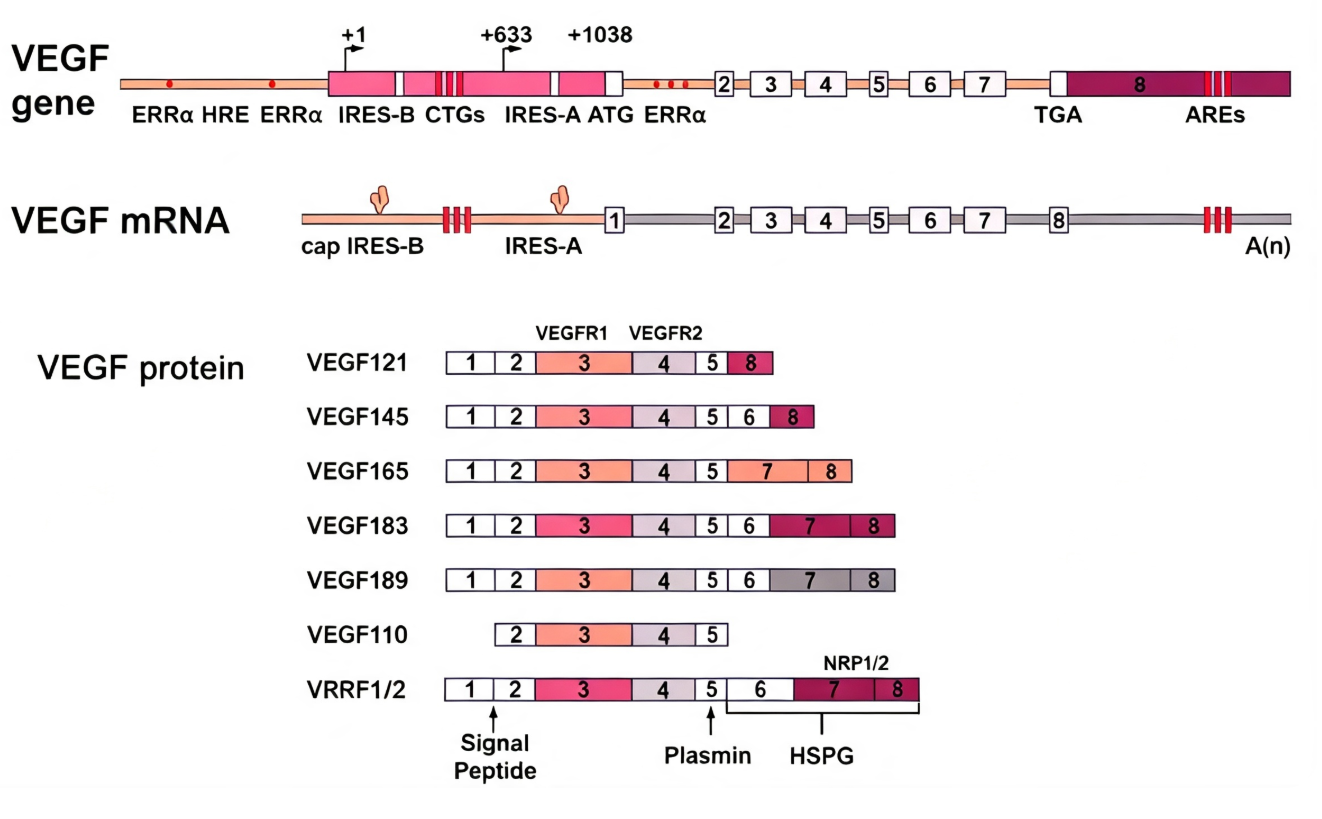
2. Molecular Mechanisms of VEGF165-Mediated Angiogenesis
VEGF165 exerts its biological functions by binding to two main receptors on the surface of vascular endothelial cells—VEGFR-1 and VEGFR-2. VEGFR-2 is the primary receptor mediating VEGF's pro-angiogenic effects. Upon binding, it induces receptor dimerization and autophosphorylation, activating downstream signaling pathways such as PLCγ/PKC, PI3K/AKT, and RAS/MAPK, which drive endothelial cell proliferation, survival, and migration. VEGFR-1 has a higher affinity for VEGF165 than VEGFR-2 but exhibits weaker tyrosine kinase activity and is thought to play a regulatory role in embryonic vascular development.
VEGF165-induced angiogenesis is a multi-step process. It promotes endothelial cell proliferation, enabling them to form new blood vessels; upregulates matrix metalloproteinase expression to degrade the basement membrane, creating pathways for endothelial cell migration; directs endothelial cell migration along VEGF concentration gradients; and ultimately facilitates the formation of tubular structures by endothelial cells, completing the construction of functional new blood vessels.
3. The Central Role of VEGF165 in Tumor Development
Folkman's theory posits that in the absence of angiogenesis, solid tumors can only rely on diffusion to obtain oxygen and nutrients, limiting their growth to a volume of 1 to 2 mm³. When tumor size exceeds this threshold, it must depend on angiogenesis to sustain rapid growth. VEGF165 is widely overexpressed in solid tumors and is the most closely associated known angiogenic stimulator, inducing the formation of new blood vessels within tumors to supply oxygen and nutrients. This aberrant angiogenesis also leads to disordered vascular structures and increased permeability, facilitating hematogenous metastasis of tumor cells.
4. Clinical Applications of VEGF165
The value of VEGF165 as a broad-spectrum tumor biomarker has been confirmed by extensive research. Unlike most traditional tumor markers that target specific cancer types, VEGF is abnormally elevated in nearly all solid tumors, providing broad coverage.
In clinical applications, VEGF detection can achieve a lower limit of detection at the pg level, placing its analytical sensitivity among the highest of current tumor markers. It is unaffected by changes in tumor biological characteristics and remains sensitive to recurrence and metastases. Studies show its sensitivity can reach 79.4%, with specificity up to 97.3%, making it suitable for early tumor screening, efficacy evaluation, and recurrence monitoring.
Given VEGF's central role in tumor angiogenesis, therapeutic strategies targeting VEGF165 have also achieved breakthroughs. In 2004, the U.S. FDA approved the first humanized monoclonal antibody targeting VEGF for clinical cancer treatment, further validating VEGF165 as a therapeutic target.
5. Conclusion
As the most critical regulator of angiogenesis, VEGF165 plays an irreplaceable central role in the initiation, progression, and metastasis of solid tumors. Its clinical value as a broad-spectrum tumor biomarker has been validated in numerous studies, providing a powerful tool for early tumor screening and dynamic monitoring. Human VEGF165 recombinant protein, as an essential tool for basic research and drug development, will continue to support exploration of angiogenesis mechanisms and the development of anti-tumor strategies.
In VEGF-related basic research and drug screening, high-quality human VEGF165 recombinant protein is a core tool for receptor binding analysis, endothelial cell function studies, and signaling pathway dissection. To meet this research need, UniLove offers VEGF165 Protein, Human, suitable for applications such as VEGFR-1/VEGFR-2 binding analysis, vascular endothelial cell proliferation and migration studies, and in vitro activity evaluation of anti-VEGF antibody drugs.
This article is reviewed and published by the technical expert team of UA
Disclaimer: This article partially utilizes artificial intelligence assistance in its creation. If any content involves copyright or intellectual property issues, please let us know and we promise to verify and remove it as soon as possible.
Purchase recombinant protein, choose 
UA protein focuses on providing various protein reagents, raw materials, and services required for drug research and development, cell therapy, gene therapy, and basic scientific research, including drug target proteins, immune checkpoint proteins, cytokines, tool enzymes, customized protein expression, and full-length transmembrane protein development. Nanjing Univ is committed to providing customers with high-quality products and professional services, and building a High-tech Biological Enterprise with International Competitiveness.
Target proteins | membrane proteins | cytokines | enzymes | viral antigens | protein customization
Nanjing UNIV Biotechnology Co., Ltd. Email:order@ua-bio.com Phone:+86-25-56221161

Product Information

Link:





©2021-2026 all rights reserved UNIV Biotechnology Co.,Ltd.
Privacy Policy
网站备案号 苏ICP备2025207586号-2 浙公网安备33010202004867号
 Business license (three certificates in one)
 Tel:+86-25-56221161
E-mail:order@ua-bio.com
All products sold on this website shall not be used for clinical diagnosis or treatment of humans or animals, and shall only be used for non-medical purposes such as industrial or scientific research.