




PARP protein family and tumor treatment: revealing the secret of synthesis and death


The PARP protein family plays a key role in maintaining gene stability and DNA damage repair, and PARP inhibitors provide new strategies for tumor treatment through the synthesis of lethality principle. With in-depth research on the function of the PARP family and the development of new PARP inhibitors, it is expected to bring more treatment options and hope to cancer patients in the future.
- Recent Advances
- Product Information
PARP protein family and tumor treatment: revealing the secret of synthesis and death
The PARP protein family plays an important role in the microscopic world of cells, especially in maintaining gene stability and repairing DNA damage. In recent years, PARP inhibitors have attracted much attention for their unique mechanism in tumor treatment - "synthetic lethality". Today, we will gain an in-depth understanding of the functions of the PARP protein family and the application of PARP inhibitors in tumor therapy.
PARP family: a complex protein family
Family members and categories
The PARP (polyadenosine diphosphate ribose polymerase) family is a class of enzymes involved in DNA damage repair. Currently, 17 members have been found in mammals, named PARP1 to PARP17. These members are divided into the following categories according to their structure and functions:
1. DNA-dependent PARPs: including PARP1, PARP2 and PARP3, which are directly involved in the identification and repair of DNA damage.
2. Terminal anchor polymerase (Tankyrase): includes PARP5a (Tankyrase 1) and PARP5b (Tankyrase 2), which are mainly involved in intracellular signaling.
3. CCCH type PARPs: including PARP7, PARP12 and PARP13, and their functions are related to immunomodulation.
4. MacroPARPs: including PARP9, PARP14 and PARP15, which are mainly involved in signal transduction and gene expression regulation in cells.
PARP1: "Star Member" in the Family
In the PARP family, PARP1 is the most studied and most critical member. It plays a central role in the repair of DNA single-strand break (SSB), accounting for more than 90% of the total activity of the PARP family. The PARP1 protein consists of 1014 amino acids and its structure is divided into three main parts: the DNA binding domain, the self-modification domain and the catalytic domain. When DNA is damaged, PARP1 binds to the damaged site through its DNA binding domain, activates catalytic activity, and then PAR-modify the substrate, promoting the recruitment of DNA repair factors and chromatin reconstruction.
PARP1 and DNA damage repair
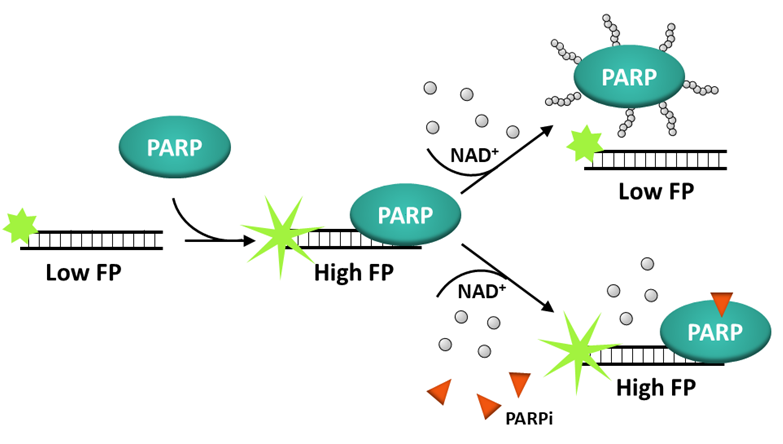
When a single-strand break occurs in DNA, PARP1 can quickly sense damage and is located at the site of damage through its zinc finger domain. After activation, PARP1 catalyzes the decomposition of NAD⁺ into nicotinamide and ADP ribose, and uses ADP ribose as the substrate to form a polyADP-ribose polymer. This process not only prevents the DNA around the damaged site from recombining with the damaged DNA, but also attracts DNA repair proteins, histone H1 and other transcription factors to bind to the damaged site, thereby promoting DNA repair.
However, when the function of PARP1 is inhibited, single-strand break cannot be repaired in time, and then it develops into double-strand break (DSB). This unrepaired DNA damage can lead to cell cycle arrest and apoptosis.
PARP inhibitors: the principle of synthetic lethality
PARP inhibitors are popular research subjects in the field of tumor treatment in recent years. Its mechanism of action is mainly based on the principle of "synthetic lethality". Synthetic lethality means that two non-lethal mutations do not affect cell viability when they exist alone, but when the two mutations exist at the same time, they will cause cell death.
Synthetic lethality and BRCA mutation
In normal cells, DNA double-strand breaks can be repaired through the homologous recombination repair (HR) pathway. However, in tumor cells carrying BRCA1/2 mutations, the HR pathway is damaged and cannot effectively repair double-strand breaks. At this time, the function of PARP1 is particularly important for maintaining gene stability. When PARP1 is inhibited, single-strand break cannot be repaired, and then develops into double-strand breaks, eventually leading to cell death.
Mechanism of action of PARP inhibitors
PARP inhibitors work through two mechanisms:
1. Inhibit the catalytic activity of PARP1: prevents the catalytic of NAD⁺ by PARP1, making single-strand breaks irreparable, and then develops into double-strand breaks.
2. Capture PARP1 on damaged DNA: inhibit the PARP1's own PARization modification, enhance its binding strength with damaged DNA, and further block DNA repair.
Studies have shown that the ability of PARP inhibitors to capture PARP1 is positively correlated with their inhibitory activity of tumor cells. However, the latest research has found that the synthetic lethal effect of PARP inhibitors mainly depends on their inhibition of PARP1 catalytic activity rather than their capture ability.
Progress in the research and development of domestic PARP inhibitors
In recent years, significant progress has been made in the research and development of PARP inhibitors in China. At present, a variety of PARP inhibitors have been approved for the treatment of tumors such as breast cancer, prostate cancer and pancreatic cancer. Domestic R&D pipelines are also constantly advancing, and many new PARP inhibitors are in clinical trial stages, aiming to improve drug selectivity and reduce toxicity.
Conclusion
The PARP protein family plays a key role in maintaining gene stability and DNA damage repair, and PARP inhibitors provide new strategies for tumor treatment through the synthesis of lethality principle. With in-depth research on the function of the PARP family and the development of new PARP inhibitors, it is expected to bring more treatment options and hope to cancer patients in the future.
This article is reviewed and published by the technical expert team of UA
Disclaimer: This article partially utilizes artificial intelligence assistance in its creation. If any content involves copyright or intellectual property issues, please let us know and we promise to verify and remove it as soon as possible.
Purchase recombinant protein, choose Nanjing UA-Bio
UA protein focuses on providing various protein reagents, raw materials, and services required for drug research and development, cell therapy, gene therapy, and basic scientific research, including drug target proteins, immune checkpoint proteins, cytokines, tool enzymes, customized protein expression, and full-length transmembrane protein development. Youai is committed to providing customers with high-quality products and professional services, and building a High-tech Biological Enterprise with International Competitiveness.







 Business license (three certificates in one)