




TEAD1: The "cell guardian" that protects the kidneys, solving the mystery of kidney damage caused by cisplatin chemotherapy


The discovery of TEAD1 has built a bridge between basic research and clinical transformation. When this "cell defender" is empowered by science, cancer patients may be able to fight the disease without having to bear the cost of kidney failure.
- Recent Advances
- Product Information
TEAD1: The "cell guardian" that protects the kidneys, solving the mystery of kidney damage caused by cisplatin chemotherapy
The chemotherapy drug cisplatin is a "trump card" in the fight against cancer, helping millions of cancer patients around the world to prolong their lives every year. However, this "fighting poison with poison" treatment method has a fatal weakness - about one-third of patients will suffer from acute kidney injury (AKI) due to nephrotoxicity, leading to a sharp decline in renal function. Recently, a team from the University of Connecticut School of Medicine published a breakthrough study in the International Journal of Biological Sciences, revealing the key role of transcription factor TEAD1 in kidney protection, providing a new idea for solving this clinical problem.
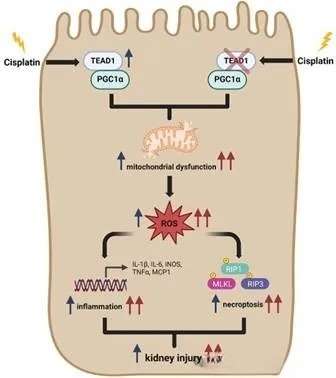
1. The "double-edged sword effect" of cisplatin chemotherapy
Cisplatin binds to tumor cell DNA to induce apoptosis, but it is also lethal to normal cells. As the main organ for drug metabolism and excretion, the kidney is the first to be attacked. Renal tubular epithelial cells are particularly sensitive to cisplatin, and the drug accumulates in these cells, triggering a series of chain reactions:
Energy factory paralysis: mitochondrial membrane potential collapses, leading to a sharp decrease in ATP synthesis;
Oxidative storm rages: reactive oxygen species (ROS) levels soar, damaging cell membranes and DNA;
Inflammation breaks out of control: proinflammatory factors such as TNF-α and IL-6 are excessively released, forming a vicious cycle;
Programmed death is out of control: apoptosis and necroptosis are activated simultaneously, accelerating tissue damage.
These mechanisms together lead to renal tubular necrosis and renal failure, and severe cases even require dialysis treatment. How to retain the anti-cancer effect of cisplatin while avoiding "harming innocent people" has become a major challenge in the field of tumor treatment.
2. TEAD1: The "secret guardian" of the kidney
The transcription factor TEAD1 (TEA Domain Transcription Factor 1) was once believed to be mainly involved in embryonic development and tissue regeneration. However, this study found that it also plays the role of "cell guard" in adult kidneys:
"Switch" of stress response: under the stimulation of cisplatin, the expression of TEAD1 in renal tubular epithelial cells surged more than 3 times, trying to start the self-protection program;
"Commander" of mitochondrial homeostasis: by binding to PGC1α, a key regulator of mitochondrial biogenesis, TEAD1 can enhance the expression of mitochondrial fusion proteins (such as MFN2), inhibit the activity of fission protein DRP1, and maintain the integrity of mitochondrial network structure;
"Fire extinguisher" of inflammatory storm: TEAD1 can inhibit the NF-κB signaling pathway, reduce the release of proinflammatory cytokines, and relieve renal inflammatory response.
The research team constructed a proximal tubule-specific knockout mouse model (TEAD1PKO) and confirmed for the first time that when TEAD1 was "lost", cisplatin-induced AKI was significantly aggravated, as shown by a 2.3-fold increase in serum creatinine levels, a 40% increase in tubular injury scores, and a doubling of the number of necrotic apoptotic cells.
3. Mechanism decoding: multi-layer protection from molecules to organs
Energy defense line reinforcement
In TEAD1-deficient cells, the activity of mitochondrial respiratory chain complexes decreased by 60% and ATP synthesis decreased by 45%. However, overexpression of PGC1α can partially restore energy metabolism, confirming that TEAD1 maintains mitochondrial function through the "PGC1α axis".
Oxidative stress interception
After cisplatin treatment, the ROS level of TEAD1 knockout cells was 2.8 times that of the control group, resulting in a 3-fold increase in the mitochondrial DNA damage rate. Supplementation with the antioxidant NAC can significantly alleviate this effect, suggesting that TEAD1 scavenges free radicals by regulating the antioxidant enzyme system.
Cell death brake
The phosphorylation level of MLKL, a core protein of necroptosis, increased 5 times in TEAD1PKO mice, while the apoptosis marker Caspase-3 did not change significantly, clarifying that TEAD1 specifically inhibits the necroptosis pathway.
Blocking of the inflammatory network
The amount of macrophage infiltration increased 3 times in TEAD1-deficient kidneys, and the expression of proinflammatory factors IL-6 and TNF-α was upregulated 4-5 times, forming a death spiral of "oxidative stress-mitochondrial damage-inflammation".
4. Conclusion
The discovery of TEAD1 has built a bridge between basic research and clinical transformation. When this "cell defender" is empowered by science, cancer patients may be able to fight the disease without having to bear the cost of kidney failure.
This article is reviewed and published by the technical expert team of UA
Disclaimer: This article partially utilizes artificial intelligence assistance in its creation. If any content involves copyright or intellectual property issues, please let us know and we promise to verify and remove it as soon as possible.
Purchase recombinant protein, choose Nanjing UA-Bio
UA protein focuses on providing various protein reagents, raw materials, and services required for drug research and development, cell therapy, gene therapy, and basic scientific research, including drug target proteins, immune checkpoint proteins, cytokines, tool enzymes, customized protein expression, and full-length transmembrane protein development. Youai is committed to providing customers with high-quality products and professional services, and building a High-tech Biological Enterprise with International Competitiveness.







 Business license (three certificates in one)