




TEAD2: The "secret operator" of tumor metabolism, unlocking the carcinogenic code of acetyl-CoA


Recently, Michael N. Hall's team at the Biocenter of the University of Basel revealed a subversive discovery in the journal Molecular Cell - the transcription factor TEAD2 is actually the "behind-the-scenes director" of tumor metabolic reprogramming, driving the malignant progression of cancers such as hepatocellular carcinoma (HCC) by inhibiting the synthesis of acetyl-CoA.
- Recent Advances
- Product Information
TEAD2: The "secret operator" of tumor metabolism, unlocking the carcinogenic code of acetyl-CoA
In the human war against cancer, the "survival wisdom" shown by tumor cells is often amazing: they can rewrite their own metabolic rules like chameleons, and even manipulate the "energy currency" in the cell for their own use. Recently, Michael N. Hall's team at the Biocenter of the University of Basel revealed a subversive discovery in the journal Molecular Cell - the transcription factor TEAD2 is actually the "behind-the-scenes director" of tumor metabolic reprogramming, driving the malignant progression of cancers such as hepatocellular carcinoma (HCC) by inhibiting the synthesis of acetyl-CoA. This discovery not only provides a new perspective for understanding cancer metabolism, but also may give rise to a new anti-cancer strategy.
1. Acetyl-CoA: the "universal fuel" of cell metabolism
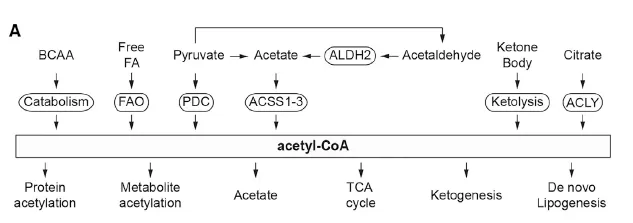
Acetyl-CoA is the "metabolic hub" in cells, and its function is comparable to that of a Swiss Army knife:
"Raw materials" of energy factories: in mitochondria, it produces ATP for cells through the tricarboxylic acid cycle (TCA) to support high-intensity proliferation;
"Cornerstone" of biosynthesis: provides carbon skeletons for macromolecules such as fatty acids and cholesterol, builds cell membranes and signaling molecules;
"Palette" of epigenetics: as an acetyl donor, modifies histones and non-histones, and regulates gene expression and cell fate.
In normal cells, the synthesis of acetyl-CoA is strictly regulated, but in tumor cells, this "fuel depot" may become a "double-edged sword" of carcinogenesis - some cancer cells accelerate proliferation by increasing its level, while others do the opposite and activate dedifferentiation programs by inhibiting synthesis.
2. TEAD2: The "Commander" of Metabolic Reprogramming
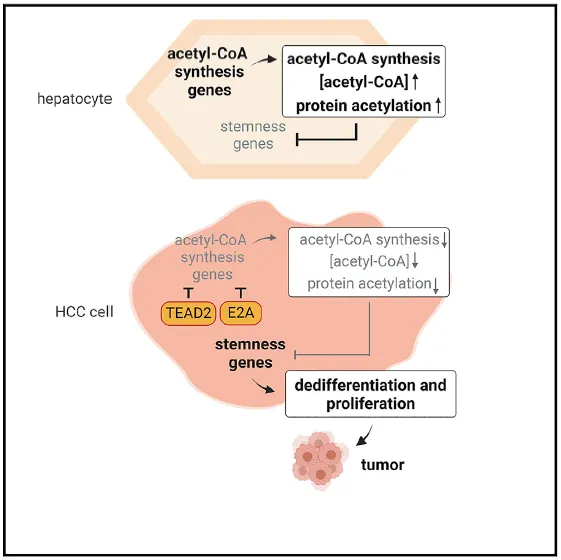
The research team found that in hepatocellular carcinoma, the transcription factor TEAD2 and E2A (TCF3) form a "carcinogenic partner" to reshape the metabolic pattern through the following mechanisms:
Global transcriptional inhibition
TEAD2 and E2A directly bind to the promoter region of acetyl-CoA synthesis genes (such as ACSS2 and ACLY) to form a "gene silencing complex", which reduces the expression of 6 key synthesis pathways by an average of 40%-60%. This global inhibition causes a 30% drop in intracellular acetyl-CoA levels, which in turn causes a 70% reduction in acetylation modification of non-histone proteins (such as metabolic enzymes and signaling proteins).
Metabolism-epigenetic cascade reaction
The activity of metabolic enzymes (such as PKM2 and PDH) with acetylation loss is reduced, glycolysis flux is abnormally increased, ATP production is increased by 25%, and reactive oxygen species (ROS) levels are reduced by 40%. This "hypoxic stress simulation" state promotes hepatocyte dedifferentiation, acquires stem cell-like characteristics, and forms "hepatocyte spheroids" with strong tumorigenicity.
"Incubator" of tumor stemness
The acetylation of pluripotency factors OCT4 and SOX2 is reduced, resulting in enhanced DNA binding ability and activation of stem cell-related genes (such as NANOG and KLF4). In a subcutaneous xenograft model, TEAD2/E2A double-knockout cancer cells cannot form tumors, while knocking out either factor alone can only partially inhibit proliferation, revealing that the two have a synergistic effect.
3. Clinical association: "Metabolic fingerprint" from liver cancer to pan-cancer
By analyzing the genomic data of more than 1,200 liver cancer patients in the TCGA database, the research team found:
Survival rate association: The median overall survival (OS) of patients with high expression of TEAD2/E2A was shortened by 18 months, and the progression-free survival (PFS) was reduced by 12 months;
Prognostic value of metabolic genes: The OS of patients with high expression of acetyl-CoA synthesis genes (such as ACSS2) was extended by 24 months, suggesting that it can be used as an independent prognostic marker;
Pan-cancer universality: In clear cell renal cell carcinoma, pancreatic cancer, lung cancer and prostate cancer, the negative correlation pattern between TEAD2/E2A and synthesis genes also exists and is significantly correlated with patient prognosis.
4. New anti-cancer targets: breaking the metabolic "carcinogenic cycle"
This study has opened up three potential paths for cancer treatment:
Metabolic intervention: Develop TEAD2/E2A small molecule inhibitors to relieve the inhibition of acetyl-CoA synthesis genes and restore normal metabolism of tumor cells;
Epigenetic regulation: Use histone deacetylase (HDAC) inhibitors to reverse the hypoacetylation state of non-histones and inhibit tumor stemness;
Combined therapy: Combine metabolic targeted drugs (such as ACSS2 agonists) with immune checkpoint inhibitors to enhance efficacy by reshaping the tumor microenvironment.
5. Future prospects: A "panoramic view" of metabolic reprogramming
The discovery of TEAD2 reveals another side of tumor metabolism - not all cancer cells rely on "hypermetabolism", and some cancers may achieve malignant transformation through "metabolic control". Future research needs to answer the following questions:
Cancer specificity: Which cancer cells rely on TEAD2-mediated metabolic inhibition? Which rely on enhanced synthesis?
Spatiotemporal dynamics: How does TEAD2 activity change at different stages of the tumor? Is it related to metastatic ability?
Drug delivery: How to accurately deliver metabolic regulators to tumor tissues to avoid affecting normal cell metabolism?
From the manipulation of "energy currency" to the unveiling of transcription factors, the discovery of TEAD2 allows us to re-examine the complexity of cancer metabolism. Perhaps, the future war against cancer will no longer be limited to directly killing tumor cells, but by regulating the metabolic "soft switch" to allow cancer cells to self-disintegrate in the "energy crisis". As Professor Michael N. Hall said: "We are drawing a 'circuit diagram' of tumor metabolism, and TEAD2 is undoubtedly one of the most critical 'resistors'."
This article is reviewed and published by the technical expert team of UA
Disclaimer: This article partially utilizes artificial intelligence assistance in its creation. If any content involves copyright or intellectual property issues, please let us know and we promise to verify and remove it as soon as possible.
Purchase recombinant protein, choose Nanjing UA-Bio
UA protein focuses on providing various protein reagents, raw materials, and services required for drug research and development, cell therapy, gene therapy, and basic scientific research, including drug target proteins, immune checkpoint proteins, cytokines, tool enzymes, customized protein expression, and full-length transmembrane protein development. Youai is committed to providing customers with high-quality products and professional services, and building a High-tech Biological Enterprise with International Competitiveness.







 Business license (three certificates in one)